Corporate Governance Storm Hits M-KOPA As Co-Founder Accuses Board of Share Price Manipulation
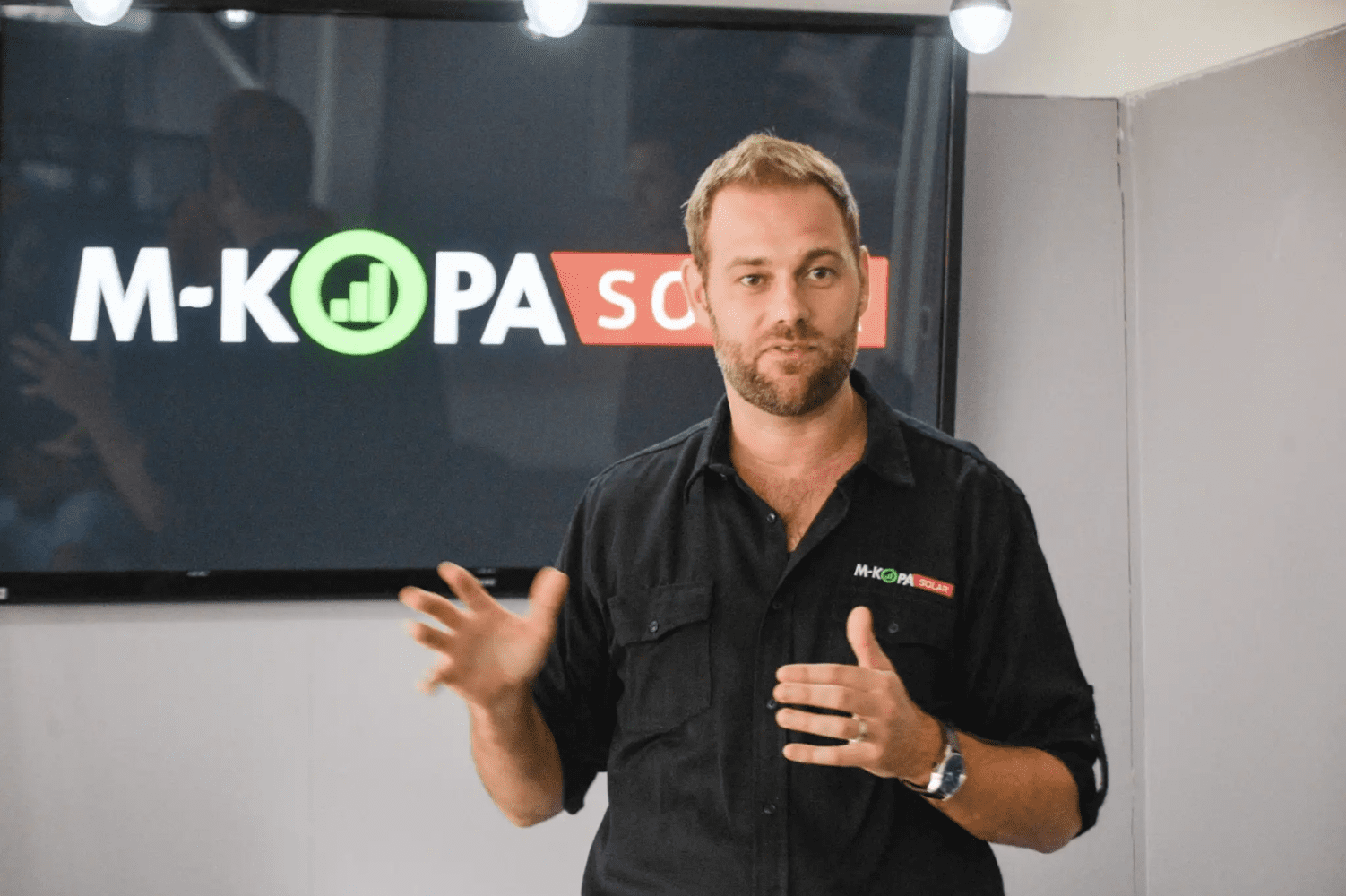
The reputation of M-KOPA, the celebrated fintech pioneer of Africa’s pay-as-you-go sector, is facing an unprecedented governance crisis.
This comes as co-founder Chad Larson filed a formal complaint with the Capital Markets Authority (CMA), accusing the company’s board, key investor Sumitomo Corporation, and advisory firm Eden Global Partners of orchestrating a share buyback that “unfairly and deliberately exploits Kenyan employees.”
In a letter dated November 6, 2025, addressed to CMA Chief Executive Officer Wyckliffe Shamiah, Larson described the process as “a systematic and calculated pattern of unfair practices and breaches of fiduciary duty.”
He alleges that the valuation used in the buyback was “artificially suppressed,” offering employees a price representing “a nearly 95% discount to the actual market value.”
According to Larson, the scheme benefits Sumitomo Corporation, which sits on M-KOPA’s board, and Eden Global Partners, which earns substantial fees deducted directly from the proceeds of local shareholders.







Larson’s complaint highlights a web of governance failures that, if proven, could mark one of the biggest shareholder protection tests in Kenya’s fintech sector.
Governance Breaches and Stakeholder Suppression
The formal complaint identifies a clear conflict of interest within the M-KOPA Board of Directors, specifically noting that Sumitomo Corporation’s representative, Mr. Eisuke Takenaka, was involved in approving or influencing a transaction that provides a direct financial benefit to his corporation.
“This contravenes Kenya’s Code of Corporate Governance, which requires directors to avoid situations where personal interests conflict with those of shareholders,” he wrote.
Further, Larson accuses M-KOPA of gagging dissent. “The sale agreement explicitly forbids employees from discussing the buyback among themselves,” he said, arguing that this restriction isolates staff, prevents them from obtaining proper independent legal counsel, and severely limits their capacity to collectively assess the fairness of the transaction.
Employees defined as “minor shareholders”, those holding fewer than 500 shares, were also reportedly barred from meetings and denied access to notices and minutes, while large investors such as Sumitomo retained full rights. “These measures disenfranchise Kenyan employee shareholders,” Larson warned, “and contradict the very principles of transparency and fair treatment the company was built on.”
Strong Profits, Weak Protections
It comes at a time when M-KOPA’s financial performance appears stronger than ever. The company recently achieved its first-ever annual profit in 2024, KSH 1.2 B (USD 9.2 M), following a 66% revenue surge to KSH 53.7 B (USD 416 M), making it a key success story for impact investing in Africa.
It has expanded to five African markets, disbursed over USD 1.5 B in credit, and now serves more than five million customers. In Kenya alone, M-KOPA has surpassed three million active users and claims to have created 16,000 local jobs through its smartphone assembly and distribution network.
Yet, this commercial milestone is overshadowed by internal strife.
Against this backdrop of growth, Larson’s claims raise sharp questions about whether the company’s governance practices are keeping pace with its financial success.
If employee shareholders are being offered buyback terms at a fraction of market value while the firm’s revenues soar, it suggests a widening divide between M-KOPA’s public narrative of empowerment and the reality within its boardroom.
According to his letter, Larson fears that such actions could “undermine investor confidence in Kenya and tarnish the reputation of M-KOPA as a Kenyan-founded innovation leader.” He has called on the CMA to suspend the buyback immediately, investigate potential conflicts of interest, and order an “independent and transparent revaluation” by a CMA-approved third-party valuer.
Larson, who holds an MBA from Oxford University and is a Chartered Financial Analyst, has offered to provide the CMA with detailed valuation documents, correspondence, and evidence supporting his allegations.
A Historical Pattern of Controversy Despite Market Success
Larson’s petition serves as the latest, high-profile incident in a disturbing series of actions that challenge M-KOPA’s public image as a force for positive change.
An earlier court petition filed in June 2025 by former employee Elizabeth Njoki alleged a systematic pattern of racial discrimination embedded within the employee shareholding structure.
This lawsuit, filed at the Employment and Labour Relations Court, claimed that a 2019 board decision created new “Growth Shares” that primarily favored white and expatriate staff, while African employees were reclassified into the “Minor Holder” category, effectively stripping them of key rights like voting and access to crucial company information.
Court documents cited in that case showed that board discussions focused on protecting “preferred shareholders” (international investors like Generation Investment Management), resulting in the collective equity stake held by “Ordinary Shareholders,” most of whom were local Kenyan staff, shrinking drastically from 27% to a mere 7% without their consent.
Compounding these are issues regarding the company’s financial responsibility to its primary operating country. In September 2024, the Tax Appeals Tribunal issued a landmark ruling against the company, ordering M-KOPA to pay USD 6.8 million (KSH 885 million) in back taxes covering the period from 2017 to 2019.
The UK-incorporated company had attempted to claim exemption from Kenyan corporate taxes, arguing it was managed and controlled from the UK. However, the Tribunal rejected this, establishing M-KOPA’s local tax residency and raising severe questions about efforts by a company that relies on 3 million active customers across five markets to avoid its fiscal responsibilities in the jurisdiction where it generates the majority of its revenue.
The controversies go back further. As far back as 2021, a whistle-blower site exposed alleged executive self-dealing dating back to 2015, where former CEO Jesse Moore and another executive reportedly sold shares to the company for a substantial sum at the same time the company was promoting stock sales to African employees at a significantly lower, and allegedly exploitative, price.
Furthermore, while M-KOPA has successfully provided 2.5 million first-time mobile internet users with smartphones since 2020—a key metric of its impact —its financing model continues to draw criticism. Academic reviews of M-KOPA’s financing model at the time revealed effective annual interest rates of up to 254%, more than four times higher than the legal cap in some jurisdictions, fueling criticism that the firm’s pay-as-you-go business operates more like a high-cost lender than a social enterprise.
Despite these controversies, M-KOPA continues to project itself as a transformative force in African households. Its 2025 Impact Report claims that nine out of ten active customers say the company has improved their quality of life through access to solar power, smartphones, and credit.
However, Larson’s letter now forces regulators and investors to confront a stark contradiction: a firm that has improved millions of lives may be failing to protect the very employees who built it.