Amazon vs Starlink: Bezos Takes On Musk For Kenya’s Internet Sky
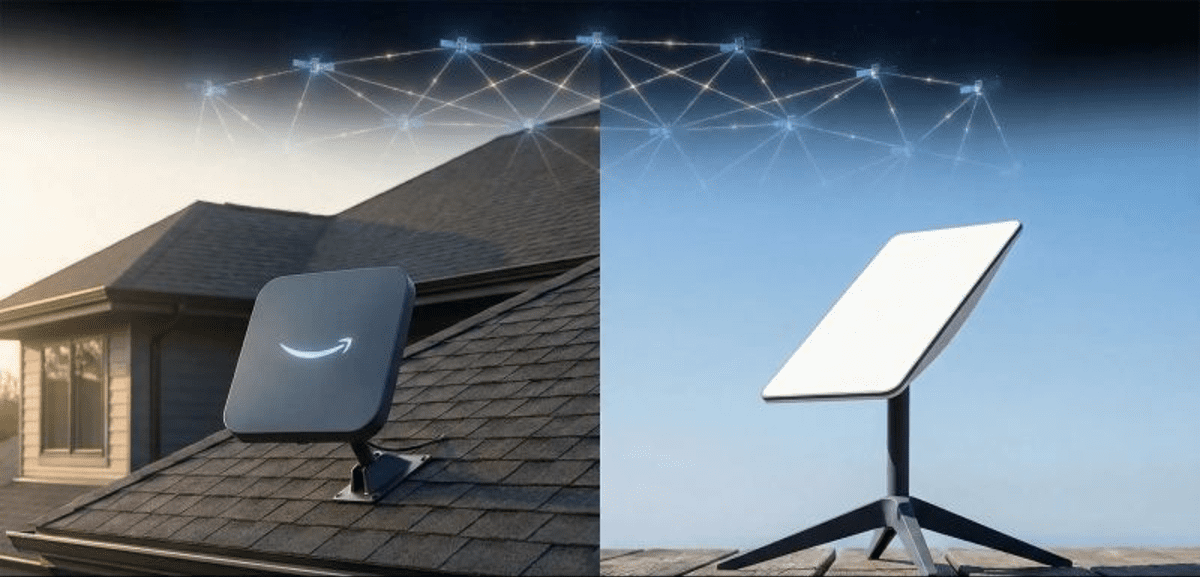
The battle to connect the unconnected in Africa has just turned into a billionaire’s boxing match. Amazon, owned by Jeff Bezos, has formally applied for a license to roll out its satellite internet service in Kenya, firing the opening salvo in a direct challenge to Elon Musk’s Starlink. The move sets the stage for a high-stakes duel between the world’s two richest men over the future of internet access on the continent.
The application, filed through the Nairobi-based subsidiary Amazon Kuiper Kenya Limited, seeks a Tier 2 license from the Communications Authority of Kenya. This specific category allows operators to build and run communications infrastructure across the country. With the regulator now inviting public feedback, Kenya is positioned as a critical frontier in Amazon’s plan to deploy more than 3,200 low-earth orbit satellites by 2028.
As Kenya pushes to expand universal connectivity, the timing could not be more critical. Fixed broadband coverage remains uneven, with fibre rollout proving expensive and often commercially unattractive in sparsely populated counties.
Mobile broadband, while widespread, struggles with persistent coverage gaps in arid and semi-arid regions. This connectivity gap has already fuelled growth for Starlink, which entered Kenya in July 2023 and has grown to about 22,282 subscribers, representing 0.9% of the country’s fixed internet connections.
But Amazon is not entering empty-handed. The company is dangling speeds that eclipse its rival. For a standard terminal, Amazon is promising up to 400 Mbps, dwarfing Starlink’s offering of 150 Mbps.
For commercial users, Bezos’s company says it will deliver a 1,280 Mbps download rate, more than three times higher than Starlink’s maximum 400 Mbps. While Starlink currently enjoys a first-mover brand advantage, Amazon’s raw speed numbers could fundamentally shake up consumer expectations.
The deeper play, however, may not be about selling dishes to individual households. Amazon’s entry strategy hinges on a powerful partnership with traditional mobile operators, directly plugging into existing networks.
A March agreement with Vodafone, the overall parent firm of Kenya’s largest telco, Safaricom, will link Amazon’s Leo network to 4G and 5G base stations in remote locations, with initial trials set for 2026. This approach mirrors a similar partnership Starlink’s parent SpaceX made with Safaricom’s parent Vodacom, turning Kenya into a testbed for how orbital networks integrate with terrestrial giants.
Key details like pricing remain undisclosed, leaving a massive question mark over whether faster speeds can translate into affordable access for everyday Kenyans. For now, the battle lines are drawn, and the prize is connecting the continent’s most underserved populations.