The Outsider Behind Africa’s Biggest Smartphone Factory — And A New Kind Of Bank
Lydia, a 37-year-old micro-entrepreneur in Kenya, used to sell porridge door-to-door, earning about USD 6.00 a day. A quality smartphone, costing around USD 100.00, was an impossible upfront expense. She relied on a USD 25.00 feature phone that couldn’t support online marketing or help her business grow.
Today, as a long-term M-KOPA customer, Lydia owns a smartphone financed through small daily payments. She has opened a food kiosk, increased her daily income by 300%, and created new jobs.
“The most important change is the increase in revenue after getting more customers,” she says. “I got more sales, which increased revenue, then I had an increased workload. Then I had to create employment.”
For another customer, Sekabira in Uganda, an initial loan on a handset paved the way to credit for machinery that he resold for income.
Lydia’s and Sekabira’s stories are part of a larger narrative for M-KOPA, a Pan-African fintech that has just surpassed 3 million active customers. The company’s journey to this milestone began when it shifted its focus from selling consumer goods to financing productive assets.
***
M-KOPA was once best known for the small solar kits that lit up homes in rural Kenya and Uganda. They were affordable, paid off in instalments, and opened the door to television and radio for families living far from the grid.
But by 2020, the company began shifting away from solar lanterns and appliances. In their place came smartphones and, more recently, electric motorcycles. These are assets that customers use for income generation, not merely consumption. The model is not without its demands; customers commit to daily payments for a year or more to own the asset, and that isn’t always easy.
The strategy appears to be working. The company’s latest impact report shows it has now deployed over USD 2 B in credit to more than 7 million customers across Kenya, Uganda, Ghana, Nigeria, and South Africa. Crucially, 86% of surveyed customers report an improved quality of life, and 70% use their M-KOPA product to generate income.
“The unifying voice you hear from customers across all markets is that having access to pay for a phone daily improves their life, brings progress, and opens them up to a world that they probably would not have experienced,” said Chioma Agogo, M-KOPA Ghana General Manager.
The core of M-KOPA’s model is an inclusive financing system that bypasses the requirements of traditional banks. It requires a small deposit, no collateral, and no formal credit score.
Repayments are made daily through mobile money, aligning with the cash flow patterns of customers who earn their income day-by-day. This first transaction begins a financial relationship. As customers build a repayment history, they unlock access to digital loans and insurance bundled within the M-KOPA app.
This approach directly targets a significant gap in Sub-Saharan Africa. According to the 2025 Global Findex, 62% of adults lack a formal financial account, 88% have never borrowed formally, and 67% do not own a smartphone—primarily due to cost.
***
For many, the smartphone is the entry point. M-KOPA has enabled 2.5 million first-time smartphone users since 2020, with 42% of its 2025 customers being first-time owners. But the device is a Trojan horse. “We’re not simply providing affordable devices – we’re delivering pathways to financial inclusion,” said CEO Jesse Moore and Board Chair Rajeev Suri in a joint message.
The company has become a significant handset player in its own right, assembling over 2 million phones at its factory in Nairobi, which it calls the largest in Africa by volume. This local assembly is part of a broader “Local” impact pillar that includes USD 236 M in regional procurement spend in 2024. The phones compete in a market dominated by global brands like Samsung and Tecno, but M-KOPA’s edge is its financing model.
Beyond connectivity, M-KOPA is scaling its financing of electric motorbikes, positioning itself as a key player in Africa’s e-mobility transition. Having financed over 4,000 e-motorbikes, the company is among Kenya’s leading providers in this space. Riders like Armstrong, a boda driver in Kenya, report significant savings.
“With my petrol motorbike, I had to change the engine oil every month and so many parts would wear out,” Armstrong said. He now saves an average of USD 5.62 daily on fuel and maintenance, allowing him to pay school fees on time and plan to open a shop for his wife.
The e-bikes are supplied through partnerships with startups like Roam, Ampersand, and Spiro. Meanwhile, M-KOPA also has a tie-in with ride-hailing company Bolt to roll out electric bikes on credit in Nairobi, offering subsidies to drivers. For a company that once sold solar lamps, financing electric two-wheelers marks a dramatic broadening of scope.
***
The company’s model is not without risk, though. Like many lenders, M-KOPA faces defaults. Some previous reporting has placed its default rate at about 10%. For low-income customers, that can mean losing access to a device if payments are missed. Daily repayment structures mirror the cash flow of informal work but can also impose constant pressure.
M-KOPA’s trajectory highlights both the promise and the complications of asset financing in Africa’s informal economy. The phones, motorbikes, and loans may give customers the chance to earn more, but they also tether them to daily repayments.
Yet, for a population largely excluded from formal finance, the trade-off is access. The report states that 79% of customers said they could not have afforded a smartphone without M-KOPA.
Of its current customer base, 55% are accessing their first formal financial product, and 67% their first health insurance policy. That level of inclusion is notable, but it also places responsibility on the company to ensure customers are not overextended.
Environmental claims also feature in the report. M-KOPA points to 127,700 circular economy products sold and 46,000 tonnes of carbon emissions avoided, largely through e-bikes and refurbished devices. But the long-term impact depends on how batteries are recycled and how durable the products prove to be.
The company is also making an effort to close gender gaps. With funding from the Gates Foundation, it has increased its female agent network from 41% in 2024 to 45% in 2025. Women now make up 40% of its active customers. The data reveals deeper affordability challenges for women; 81% of female customers said they could not afford a smartphone without M-KOPA, compared to 78% of men.
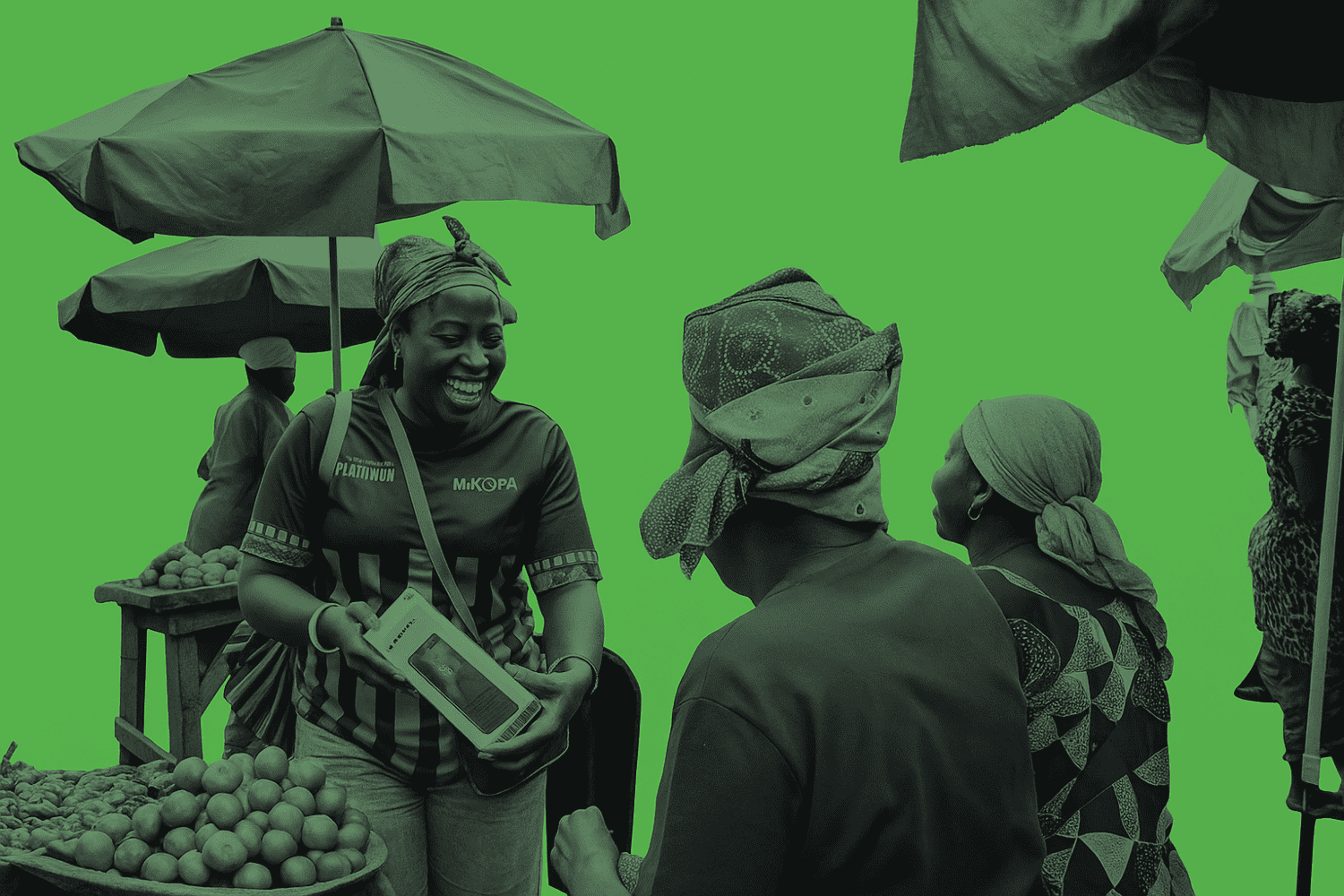
Suliyat, a rice seller in Nigeria, purchased a smartphone after meeting M-KOPA agents at her local market. “I had been trying to save to buy a phone, but when I found out the M-KOPA deposit was just USD 28.00, I paid immediately,” she said. “With the money I had been saving, I bought more rice for my business.”
The company’s goal is to reach 10 million active customers by 2030. Its path suggests it has bet that, in markets where most adults earn irregular incomes, the most effective tool for financial inclusion might not be a digital loan alone, but a physical asset that helps them earn the money to pay for it.
.