It started, as many modern discoveries do, with a social media post. Back in August, Fisayo Fosudo, a notable tech and finance YouTuber in Nigeria, shared a photo of his Chowdeck order. It was not jollof rice or suya. Instead, the receipt was for a hardcover copy of “Making It Big,” the buzzy new memoir by Nigerian billionaire Femi Otedola, delivered to his doorstep.
The post was captioned with a tidy punchline: I ordered Femi Otedola’s book from…Chowdeck. Food for thought.”
The revelation sparked a minor thread of similar discoveries. Days before, tech media pro Fatu Ogwuche spotted that Chowdeck was running banner ads for a local cinema showing Marvel Studios’ “Fantastic Four: First Steps” within the app.
“Chowdeck is doing ads for Marvel Studios/Filmhouse on the app, and I just noticed that they also have a courier service. Uber launched ads on its app in 2022, and the annual revenue of its ads business has surpassed USD 1.5 B to date…they are coming for everybody’s lunch, I fear lol,” she concluded on a punny note.
Before any of this, some had been using the platform to send a small package across Lagos while others had relied on it for pharmaceuticals and groceries. For a company known for bringing meals to doorsteps, the service was suddenly serving up much more, including its newest service revealed just yesterday, when users woke up to being able to top up their phone data through the app.
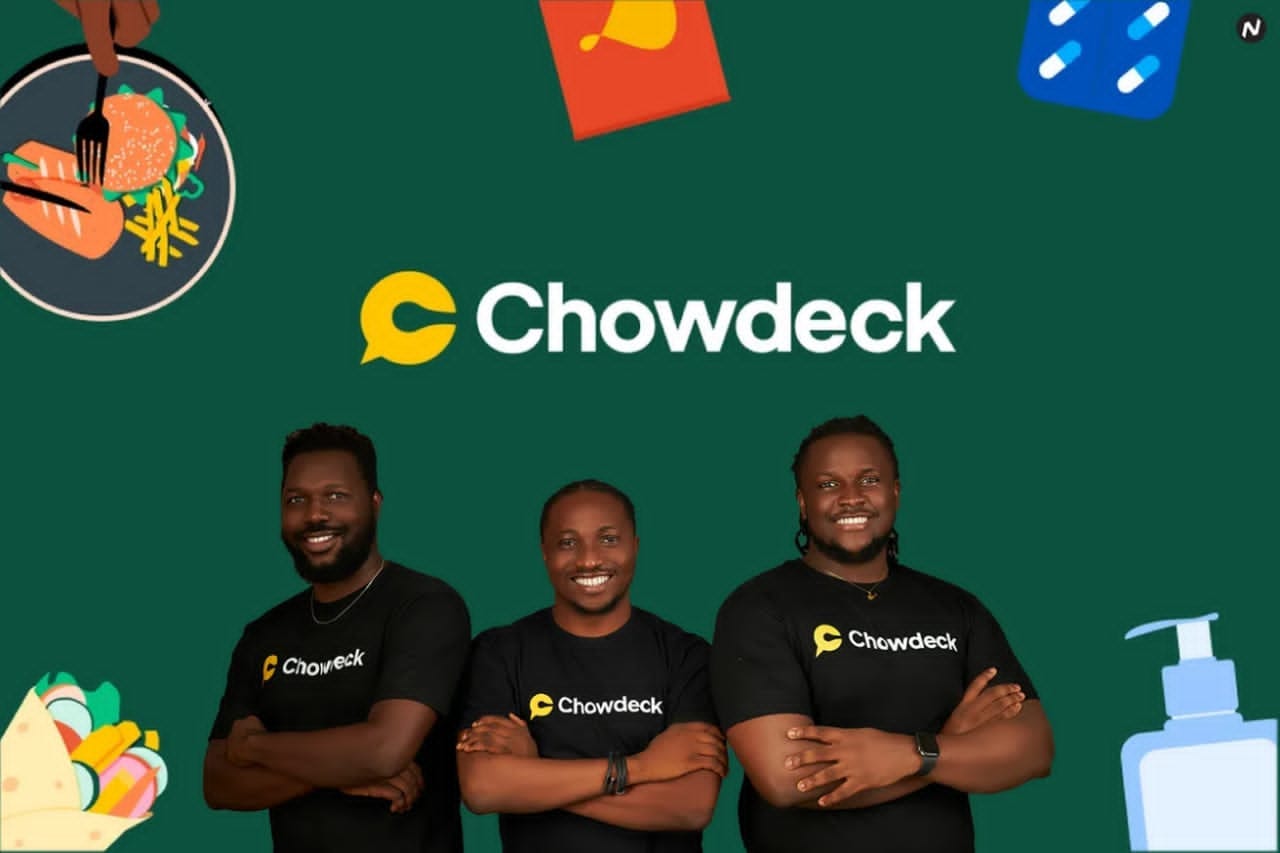
This quiet expansion is the core of Chowdeck’s new strategy. The Y Combinator-backed Nigerian food delivery startup, which recently announced it processes over one million orders a month, is morphing beyond a food delivery app and methodically assembling the pieces of a superapp, a single platform designed to handle a multitude of daily needs.
In a market where the concept of a superapp has often stumbled, Chowdeck is trying to build one not by announcing a grand vision, but by layering new services onto a foundation of full stomachs.
***
The most recent layer is financial. On Monday, Chowdeck softly launched a “Bills” section within its app. The feature allows users to purchase airtime and data. This move into basic fintech is a direct play to become more useful and to keep customer wallets within its ecosystem.
The company’s CEO, Femi Aluko, shared on X that more than a thousand customers used the new feature within its first few hours of release while outlining the drivers.
“Two things greatly inspired this,” he says. “We now have over 20,000 Chowdeck riders spending NGN 5 K weekly on airtime and data. Figured it’d be great to offer them this service as well as allow them borrow from their weekly earnings.
The second factor, according to him, is, “Majority of our users leave spare funds in their wallets, and this can be repurposed to airtime/data without having to leave the app.”
The strategy is underpinned by a simple logic. Food is ordered frequently, often daily. This creates habitual app use. Once a user is comfortable opening an app for one need, introducing a second or third becomes easier.
A common view among seasoned tech industry players, among the wave of comments questioning the move, is that Chowdeck is betting that the high frequency of food orders will naturally lead to adoption of its other services, effectively making the app a daily utility.
“Selling airtime is like the fintech version of daily cardio,” PiggyVest Co-Founder Odun Eweniyi pointed out in an interesting take.
“Every transaction (no matter how infrequent) keeps the wallet alive and the float moving; it all adds up. If you already have trust in Nigeria, adding a utility is not regression, it’s actually a vertical integration of boredom…the best companies will work to turn routine into a rhythm.”
But the company’s ambitions stretch beyond consumer services. It’s foray into digital advertising, a high-margin revenue stream that diverges completely from delivery logistics, has significant potential. Uber, for instance, launched its own ads business in 2022, and it has since grown into a billion-dollar annual revenue stream for the ride-hailing giant.
***
This transformation from a logistics company to a media and services platform is a deliberate shift. Femi Aluko, Co-founder and CEO of Chowdeck, recently spoke about the company’s record-breaking order milestone.
He credited the hard work of riders, restaurant partners, and the commitment of customers. While not directly commenting on the new ads or fintech features, his statement highlighted the scale the company has achieved, a scale that makes these new ventures possible.
That scale is being bankrolled by significant investor confidence. In August, the company secured a USD 9 M Series A funding round led by Novastar Ventures. This capital is fueling a two-pronged expansion. On one hand, it is building out a quick-commerce network, planning to open hundreds of dark stores to slash delivery times for groceries and other essentials.
On the other, it has fully integrated Mira, a point-of-sale startup it acquired earlier in the year shortly after its Ghana launch. This move provides restaurants with inventory and payment management tools, deepening Chowdeck’s ties with its merchant partners and positioning it as a broader technology provider for businesses.
Brian Waswani Odhiambo, a Partner at Novastar Ventures, explained the investment thesis, asserting that Chowdeck is redefining last-mile delivery and building the future of logistics for African cities thanks to deep local insight, a sustainability-first approach, and impressive execution.
The path to a superapp, however, is littered with challenges. Adding financial services like airtime purchases is one thing. Becoming a full-fledged payments platform is another. To allow transfers between user wallets, Chowdeck would need to navigate Nigeria’s complex fintech regulations and potentially secure a costly license. Furthermore, each new service adds technical complexity and must maintain the same reliability that users expect from its core food delivery business.
For now, Chowdeck is not calling itself a superapp. But it does look to be building one, feature by feature, order by order, betting that the trust earned from reliably delivering a warm meal is the strongest foundation upon which to build an empire.
And users who received their book in one bag and their lunch in another can testify said empire is already taking shape, one delivery at a time.