How Nigerian Agritech Startup Zowasel Is Changing The Lives Of Smallholder Farmers

By Nao Fuwa  |  November 29, 2022

In Africa, many agritech startups are developing businesses to solve the problems smallholder farmers face. These challenges are numerous and significant, including crop damage from natural disasters, high food wastage due to supply chain inefficiencies, and limited access to financial services. According to a report by the United Nations, Nigeria has the highest “per capita food waste rate” in Africa, estimated at 40% to 50%.


Many agritech startups begin their business from a single point in the agricultural supply chain. For example, they set up marketplaces that connect farmers (sellers) and companies (buyers). In the past few years, many startups that began as marketplaces pivoted their business to agricultural supply chains, such as cold storage and cold storage vehicles to prevent waste of farm products, or companies that manufacture processed farm products.


Zowasel, a Nigerian agritech startup, is one such company that comprehensively addresses the issues faced by smallholder farmers.

[Jerry (right), CEO of Zowasel, a cocoa farm in Ondo State, Nigeria]

Jerry Oche was born into a farming family in northeastern Nigeria, and before founding Zowasel, he ran a crowdfunding business for small farmers. The crowdfunding business model was to sell the harvested crops and return the profits to investors, but it did not work out. The main reason was that small-scale farmers did not have appropriate sales outlets and could not sell their products at appropriate prices.

To solve this problem, Jerry founded Zowasel in 2017 as a marketplace business where farmers (sellers) and companies (buyers) could trade at an appropriate price. Over the years, the company started providing production guidance to farmers, selling inputs such as fertilizers and agrochemicals at lower prices than market prices, supporting opening bank accounts, etc.

Currently, in cooperation with Mitsubishi Corporation (MC) Nigeria, the company is implementing a farm machinery rental business for smallholder farmers and conducting a demonstration experiment of a credit-scoring business in cooperation with the Japan International Cooperation Agency (JICA).

A One-Stop Solution to the Challenges Facing Small Farmers

In order to provide an end-to-end solution to smallholder farmers, Zowasel has its main business is spread across 5 key verticals

(1) Marketplace (increase in profits and reduction of food loss)

(2) Crop cultivation education (improvement of cultivation knowledge) 

(3) Introduction of farm machinery (production efficiency improvement)

(4) Credit scoring (improving access to finance) 

(5) Traceability (visualization of distribution channels)

Currently, the company has a network of over 2 million smallholder farmers and about 5,000 sales partners. The agritech’s activities have expanded to many states in Nigeria. Its sales partners include major companies such as Olam, an agricultural general trading company headquartered in Singapore, Promasidor, based in South Africa, and Ireland’s Guinness.

In addition to providing fertilizers, seeds and guidance on appropriate cultivation & harvesting methods, the introduction of agricultural machinery by the startup has greatly improved productivity. Furthermore, Zowasel has removed the middlemen (usually 2 to 5 companies) from the supply chain, creating a win-win situation for farmers.

Now the farmers can sell at better prices, and companies can purchase farm products at lower prices. As a result, small farmers who have business relationships with Zowasel have seen their profits increase by an average of 30%.

Marketplace


Zowasel provides an online trading platform that connects small-scale farmers with companies and enables them to buy and sell at appropriate prices.

There are three major challenges faced by small-scale farmers when buying and selling agricultural products: (1) lack of understanding of appropriate market prices, (2) lack of sales channels, and (3) logistics for transporting agricultural products.

Zowasel researches and provides farmers with weekly reports of market prices for each agricultural commodity by region. The price list (below) shows the market prices of cassava and cocoa by region as surveyed by Zowasel.
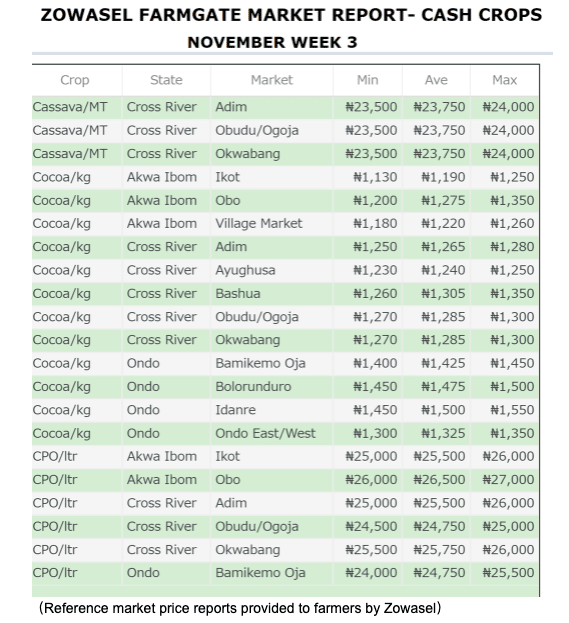
When selling their produce, farmers determine the selling by themselves or with assistance from Zowasel, if needed. Every product undergoes quality inspections by Zowasel and is then entered into the online platform. By matching these data with the requirement entered online by the company (buyer), the transaction is concluded at a price that benefits both parties while eliminating the middleman. The final transaction price is determined through negotiations between the seller and buyer.

Another feature of the system is the use of mobile money to streamline payment. It is inefficient for both parties to travel great distances to make cash payments for sales. Since many smallholder farmers do not have bank accounts, Zowasel also assists them in opening bank accounts.

The company also provides logistics services after the transaction is completed, allowing customers to safely transport fresh products by hiring a carrier in partnership with Zowasel.

In addition, Zowasel has set up offices in each region to provide support to farmers who do not own cellphones & thereby, cannot use online trading and payment systems.
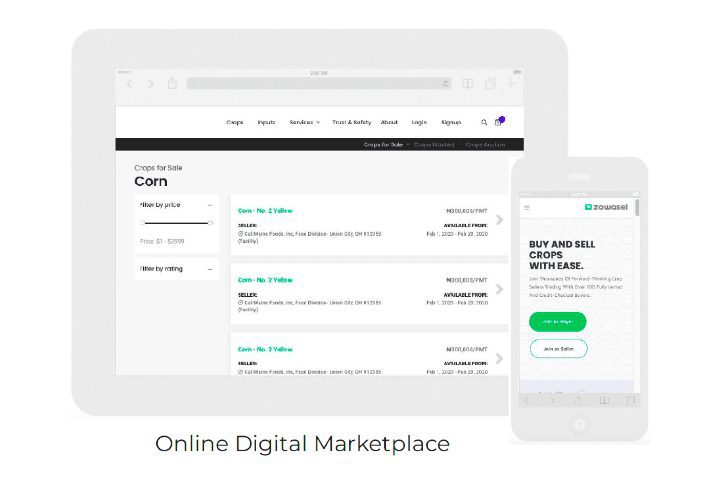
(Online platform provided by Zowasel)

Education on crop cultivation

Lack of uniformity in crop production and inconsistent quality & quantity are other challenges faced by smallholder farmers. In most cases, the problem is due to ‘inexperience’ in cultivation techniques.

Zowasel provides free education to smallholder farmers on the cultivation of each crop, storage after harvest, and cutting fertilizer costs. It also updates current crop sales market trends and helps farmers grow their farming businesses.

The company offers 24-hour customer support, where farmers can call and talk to experts about commodity market trends and ways to improve their businesses.
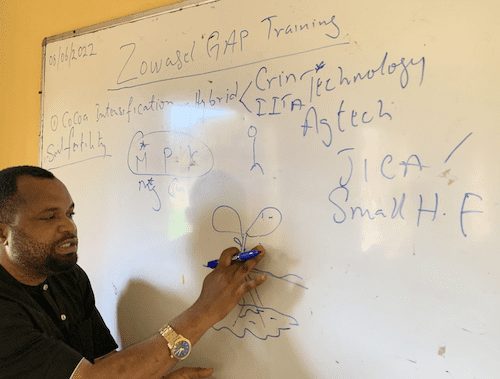
(One of the classes offered by Zowasel)

Agricultural machinery rental business

Many smallholder farmers in Nigeria have difficulty purchasing agricultural machinery owing to their low incomes, and much of their farming is still done manually. As a result, the yield of harvest remains low.

On the other hand, the number of farmers leaving farming in Japan is increasing due to the ageing of the farming population. Many farmers are transferring or scrapping their farm machinery, and many unused, used farm machines are available in Japan. In addition, pre-owned machinery in Japan used for the cultivation of small fields meets the needs of smallholder farmers in Nigeria.

Therefore, in order to improve agricultural productivity through the diffusion of agricultural machinery to smallholder farmers in Nigeria, Zowasel and MC Nigeria have started a demonstration experiment of an agricultural machinery rental business in Nasarawa State. A total of four machines, an Iseki tractor, a Kubota combine harvester, and two hand-pushed rice transplanters manufactured by Kubota and Yanmar, were imported from Japan to provide rental services to farmers. This rental business, which started this year, is going well. Rental demand for agricultural machinery is strong, and the reservation list is full of requests from farmers.

Mr Makoto Saito, CEO of MC Nigeria, said, “Through the demonstration test, we are measuring the impact of agricultural machinery on farmers’ productivity and income and analyzing the economic rationale for the agricultural machinery rental business. If we can introduce a business-oriented agricultural machinery service, the Nigerian agricultural market will change dramatically. The potential is enormous.”

However, there are issues to be addressed in the farm machinery dissemination and rental business, such as (1) setting prices that farmers can afford, (2) appropriate maintenance, and (3) securing spare parts in case of breakdowns.

Mr Kisho Miyamoto, JICA Rice Extension Specialist, says, “Farm machines with simple functions that are popular in Southeast Asian countries like Thailand and Indonesia are more suitable for Africa. There is room to verify whether high-performance products for the Japanese market are better suited for the dissemination of agricultural machinery to small farmers in Nigeria or whether simpler, less expensive agricultural machinery with simplified performance used in Southeast Asia is more suitable for Nigeria.”

Another issue is whether the market is large enough to be a viable business in terms of securing spare parts in case of breakdowns. The key to building such an ecosystem is to first distribute a large number of agricultural machinery in the market. As the number of used agricultural machinery in circulation increases, more distributors would come up offering genuine spare parts, thereby growing the market. However, another challenge could follow with the distribution of non-genuine spare parts in the market.

Credit Scoring

Many small-scale farmers in Nigeria have low credit ratings and have difficulty utilizing bank loans and guarantees for business transactions. Most deals on the spot are in cash, making it difficult for the farmers to secure large sums of money to expand their businesses. Banks and other financial institutions are often reluctant to provide loans to small farmers, owing to the cost of access to remote and distant areas. 

On the other hand, in addition to access to data on crop sales, purchases, and farm machinery rentals, Zowasel has extensive information on farmers’ personalities, family relationships, and farmland through its efforts to provide farmers with guidance on production methods. This data could be effectively utilized as credit data, especially since MC Nigeria and Zowasel are engaged in the farm equipment rental business

To add more meaning to the data, JICA and Office for Nigerian Digital Innovation (ONDI) launched the “Project for Improving Access to Finance and Livelihoods of Small-scale Farmers” in July 2022 in collaboration with Mitsubishi Corporation Nigeria and Zowasel. The project is an initiative to bridge the gap between financial institutions and small-scale farmers to solve the problems of both parties. This is part of JICA’s “Project NINJA (Next Innovation with Japan)” initiative to promote collaboration between local startups and Japanese companies.

The project’s objective is directly to improve smallholder farmers’ access to finance, expand their businesses, and improve their livelihoods, and in the process, various issues faced by small-scale farmers are expected to be resolved.
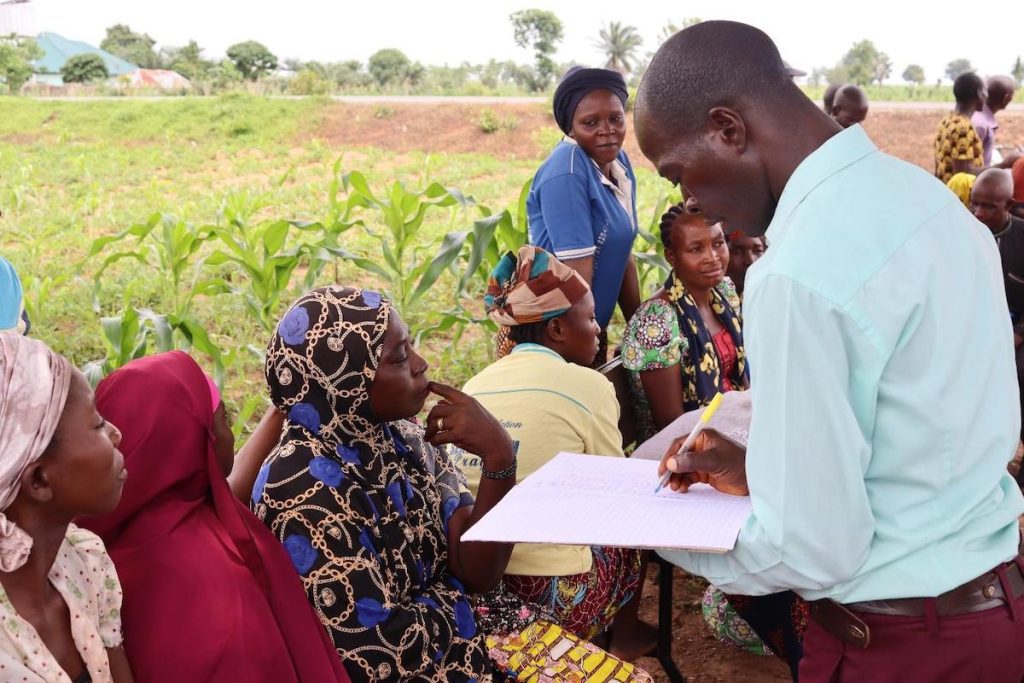
Small farmers in Nasarawa State (left) and Zowacel staff (right) collecting information on farmers

For example, improved access to finance will allow them to use rented farm equipment more, and increased productivity will free up more of their free time, allowing them to start a side business in their spare time. Children who used to help with farming would be able to focus on their schoolwork. In addition, if the improved livelihoods allow for the purchase of a small private power generation system (solar home system, SHS), children can study even in the middle of the night when there is no natural light. For an individual farmer, not only the access to finance will improve, but many other social issues are expected to be solved through derivative effects. 

Furthermore, when the income of small-scale farmers improves, Zowasel, which has close relationships with farmers, will be able to provide a wider range of products and services.

Traceability

The European Union (EU) is debating a new bill aimed at preventing deforestation and forest degradation. Under the bill, 14 commodities to be exported to the EU, including cocoa, coffee, soybeans, beef, and corn, will have to prove that they are not produced on land that has caused deforestation. Since Africa exports many agricultural products to the EU, and cocoa is one of Nigeria’s main exports to Germany, the Netherlands, Spain, Belgium, and other countries, there is concern about the impact of the bill.

Products that meet EU standards will be exported, while those that do not meet standards will be bought cheaply by other countries, potentially putting small farmers in developing countries at a disadvantage. 

In anticipation of the proposed legislation, Zowasel is focusing on traceability to provide data on “where, when, by whom, and how the products it purchases were produced. The company is working with Barry Callebaut AG, a major Swiss company that deals mainly in cacao beans and chocolate products, to promote sustainable cocoa production in Nigeria.

Specifically, agricultural and sustainability experts will be dispatched to production sites to provide guidance to farmers on production, collection of farmland and crop data, as well as gender considerations, forest and environmental protection, and other issues. Barry Callebaut has also pledged to strengthen its support for cocoa cultivation to achieve carbon neutrality by 2025.

Jerry, CEO of Zowasel, said, “The EU bill could be detrimental to small farmers and companies that produce commodities that do not meet EU standards. We want to develop our business in a way that benefits both Nigerian farmers and the EU,” he said.

Strong relationship with farmers

Zowasel’s greatest strength is the direct and strong relationships with farmers that Jerry, CEO of the company, has built and the business he develops by leveraging these strong relationships.

Jerry’s relationship-building is solid and reliable. He spends many days in rural areas during the year, building strong relationships with government officials and town and village mayors in each state. He is very active in explaining the company’s business activities to farmers in the region, and after gaining the approval of smallholder farmers, he onboards them onto the company’s platform.

Zowasel has established 45 crop centres in Nigeria. These centres not only work as service centres of the company but also as a place for farmers to enjoy conversations and build relationships. I visited Ondo State, Nigeria, a cocoa-producing region, in May this year and Nasarawa State in November and was able to experience firsthand the close relationship between the company and the village heads and farmers in these areas.

(Cacao farmers in Ondo State with JICA staff

The business model of Zowasel is time-consuming and human-centric, and the speed of business expansion is slower than that of software startups such as FinTech. However, the company’s strength lies in its “access to small farmers,” a solid network of small farmers that Jerry has built through his visits.

Such a tight-knit network is highly attractive to foreign companies that want to do business with small farmers in Nigeria but do not have a network. Some European companies, such as MAS Seeds of France, are already using the company’s network to conduct demonstrations to adapt their fertilizers, seeds, and other inputs to the Nigerian environment.

How it looks like going forward

Agritech startups targeting small-scale farmers in Africa are increasingly offering one-stop services from production to sales. These services range from agricultural technology guidance, provision of necessary materials at low cost, farm equipment rental services, trading at appropriate prices on online platforms, AI-based credit scoring businesses, and mobile money utilization and financial access services.

Depending on the business model, future agritech businesses targeting smallholder farmers are likely to approach the role of a platform that sells a wide range of offerings, including daily necessities. The business can be more robust by building strong relationships with small-scale farmers and collaborating with more companies to create a value chain.

In business for the BOP (low-income earners/small-scale farmers), collaboration among other industries centred on companies with sales access to customers will be key.

Mr Susumu Yuzurio, Chief Representative of JICA’s Nigeria Office, commented, “While JICA’s business mainly involves government agencies as counterparts, startups have the advantage of building close relationships with end-users. As with the credit scoring project, we would like to actively seek linkages between the startups’ strengths and existing JICA projects in areas such as agriculture and health in order to implement projects with greater impact and solve social issues,” he said.


Egyptians Are Using AI For Shopping But Won’t Let It Touch Their Money

By Henry Nzekwe  |  June 10, 2026

Nearly all Egyptian consumers use artificial intelligence to help them shop, but only a fraction trust AI to complete a purchase on their behalf; a paradox that reveals a broader challenge facing the global payments industry as it rushes to build infrastructure for autonomous commerce.

A Visa study released Tuesday found that 91% of consumers in Egypt have used AI tools to assist with shopping, comparing prices, checking reviews and finding gift ideas. Fully 97% say the technology makes online shopping faster and easier. Yet when asked whether they would trust an AI agent to handle checkout, that figure collapsed to just 38%.

The findings, from the annual Stay Secure survey conducted by Wakefield Research, lay bare the gap between consumer appetite for AI-assisted discovery and their reluctance to cede control of the payment itself. The study surveyed 5,800 adults across 17 markets in Central Europe, the Middle East and Africa, including Egypt, Kenya, Nigeria and South Africa.

The trust gap is not unique to Egypt. In South Africa, only 23% of consumers would trust an AI agent to complete a purchase, according to the same study. In Kenya, that figure stood at 29%. Across the region, consumers are embracing AI for research, but they draw a firm line when money changes hands.

“Consumers see fraud protection as a shared responsibility, but they expect financial institutions, governments, and payment providers to take the lead,” said Leila Serhan, Visa’s senior vice president for North Africa, the Levant and Pakistan.

The study also revealed a rapidly shifting e-commerce landscape. Eighty‑five percent of Egyptian consumers have purchased products directly through social media platforms. But as commerce migrates to new channels, fraud follows. Among consumers who reported experiencing a financial scam in the past 12 months, some 36% of respondents, nearly half said the incident occurred on social media, more than on any other platform.

In 2025 alone, Egyptian authorities said they thwarted financial fraud operations worth an estimated EGP 4 B (approximately USD 77 M), according to statements from the Central Bank of Egypt. Across the continent, an Interpol‑coordinated operation in early 2026 involving 16 African countries resulted in 651 arrests and exposed scams tied to over USD 45 M in losses.

The findings arrive as Visa, Mastercard, and other payments giants race to prepare financial institutions for agentic commerce – autonomous transactions executed by AI agents with minimal human involvement. Visa has already begun enrolling banks in its Agentic Ready programme, which enables institutions to process such payments.

But as the Egypt data makes clear, the infrastructure is arriving ahead of consumer trust. Asked who should bear primary responsibility for fraud protection while shopping online, nearly half of Egyptian consumers pointed to government authorities. Only 13% believed consumers themselves should be primarily responsible.

The path forward remains uncertain for payments companies. Consumers have demonstrated they will use AI to discover products and compare prices. Whether they will ever trust it to spend their money remains an open question.

Feature Image Credits: Consultancy-ME

Nigeria Plans Salvage Job For Its eNaira Digital Currency Flop

By Staff Reporter  |  June 9, 2026

Nearly five years after its high-profile launch as Africa’s first central bank digital currency, Nigeria’s eNaira is being quietly repurposed. The Central Bank of Nigeria (CBN) has acknowledged in a new strategy document that adoption of the Central Bank Digital Currency (CBDC) has been slow, and is now repositioning it away from a consumer-facing payment tool toward a backend infrastructure for government disbursements and cross-border settlements.

The eNaira, launched in October 2021 to much fanfare, has struggled to gain traction. According to the CBN’s Payments System Vision (PSV) 2028 strategy, unveiled on June 1, the CBDC currently has “millions of wallets” but has processed only about NGN 22 B (USD 16 M) in transactions. This is a fraction of the nearly 1 quadrillion naira in total electronic payments processed in 2024, and well below the 300 million transactions the bank had envisioned for the digital currency by 2026.

In the PSV 2028 document, the CBN acknowledged that barriers to the eNaira’s success included “limited stakeholder engagement and buy-in” during its design and implementation. The bank conceded that adoption had been slow, with the CBDC offering little that existing bank apps, fintech wallets and mobile money platforms were not already providing more conveniently.

Rather than competing directly with these established platforms, the CBN now wants the eNaira to become part of the infrastructure that underpins Nigeria’s digital payments ecosystem. The strategy, which runs through 2028, places the CBDC alongside initiatives such as open banking, digital identity and cross-border payments frameworks.

The rethink comes amid a broader strategic shift at the CBN under Governor Olayemi Cardoso, who has prioritised stabilisation, trade facilitation and investor confidence.

The PSV 2028 framework, unveiled at a gathering of banking executives and fintech operators in Abuja on June 1, aims to position Nigeria among Africa’s leading payment ecosystems by promoting faster, safer digital transactions and strengthening cross-border payment systems under the African Continental Free Trade Area (AfCFTA).

The path forward for the e-naira will focus on government-to-person (G2P) payments, such as welfare disbursements and subsidies, as well as cross-border settlements. “Routing every government payment through the eNaira is where the plan argues with itself,” noted one analysis of the strategy, pointing to the tension between the CBDC’s past failures and its future ambitions.

The repositioning reflects a quiet admission that Africa’s first CBDC experiment, once hailed as a landmark step toward a cashless economy, has fallen short of its original promise. Now, the CBN is betting that a more utilitarian role can salvage the project.

The Inside View On Why African Startups Raise Billions But Can’t Raise Leaders

By Henry Nzekwe  |  June 8, 2026

Africa’s tech ecosystem had its best funding year since 2022 as startup investments rebounded last year, ending the slump of the previous two years, thanks to record debt financing and a steady recovery in equity markets. Kenya, South Africa, Nigeria and Egypt together accounted for much of the capital raised.

The money is back, but something else is quietly choking the continent’s startup ambitions. A common view among stakeholders suggests that it’s not a lack of ideas or market, but rather leadership.

When Moniepoint CEO Tosin Eniolorunda told a Lagos audience that his company had struggled to fill 500 vacancies because Nigerian candidates were “not up to global standards,” the internet exploded. Some called it an insult, others said he was telling an uncomfortable truth. But Marcia Ashong‑Sam, founder and CEO of the executive search and leadership advisory firm, TheBoardroom Africa, has a different take.

“The question was never whether African professionals are capable,” she tells WT. “It was whether the organisations they work within are built to draw that capability out.”

Ashong‑Sam sees a painful irony every other day. “Founders will tell you in one breath that talent is their biggest challenge, and in the next, allocate the smallest slice of their budget to developing it.” Why? “Because leadership development gets treated as a cost centre, not a strategic growth lever. When you are racing to hit targets or close a round, teaching your VP of Product how to make better decisions feels abstract. Product and customer acquisition feel real. So the money flows to what feels urgent.”

But there is a deeper structural bias. The capital that flooded Africa over the last decade was priced for speed and market capture. “Investors focused more on growth metrics than leadership capacity or organisational maturity,” Ashong‑Sam says. “So founders optimised for what they were measured on.”

Many also assumed talent could simply be hired rather than developed. “That assumption is where the model breaks down,” she warns. “You cannot hire your way out of every talent challenge. At some point, you have to build capability internally.”

So what separates the companies that actually do this from the ones that collapse under their own weight? High‑performing organisations, she explains, “do not just recruit talent. They systematically compound it.” Ashong-Sam holds the view that the organisations that fare better treat leadership development as an operational discipline, not something delegated entirely to HR.

“They build clear succession plans, conduct regular talent reviews, and give people early exposure to cross‑functional responsibilities. And they think several layers ahead. Building tomorrow’s leadership bench with the same intentionality they bring to building their product,” she explains

There’s another dimension that gets missed entirely. “Organisations frequently hire people because they are excellent at one specific thing,” Ashong‑Sam notes. “The assumption is that technical excellence will advance a career. It rarely does on its own.”

What actually determines who grows into leadership is the ability to lead people, translate strategy into action, and navigate uncertainty, she asserts. “Those are human skills, and they have to be developed with genuine commitment. A well‑rounded career requires a well‑rounded professional.”

So how do you know if your company is hitting a leadership ceiling instead of a product or market problem? Ashong‑Sam says the most reliable early warning is decision velocity.

“When a company that was once agile becomes slow, when simple decisions require multiple sign‑offs and teams are waiting weeks for clarity, that is a leadership architecture problem.”

Another signal is what happens to high‑potential people. “High turnover among strong performers,” she tells WT, “particularly when they are leaving not for better compensation but because they do not feel they are growing or being heard, is a leadership culture signal that precedes deeper difficulty.”

In her view, boards often miss this because they are watching revenue, churn and burn rate, but those only tell you what has already happened.

“What boards should be tracking is succession depth, voluntary attrition, and the gap between what the organisation says its strategy is and how it actually behaves day to day.” She recommends a simple test: “Who runs this if you step away for six months? If the honest answer is that it falls apart, the board is sitting on a leadership risk.”

The debate that erupted over Moniepoint’s CEO’s comments stopped at exactly the wrong place, Ashong‑Sam argues. “A person can have full competency on paper and still be set up to fail if the organisation has not invested in building their capacity to lead.”

The leadership guru also criticises the tendency of many organisations to expect world‑class performance without world‑class development structures. “When outcomes disappoint, the individual gets the blame rather than the environment. That misdiagnosis is costly,” she says, “both for the person whose reputation suffers unfairly and for the organisation that learns nothing and repeats the same conditions with the next hire.”

Africa’s workforce is young, growing and ambitious. Sub‑Saharan Africa is expected to add 620 million people to the global workforce by 2050. That is either a dividend or a disaster, depending on who is building the systems to lead them.

Ashong‑Sam’s final lesson for the tech ecosystem is urgent. “Pipeline building does not have to wait for maturity or scale. The intent has to be present early, built into the culture before the organisation is large enough to feel the absence of it.” The capital is back. The question is whether the leadership will follow.

Lending Becomes New Battleground As Moniepoint, Rivals Square Off In Nigeria

By Henry Nzekwe  |  June 5, 2026

Tosin Eniolorunda, founder/CEO of Nigeria’s largest fintech by transaction volume, Moniepoint, has fired the starting gun on credit layering, which is shaping up to replace payments as the new battleground in Nigeria’s vibrant fintech scene. And industry insiders say the battle over customer deposits will be key to that.

Speaking at the official launch of the Central Bank of Nigeria’s Payments System Vision (PSV) 2028 framework in Abuja, the Moniepoint Group CEO argued that the next phase of growth for the country’s digital economy lies in building credit products directly on top of existing payment rails.

“I believe the next phase of growth will come from layering services like credit onto existing payment flows, using the visibility and trust already built through financial transactions,” Eniolorunda told a panel of industry leaders, including the heads of NIBSS, Remita and SANEF. “For many small businesses, access has always been the real barrier.”

Moniepoint has already demonstrated the firepower of that model. Its microfinance bank disbursed more than NGN 1 T (USD 734 M) in credit to SMEs in 2025, financing thousands of provision stores, pharmacies and building materials sellers across the country. The company processed NGN 412 T (USD 302 B) in transaction value last year, powering an estimated 80% of in-person digital payments nationwide.

Yet the credit push is merely the visible front of a deeper strategic pivot. An emerging consensus among analysts and executives is that the coming fight will not be merely about lending, but about the cheap deposits required to fund it profitably.

“Large fintechs are not going to borrow expensive money to lend, they also won’t be depending solely on float.” industry veteran Victor Asemota pointed out, suggesting operators will deploy customer deposits, leveraging microfinance bank licenses to build balance sheets that can compete with traditional commercial banks.

That puts the spotlight on the deposit side of the equation. Banks have long held a monopoly on low-cost retail and corporate deposits. But fintechs, such as Moniepoint, OPay, PalmPay, FairMoney, Flutterwave and Paystack, have been quietly accumulating user bases that rival or exceed those of many Tier-2 banks. OPay and PalmPay alone have over 80 million users between them, while Kuda and Moniepoint serves 7 million and 16 million individuals, respectively.

A recent report by Credit Direct Ltd, a leading non-bank lender, forecasts that Nigeria’s credit market will split over the coming decade. Banks will concentrate on corporate and secured lending, it argues, while non-banks will lead consumer and informal-sector credit, powered by embedded finance and AI underwriting.

That structural realignment is already forcing traditional banks to defend their turf. Analysts have tipped neobanks to aggressively poach customers from legacy lenders in 2026, while Flutterwave’s recent acquisition of a microfinance bank license was described as creating a “tectonic shift” in the competitive landscape. The CBN has also formalised the nationwide status of fast-growing fintechs, effectively placing them closer to deposit money banks on the competitive spectrum.

Governor Olayemi Cardoso underscored the stakes at the PSV 2028 launch. “Inclusion and not exclusion must define our future,” he said, setting a target of 95% financial inclusion by 2028 — incorporating 50 million more Nigerians into the formal banking system. Achieving that goal will require regulators, banks and fintechs to work together, he warned against the country’s historic “start-stop” policy cycles.

Moniepoint is not alone in positioning for this shift. FairMoney disbursed over NGN 150 B in loans to small businesses in 2025. PalmPay and OPay have built mass-market payment networks and lending features. Flutterwave’s 2 million-strong Send App user base now has a banking licence behind it. Paystack, too, has acquired a microfinance bank licence, though it faces a significant competitive gap against larger incumbents.

Uganda Puts The Squeeze On Cash While Taxes On Digital Alternatives Bite

By Staff Reporter  |  June 4, 2026

Uganda’s central bank is tightening the screws on cash, imposing new withdrawal and cheque limits in its strongest push yet toward a cashless economy, even as the government’s own digital transaction taxes threaten to undermine adoption.

The Bank of Uganda, in a circular issued last week, set daily over‑the‑counter cash withdrawal caps of UGX 50 M (USD 13.7 K) for individuals and UGX 500 M (USD 137 K) for businesses. Weekly limits are set at UGX 250 M and UGX 2.5 B, respectively. The rules take effect on Jan. 1, 2027.

“In line with the Bank of Uganda e‑payments strategy, which aims to promote a cash‑lite economy as part of the broader national digitisation agenda,” the central bank said it had also reduced interbank cheque limits and introduced the withdrawal caps, according to the circular.

The move comes as digital payments surge. According to the central bank’s own data, electronic money transaction values in the East African nation rose 28% in 2025 to UGX 366 T (USD 100.3 B), while transaction volumes grew 17.3% to 9.1 billion. Mobile money remains the primary driver, with transaction values jumping 40% to UGX 66.1 T last year.

But a 0.5 percent excise duty on mobile money cash withdrawals, charged on top of service fees, is creating friction. Telecommunications firms MTN Uganda and Airtel Uganda told Parliament’s finance committee in April that the levy disproportionately hurts low‑income users. The operators are pushing for a reduction to 0.25 percent, arguing it would stimulate usage and ultimately lift tax revenue.

“When you send money for Parish Development Model, Emyooga, women down there will suffer the tax burden, they are your taxpayers,” MTN’s Dennis Kakonge told lawmakers.

The cost has sparked a shift. Agency banking transaction values rose 76% in 2025 to UGX 29.4 T as consumers seek cheaper channels, according to industry data. The number of agents expanded to more than 22,000. Refactory CEO Michael Niyitegeka, a tax expert, called the current framework “a distortion in the digital payments ecosystem,” noting that the tax burdens one channel while similar banking transactions attract lower costs.

The central bank’s restrictions may backfire if the cost of digital channels remains prohibitive. But mobile money remains the most accessible payment option for households and small merchants, even with the levy.

Amazon Brings Prime To South Africa In A Renewed Push Against Local Rivals

By Henry Nzekwe  |  June 4, 2026

Amazon has launched its paid Prime service in South Africa, deploying the loyalty engine that underpins its global dominance two years after the U.S. e‑commerce giant quietly entered the country’s crowded online retail market.

The subscription, priced at ZAR 59 (USD 3.20) monthly or ZAR 399.00 annually, offers unlimited same‑day delivery in major metros, access to Prime Video streaming and Amazon Luna cloud gaming, as well as exclusive entry to the company’s annual Prime Day sales event, scheduled for June 23‑29. The launch makes South Africa the 27th country to receive the service.

Amazon’s marketplace went live in South Africa in May 2024 to a muted reception, with limited product selection and no Prime offering in place. Nearly two years later, independent data suggests the platform has gained traction. During the 2025 Black Friday period, Amazon recorded the third‑highest transaction value among customers of both FNB and Discovery Bank, trailing only Takealot and Checkers Sixty60. One logistics partner, The Courier Guy, processed a peak of nearly 224,000 deliveries for Amazon in September 2025.

“Since launching Amazon in South Africa two years ago, we have built a store our customers love, with a great selection of local and international products backed by a reliable delivery experience,” Robert Koen, managing director for Sub‑Saharan Africa at Amazon, said in a statement. “Launching Prime is the next exciting milestone on our journey in the country.”

The move ratchets up pressure on incumbent rivals. Naspers‑owned Takealot remains South Africa’s largest e‑commerce platform, holding about 45% of regular online consumers, but its market share has fallen from 35% in 2020 to 24% in 2025.

Takealot introduced its own TakealotMore subscription service days after Amazon’s entry, while Shoprite’s grocery delivery app Sixty60 has emerged as a formidable competitor.

South Africa’s online retail sector remains underpenetrated, accounting for an estimated 5%‑8% of total retail sales, a gap that Koen said presents a growth opportunity. Amazon has expanded its physical footprint to support the push, including more than 4,000 pickup points across the country and delivery coverage extending into rural areas.

“We want to price it at an affordable level, which I think adds a lot of value in the offering,” Koen told local media. Customers can sign up for a 30‑day free trial before committing to the subscription.

Canal+ Lists In South Africa With Bold Plan To Reverse DStv Decline

By Henry Nzekwe  |  June 3, 2026

Canal+ began trading on the Johannesburg Stock Exchange on Wednesday in a secondary listing that fulfils a key regulatory pledge tied to its USD 3.2 B acquisition of MultiChoice, as the French media group doubles down on live sports rights to reverse steep subscriber losses at Africa’s largest pay-TV operator.

The listing, the first ever by a French company on the JSE, comes eight months after Canal+ took full control of MultiChoice, which has shed nearly three million linear subscribers over the past two financial years across its DStv and GOtv platforms. The stock opened at 58.50 rand, above its reference price based on London-traded shares, before settling.

While the listing hands South African investors rand-denominated exposure to a combined entity serving 42 million subscribers across 70 countries, the operational challenge facing the group is quite tasking.

MultiChoice ended 2025 with 14.4 million subscribers, down from 14.9 million a year earlier, with revenue sliding 6% to EUR 2.4 B. In South Africa alone, DStv shed 589,000 subscribers in the 2025 financial year, an 8% decline across every pricing tier from premium to mass-market.

Sports as a shield

Canal+ has moved decisively to lock in premium rights across multiple disciplines in a bid to stem churn. On Wednesday, the same day as the JSE listing, the group extended its Premier Soccer League broadcast rights through SuperSport across sub-Saharan Africa. That followed a May renewal of its multi-year domestic rugby rights with the South African Rugby Union, covering all Springbok matches.

SuperSport will also broadcast all 104 matches of the 2026 FIFA World Cup across 27 African nations, a tournament featuring a record 10 African teams.

“The renewal of the domestic broadcast agreement is not just the strengthening of our long-standing partnership,” said Rendani Ramovha, Canal+ director for sports content in English and Portuguese-speaking Africa, following the rugby deal. “It is a victory for DStv viewers and subscribers”.

Canal+ Africa CEO David Mignot said the rugby extension “reaffirms our long-term commitment to local sport,” while the group has also committed EUR 100 M to a turnaround plan that includes hiring more than 1,000 salespeople across African markets and lowering subscriber entry costs.

Content consolidation

The Paris-based group has simultaneously moved to rationalise MultiChoice’s streaming bets, shuttering the loss-making Showmax platform in March after years of heavy investment failed to deliver scale.

By centralising sports rights through SuperSport while cutting standalone streaming overhead, Canal+ is betting that live events, which are less vulnerable to cord-cutting than general entertainment, can anchor a broader content proposition that includes thousands of hours of local African productions.

Canal+ CEO Maxime Saada described the dual London-Johannesburg listing as reinforcing the group’s “ambition to be a bridge between Europe and Africa”. But question marks linger over whether a renewed focus on sports and local content can reverse years of subscriber erosion in a market where the shift to streaming appears structural.

Bitnob Expands Its Infrastructure for Global Payment Markets
Press Release

Bitnob Expands Its Infrastructure for Global Payment Markets

By Partner Content  |  June 3, 2026

Most financial infrastructure was built in markets where payments already work. Bitnob was built in markets where they don’t.

Bitnob has operated at the intersection of some of the world’s most complex financial environments: markets where businesses navigate currency volatility, limited access to dollars, fragmented payment networks, long settlement timelines, and costly cross-border transactions in their everyday operations.

Today, the company is introducing the next evolution of its infrastructure platform.

Bitnob announced the launch of Bitnob Enterprise, a non-custodial infrastructure stack, alongside the next generation of Bitnob Business, its managed platform for businesses building with modern financial rails.

Together, the two offerings provide businesses with a choice between managed and non-custodial operating models while leveraging the same underlying infrastructure.

“We’ve spent years building infrastructure in environments where financial inefficiency is not an inconvenience but a business risk,” said Bernard Parah, Founder and CEO of Bitnob.

“When your customers deal with currency volatility, delayed settlements, restricted access to global currencies, and expensive cross-border payments, you learn very quickly what matters and what doesn’t. The infrastructure we built to solve those problems is increasingly relevant far beyond the markets where we started.”

Over the last five years, Bitnob has built infrastructure powering wallets-as-a-service, payments, treasury operations, stablecoin settlement, swaps, collections, payouts, and virtual card products used by businesses operating across global markets. Today, more than USD 4.5 B has moved through its infrastructure.

First launched in 2022, Bitnob Business provides businesses with access to managed infrastructure via APIs and dashboards, enabling them to launch and scale financial products without having to manage blockchain infrastructure or internal operational complexity.

The next generation of Bitnob Business introduces a redesigned experience and enhanced infrastructure designed to support growing treasury workflows and operational requirements.

Alongside it, Bitnob Enterprise introduces a non-custodial infrastructure layer for organisations and developers that prefer greater ownership and control over how financial products are built and operated.

Customers using Enterprise retain control of their custody architecture while leveraging Bitnob’s infrastructure for wallets, payments, treasury operations, market intelligence, and embedded financial services. It is available to regulated financial institutions, fintechs, and developers building products that prefer a non-custodial architecture from day one.

The launch comes at a time when businesses across emerging markets are increasingly turning to stablecoin infrastructure to move money more efficiently across borders.

According to a 2025 Oui Capital report, Africa’s cross-border payments corridor is projected to grow from approximately USD 329 B annually today to nearly USD 1 T by 2035. Across Sub-Saharan Africa, stablecoins now account for roughly 43% of digital asset transaction activity, driven increasingly by practical use cases such as supplier payments, treasury management, payroll, and international commerce.

At the same time, institutional adoption continues to accelerate globally. Stablecoin frameworks are emerging across major jurisdictions, financial institutions are increasing participation, and programmable financial infrastructure is becoming an increasingly important part of the global financial system.

Bitnob believes the future of financial infrastructure will be shaped not by geography, but by utility. As businesses become increasingly global from day one, the demand for infrastructure that is programmable, borderless, and accessible continues to grow.

The same infrastructure that helps a business in Lagos access global markets can help a company in São Paulo manage treasury more efficiently, or enable a fintech company in Nairobi to move money across borders faster and at lower cost.

Bitnob Business and Bitnob Enterprise are available free beginning today. For more information, visit https://bitnob.com/ or schedule a call with the sales team

Kenyans Furious At PayPal As Frozen Funds And Banned Accounts Hit Many

By Henry Nzekwe  |  June 3, 2026

For more than a decade, Kenyan freelancers and remote workers built their livelihoods around PayPal. Now, many of them are locked out of their accounts, with funds frozen and no clear path to access their earnings.

The crisis exploded this week after PayPal began restricting and permanently blocking several Kenyan accounts, citing anti-money laundering compliance and fraud prevention obligations. The company required proof of identity, a physical address, and government-issued identification, along with utility bills, contracts or agreements for freelance work, invoices, and bank statements. The requirements proved impossible for many Kenyans.

One freelance writer said he has been unable to access USD 190.00 (about KES 24.5 K) paid by a client in the United Kingdom after PayPal flagged the transaction. “We have chosen to permanently limit your account following a review, thus you are no longer able to use PayPal,” the company informed him.

The crackdown follows Kenya’s placement on the Financial Action Task Force’s (FATF) grey list of countries considered at increased risk for money laundering and terrorist financing. Enhanced due diligence is now mandatory for all grey-listed counterparties, prompting international payment providers to adopt stricter verification measures. But for affected freelancers, the explanation offers little comfort.

Affected users include freelancers, online sellers, small businesses, artists, and people receiving donations or family support.

One of the most challenging requirements has been proving a physical address. PayPal demands formal documentation such as electricity, water, gas, or internet bills linked to a formally registered residential address. This is not always straightforward in Kenya as many homes are identified by landmarks and informal descriptions, not the structured street addressing common in the United States and Europe.

Accounts that remain non-compliant for more than six months are permanently deactivated without wiring the cash back to the sender. For users whose accounts have already been blocked, balances can be held for up to 180 days, making the platform an increasingly unreliable option for those who depend on timely access to their earnings.

The situation is eerily familiar to Nigerians, who have a painful history with the global payments giant. In 2004, PayPal restricted Nigerian accounts to “send only” status, citing fraud concerns, locking an entire generation of digital entrepreneurs out of receiving international payments. When PayPal partnered with local fintech Paga in January 2026 to finally enable inbound payments, many greeted the news with anger.

“Don’t use it!” one Nigerian user posted on X. “They seized our people’s money for years and stigmatised us as fraudsters. We have better local platforms that do it faster and cheaper”.

Many Nigerians lost thousands of dollars over two decades of account freezes and withheld funds. Sceptics warn that PayPal’s return does not erase the past. A Nigerian user whose account was locked immediately after receiving a one-dollar test payment after the Paga partnership remains blocked.

Across both countries, PayPal’s automated systems have been accused of flagging legitimate African users as suspicious, and demanding documents that ignore how people actually live and work on the continent.

Direct withdrawal from PayPal to M-PESA, as an alternative, has long been available to Kenyans, but that does not solve account freezes. The Pan-African Payment and Settlement System (PAPSS) now offers instant local-currency transfers across African borders, bypassing correspondent banking chains. Other fintechs like Flutterwave, Paystack and Grey have filled the gap PayPal left behind.

But for many Kenyans who have seen their earnings held hostage by compliance paperwork they cannot produce, none of that helps right now.

Chowdeck Moves To Fix Gaps After Impersonation Controversy As Grievances Remain

By Henry Nzekwe  |  June 2, 2026

When a Techpoint Africa investigation revealed in May that a fictitious restaurant could be set up and take live orders on both Glovo and Chowdeck without any real identity check, it laid bare a deeper crisis of trust in Nigeria’s USD 1.1 B online food delivery industry, and triggered an urgent response from one of its biggest players.

The controversy, which followed a December 2025 complaint by a legitimate food brand that had been impersonated on Glovo, prompted Chowdeck to overhaul its vendor verification framework. Today, the company rolled out a three-tier “Vendor Badge” system designed to give customers clarity about who is actually preparing their food.

“We built Chowdeck on trust,” founder Femi Aluko said in a statement. “A recent incident exposed a vulnerability in a system we created to support small businesses. It raised important questions about customer safety and how vendor verification works.”

Under the new system, “Verified” badges designate fully vetted official partners. “Awaiting Verification” badges apply to starter businesses completing their paperwork, while “Shopper” badges indicate a local store that is fulfilling orders through a trained Chowdeck shopper rather than a direct partnership. The platform’s official blog stressed that compliance does not end at onboarding, promising continuous monitoring and enforcement.

Yet for vendors whose businesses are being listed without their knowledge or consent, the badges do not resolve the core grievance.

A complaint shared publicly on May 28, seen by WT, detailed the frustration of yet another food business, an outlet called Norma known for its suya, which discovered an unauthorised listing on Chowdeck and struggled to have it removed. In the company’s official blog, it wrote that “we take unauthorised listings seriously and will investigate and resolve them promptly.”

Nigeria’s digital commerce ecosystem is steadily expanding, and the federal government has already announced a National Digital Trust Mark to combat online fraud. Industry observers have pointed out that weaker merchant verification on food delivery platforms can lead to consequences ranging from counterfeit goods to health risks.

Chowdeck’s introduction of transparent badges is a calculated step toward rebuilding consumer faith. But as Aluko acknowledged, “trust guides every decision we make.” Whether the badges can restore that trust, and protect the real businesses that are its engine, is now the question the industry is watching.