SA-Born Massive Crypto Scam Draws Largest-Ever Fine Globally

By Staff Reporter  |  May 3, 2023

The founder of the South African company at the centre of one of the largest-ever crypto scams in history has been struck with what regulators are calling the highest civil monetary penalty ever in any case brought by the US Commodity Futures Trading Commission (CFTC).

According to a statement released by the nation’s top commodities watchdog, a U.S. court has ordered the CEO of bitcoin (BTC) pool operator Mirror Trading International (MTI) to pay USD 3.4 B in fines and restitution.

In June 2022, the CFTC filed a fraud complaint against South African national Cornelius Johannes Steynberg, stating that he was the “controlling person” at MTI who had taken 29,421 BTC (worth more than USD 1.7 B at the time) from 23,000 Americans, as well as people from other parts of the world, to operate an unlawful commodity pool operation.

The agency stated in a statement announcing the ruling by US District Judge Lee Yeakel that Steynberg engaged in a fraud connected to retail foreign currency transactions among other offences.

The commission claims that between 2018 and 2021, Steynberg participated in a global “fraudulent multi-level marketing scheme” to solicit Bitcoin from individuals for membership in an unlicensed commodity pool run by Mirror Trading, as WT had earlier reported.

“The order finds that Steynberg, the founder and CEO of Mirror Trading International Proprietary Limited (MTI), a company currently in liquidation in the Republic of South Africa, is liable for fraud in connection with retail foreign currency (forex) transactions, fraud by an associated person of a commodity pool operator (CPO), registration violations, and failure to comply with CPO regulations,” reads part of the statement from the commission.

MTI operated an unregistered bitcoin trading outlet that offered its members a guaranteed 10 percent monthly return on investment by implementing what it called a specialized trading approach. The operation imploded in December 2020 following revelations of malfeasance culminating in the disappearance of Steynberg who was reported to have fled South Africa.

After Mirror Trading International (MTI) disappeared with more than USD 589 M in cryptocurrency, Chainalysis dubbed it the “by far biggest cryptocurrency scam in 2020 globally,” WT reported. Along with the United States, United Kingdom, Mexico, and Canada, South Africa also contributed more than half of the company’s traffic.

“Either directly or indirectly, the defendants misappropriated all of the Bitcoin they accepted from pool participants,” the CFTC said.

The court, however, warned that the declared penalty might not imply the recovery of the funds which victims lost to the MTI sham as the culpable party might not possess sufficient resources.

According to the CFTC, Steynberg, a wanted man by South African authorities, has been detained in Brazil since the end of 2021 as a result of an Interpol arrest warrant. The CFTC has permanently barred him from trading in any markets that are subject to its regulation.

It is also understood that MTI is undergoing liquidation in South Africa where a court recently declared MTI an unlawful pyramid scheme.

Featured Image Credits: Yahoo Finance
Nigeria’s Famous Fintech Duo Extend Rivalry In Belated Consumer Play

By Henry Nzekwe  |  April 7, 2026

After a decade of powering business payments across Africa, Nigeria’s famous rival fintech duo is finally making their play for the average person on the street. But getting there has meant burying a string of failed consumer experiments first.

For years, Flutterwave and Paystack built their reputations on the merchant side of the economy. Flutterwave processes payments for Uber, Netflix and Microsoft. Paystack powers checkout for thousands of Nigerian online stores. Both companies have thrived without ever needing a consumer to download their app.

That is changing fast. In the span of just four months, the two fintech pioneers have each acquired a microfinance banking license in Nigeria, a move that positions them to finally compete for the accounts and wallets of ordinary Nigerians.

Flutterwave announced its license last week, a defining step after a decade of building payment rails across the continent. Chief executive Olugbenga Agboola described it as a shift “from enabling transactions to managing them end to end.”

The company will now use its remittance product SendApp, already used by over one million people, as the entry point for a full consumer banking experience, including personal account numbers and instant transfers.

Paystack moved first in January when the Stripe-owned company quietly acquired Ladder Microfinance Bank, rebranding it as Paystack Microfinance Bank, and unveiled a new corporate structure soon after. The acquisition followed the launch of Zap, its first consumer-facing payments app, in March 2025.

The Zap rollout was, however, far from smooth as the Central Bank of Nigeria (CBN) fined Paystack NGN 250 M (about UD 190 K) in April 2025 for allegedly operating Zap as a wallet in violation of its regulatory license. The fine was a warning that consumer finance comes with a different set of rules.

***

In early 2026, the CBN upgraded several fintechs, including Moniepoint, OPay and PalmPay, to national banking licenses, cementing their dominance in the consumer space. OPay reportedly serves an estimated 40 to 50 million registered customers in Nigeria, while PalmPay has around 35 million users. Flutterwave and Paystack, for all their merchant power, have been late to this party.

That lateness is rooted in a history of failed consumer bets, as Emeka Ajene, Founder & CEO of Afridigest, pointed out in a recent analysis.

Flutterwave shut down three consumer-facing products between 2024 and 2025. Barter, its virtual card app launched with Visa in 2017, ceased operations in March 2024. Disha, a no-code platform for creators that it acquired in 2021, was paused indefinitely on March 31, 2024. Afritickets, an event ticketing service, also faded. The company laid off about 30 employees, roughly 3% of its workforce, as it retreated from these experiments.

“The decision to sunset Barter stems from evolving customer needs and market trends,” Flutterwave said at the time, noting the product represented only 1% of its business.

What remains is SendApp, a thriving remittance product launched in 2023 for Africans abroad sending money home. That single survivor is now the foundation for Flutterwave’s entire consumer banking strategy.

Paystack’s path has been more deliberate but not without its own learning curve. The company spent ten years purely on business payments before launching Zap. The microfinance bank license now gives it a regulated foundation to offer deposit-taking and lending; services that Zap alone could not legally provide.

The wider context is a regulatory environment that increasingly forces fintechs to choose. The CBN has made it clear that payments-only licenses are no longer enough for companies that want to hold customer funds. The national license upgrades for Moniepoint and OPay set a new baseline. Flutterwave and Paystack, having secured their own microfinance licenses, are now racing to catch up.

The effect is that SendApp will soon function as a full digital bank account, and Zap will offer fast local transfers with Apple Pay support. Both companies will be able to lend money and offer savings products directly, cutting out the partner banks they previously relied on.

The two fintechs that unlocked business payments for a continent are now belatedly turning their attention to the consumer. It appears that after years of watching from the sidelines, both fintech champions have decided that the real prize is not just moving money for businesses but holding it for everyone else.

South Africa’s Pay-TV Market Just Lost 1.6 Million Viewers In Major Slump

By Staff Reporter  |  April 7, 2026

South Africa’s pay-TV industry has slipped below a critical threshold, losing nearly a fifth of its audience in just five years.

The number of pay-TV subscribers in the continent’s most advanced media market fell to 6.7 million in the year to September 2025, down 9.6% from the previous year, according to the latest State of the ICT Sector report from the Independent Communications Authority of South Africa (Icasa).

It is the first time subscriptions have dropped below seven million in at least half a decade. Over the five-year period from 2021 to 2025, the industry lost 1.6 million subscribers, a compound annual decline of 5.2%.

The trend is now bleeding into broadcaster finances. Total broadcasting revenue fell 4.6% to ZAR 33 B (USD 1.95 B) in 2024, driven by a 5.1% drop in subscription income to ZAR 26.2 B (USD 1.55 B). Yet programme expenditure climbed 7.6% to ZAR 17.2 B (USD 1.01 B) over the same period, meaning operators are paying more for content while earning less from viewers.

Icasa attributed the slump to the rapid growth of over-the-top streaming services, which offer on-demand content with greater flexibility, as well as rising costs and economic pressure on households.

The regulatory data helps explain the strategic upheaval at MultiChoice, the dominant operator behind DStv. MultiChoice lost 589,000 South African subscribers in its latest financial year, with declines across premium, mid-market and mass segments.

After completing its acquisition of MultiChoice, Canal+ has moved to stabilise the business. It scrapped DStv’s annual price increase and decided to shut down Showmax, the in-house streaming platform that struggled to compete with Netflix and Amazon Prime Video.

Canal+execs have described Showmax as unsuccessful, noting that the difficult transition to online streaming, combined with currency devaluation in Nigeria and power cuts, had hurt MultiChoice’s profitability. MultiChoice ended 2025 with 14.4 million subscribers across Africa, down from 14.9 million a year earlier, while revenue declined 6% to EUR 2.4 B (USD 2.7 B).

Not all TV viewing in South Africa is shrinking. eMedia’s Openview, a free-to-view satellite service, added over 300,000 subscribers in 2025 and surpassed 3.8 million activations by February 2026. Industry observers note viewers aren’t abandoning television but, rather, choosing cheaper, more flexible options.

On its part, the mandate from MultiChoice’s new leadership, at this point, is to “stop the bleeding and get back to growth,” according to CEO David Mignot.

Flutterwave Becomes Bank As Fintechs Figure Payments Aren’t Enough

By Henry Nzekwe  |  April 2, 2026

For years, Africa’s biggest fintech companies have built thriving businesses by finding smarter ways to move money around broken banking systems. Now they are deciding that working around the banks is not enough. They want to become the banks themselves.

Flutterwave, the continent’s most valuable fintech, announced on Thursday that it has secured a microfinance banking license from the Central Bank of Nigeria. The move allows the payments giant to hold customer deposits, offer bank accounts and lend directly, functions it previously had to rely on partner banks to perform.

“We can now build, innovate and solve customer problems faster than before because we now control the value chain of payments in Nigeria,” chief executive Olugbenga Agboola said in a post on X.

The license transforms Flutterwave from a payment processor into a deposit-taking lender. It also pits it as a direct competitor to operators like OPay, FairMoney and Moniepoint, which themselves received upgraded national licenses.

Flutterwave’s strategic pivot is not happening in isolation. Paystack, the Stripe-owned payments company valued at USD 500 M, acquired Ladder Microfinance Bank in January, rebranding it as Paystack Microfinance Bank. Chief operating officer Amadine Lobelle said the bank would initially focus on lending to businesses, capabilities Paystack could not offer under its payments-only license.

This license rush has also taken hold elsewhere on the continent, where notable regional fintech player, such as Fawry, Wave, and Rank (formerly Moni), have secured strategic setups enabling them to directly offer financial products without relying entirely on partner banks.

The shift towards banking licenses marks a maturation point for Nigerian fintech. After a decade of processing payments, these companies have realised that transaction fees alone do not give them enough control. Without deposit-taking licenses, they remained middlemen, dependent on banks for settlement speed and product flexibility. “Our destiny is now in our hands,” Agboola said.

***

Flutterwave arrives at this moment with significant scale but also notable scars. The company has processed over USD 40 B in transactions for over 2 million businesses and claims to be the most licensed non-bank entity in the world, holding more than 50 licenses globally.

Yet its path has been bumpy, having been rocked by internal scandals, regulatory clashes, and a string of C-suite departures. Most recently, in September 2025, the Bank of Ghana suspended Flutterwave from entering new remittance partnerships for one month, citing unauthorised transactions and breaches of foreign-exchange reporting rules.

The suspension affected its SendApp remittance service, though other operations remained active. A number of high-profile security breaches have also created some unease in recent years.

The new license does not erase those compliance issues, but it forces a higher standard. A banking license is a powerful tool, but it is also a magnifying glass. Every compliance failure from now on will carry more weight. Agboola acknowledged as much in his announcement blog post, writing that “operating at this level requires a higher standard. Stronger governance. Deeper oversight. More rigorous compliance.”

***

For the average Nigerian business owner or consumer, the practical change is that Flutterwave’s SendApp, already used by more than 1 million people, will now offer a full banking experience with instant settlements, account numbers and tap-to-pay features.

Small businesses that already use Flutterwave to accept payments can now run payroll, manage vendor payouts and access working capital loans from the same platform, powered by real transaction data rather than paper applications.

But the deeper story is about control. By holding its own banking license, Flutterwave no longer waits on partner banks to settle funds. It manages the entire payment lifecycle from start to finish.

That control also brings risk. As the CBN upgrades licenses for OPay, Moniepoint and others to national status, regulators are tightening oversight and raising capital requirements for microfinance banks. It’s a signal that the days of fintechs operating in regulatory grey zones are ending.

Moreover, Flutterwave’s acquisition of open-banking startup Mono in January, a deal valued between USD 25 M and USD 40 M, now makes more sense in this context. Mono’s APIs allow access to customer banking data, identity verification and account-to-account payments. Combined with a banking license, Flutterwave can offer the kind of vertically integrated financial stack that would have been impossible a year ago.

Thus, it becomes a question of whether control over the value chain will translate into better outcomes for customers or simply more revenue for Flutterwave. The company says settlement becomes faster and experiences become more seamless. But trust, as Agboola noted, must be earned continuously.

Why A Fintech CEO Isn’t Losing Sleep Over Kenya’s Steep New Licensing Fee

By Henry Nzekwe  |  April 1, 2026

When Kenya’s Treasury proposed that stablecoin issuers put up KES 500 M (approximately USD 3.8 M) in paid-up capital to operate legally, the instinct was to ring the alarm bells. The crypto industry has spent years operating in a grey area, and now the bill was coming due. Startups would be priced out; innovation would stall. The usual complaints wrote themselves.

But Ifelade Ayodele, co-founder of cross-border payments company Blaaiz, sees it differently. He thinks the fixation on capital thresholds misses the point.

“I don’t think this is really about excluding smaller players,” he told WT in an interview. “It’s more about Kenya needing to put its house in order.”

Kenya has been on the global financial grey list for two years now. The Financial Action Task Force, the international watchdog, has kept the country under increased monitoring since February 2024, citing gaps in anti-money laundering controls.

The European Commission followed suit last June, adding Kenya to its list of high-risk third countries. For a country that has built its reputation as East Africa’s financial hub, it was a firm nudge to fix the system, or watch the consequences mount.

The draft Virtual Asset Service Providers Regulations 2026 [PDF], released last month, are Kenya’s answer. They set out capital requirements ranging from KES 2.5 M for investment advisers to KES 500 M for stablecoin issuers. They require physical offices, background checks for directors, and strict reserve rules. Public feedback is open until April 10.

For Ifelade, the capital thresholds are a signal, not a barrier. “Things like capital thresholds and licensing are part of that,” he said, referring to the broader push for credibility. “They help signal that the country understands the space and can manage it properly.” Once that foundation is laid, he argues, smaller players can find their way in. The bigger problem right now is the cost of regulatory ambiguity, a cost the market is already paying.

The tension in Kenya’s approach is that regulation doesn’t automatically create inclusion. Mobile money did that. M-Pesa pushed financial access to 91% of the adult population, not because someone wrote rules, but because the infrastructure worked. Regulation came later, he pointed out, and it was designed to protect what already existed.

“What actually drives inclusion is access to financial services, digital rails, credit, and broader policy decisions,” Ifelade said. “Regulation plays a different role. It protects consumers, keeps competition fair, and reduces risk.”

Then there is the capital flight argument. Treasury officials have warned that virtual assets could pressure the shilling, a concern that has shaped some of the tougher provisions in the draft rules. Ifelade acknowledges the risk but says stablecoins are not the root cause.

“If those problems exist, people will always find ways to move capital. Stablecoins just happen to be one of the easier ways to do it.” He describes them as instruments, not instigators. Fix the underlying economic issues, and the tools matter less.

What Kenya does next matters beyond its borders. The country ranks fifth globally in crypto adoption, according to the 2025 World Crypto Ranking report. With USD 19 B in crypto inflows recorded between mid-2024 and mid-2025, and more than six million Kenyans estimated to use digital assets, the regulatory framework being built now could influence how other African markets approach the same questions.

If Kenya gets it wrong, Ifelade said, the first people affected are the serious operators trying to build properly. After that, confidence takes a hit. “Investors and businesses start to look elsewhere,” he said. “Kenya is already a key financial hub in the region. If regulation pushes innovation away, the country loses out.”

The public consultation is still open, and the final rules could shift. But the debate is no longer about whether to regulate. That decision was made the moment Kenya landed on the grey list. What’s not certain is what emerges on the other side, one built for the established players or one that leaves the door open for the next generation of startups.

South Africa’s Gig Economy Becomes A Bargain With AI Skills Shortage Looming

By Staff Reporter  |  March 31, 2026

South African freelance talent is costing local businesses up to 81% less than the global rates on platforms like Upwork, but a new report suggests the country’s gig economy is not just a cheap alternative but also undergoing a structural shift where artificial intelligence is redrawing the map of who gets hired.

The 2026 State of the South African Freelance Economy report, published by local marketplace Freelance Locals, analysed platform data from 2,102 registered professionals and 180 posted projects. It found that South African software developers charge a median rate of ZAR 350.00 per hour, roughly USD 18.60 at current exchange rates.

The global median for similar work on Upwork ranges from USD 50.00 to USD 100.00 per hour. That translates to savings of between 47% in digital marketing and 81% in software development for companies hiring locally.

But the cost advantage is only part of the story. The report’s AI displacement risk model, applied to all 180 projects, found that only 4% of posted work falls into categories highly exposed to automation. These are roles like generic content writing or basic data processing. Another 59% were classified as AI-augmented, where human judgment remains essential, but AI tools can speed up delivery.

The catch is that supply is not keeping up with demand. While 8.9% of client project briefs explicitly required AI competency, only 5.3% of freelancers on the platform offered AI-related skills in their profiles or service listings. That 3.6 percentage point gap represents a window for early adopters. The report projects AI proficiency will shift from a competitive advantage to a baseline expectation by late 2027.

South African freelancers are also decentralising. The platform recorded professionals across all nine provinces, with emerging nodes in towns like Witbank, Thohoyandou, and Bethlehem. Two-thirds of all projects posted allowed fully remote delivery, meaning location is increasingly irrelevant for both talent and employers.

The local supply base operates within South African regulatory frameworks—SARS, FICA, POPIA—eliminating cross-border compliance risks. For startups building lean teams, the combination of cost efficiency, regulatory alignment, and a 73% share of freelancers with five or more years of experience offers a clear alternative to hiring offshore.

The report’s findings arrive as South African businesses across sectors report persistent difficulty filling critical technical roles despite high overall unemployment. For a generation of workers in smaller towns, the freelance economy may offer a path around the geographic barriers that have long defined access to formal employment.

Feature Image Credits: Proinvoice

Africa Drove Mobile Money To USD 2 T—Now Most Accounts Sit Idle

By Henry Nzekwe  |  March 30, 2026

The mobile money industry crossed USD 2 T in transactions in 2025, yet more than 1.7 billion registered accounts sat idle. The real story from Africa’s digital finance revolution, it turns out, is less about growth and more about who actually uses it.

Behind the headline numbers of the GSMA’s 2026 State of the Industry Report lies a paradox that should trouble policymakers from Lagos to Nairobi. Registered mobile money accounts surged by a record 268 million to 2.3 billion globally. But the proportion of accounts active on a monthly basis remains stuck at just 25.7 percent, barely budging from previous years. More than seven out of ten registered accounts are essentially dormant.

Sub-Saharan Africa accounts for the bulk of this growth and hosts the world’s highest mobile money usage rates. Yet the continent is also home to the deepest inactivity. In Nigeria alone, where nearly half of women now have mobile money accounts after a 21 percentage point increase in ownership, usage lags.

The report shows that even in markets where women and men own accounts at similar rates, women are consistently less likely to actually use them. In Uganda, 29 percent of male account owners received a mobile-enabled loan in the past month compared to just 16 percent of women. Across seven of ten countries surveyed, the gender gap in ownership persists, with Pakistan showing the widest at 63 percent.

Fraud is another major deterrent. Researchers estimate cybercriminals siphon USD 4 B annually from Africa’s economy. The GSMA survey found identity fraud affected 90 percent of mobile money providers, while social engineering schemes hit 88 percent. In Kenya, where 70 percent of citizens use digital currency, losses to online theft reached an estimated USD 883 M in 2023.

Regulators are paying attention but not always in ways that help. Transaction taxes introduced in markets like Cameroon, Mali, and Senegal are pushing users back to cash. Ghana’s experience with its e-levy had a similar impact in that after three years of reduced usage and disappointing revenue collection, the government abolished the tax in April 2025.

The policy direction that matters most is interoperability. The value of bank-to-mobile transfers rose 37 percent in 2025 to USD 167 B, and mobile-to-bank transfers grew 35 percent to USD 163 B. This shift reduces reliance on cash and agents. But cross-border integration remains fragmented. Sub-Saharan Africa is still the most expensive region for mobile money-enabled remittances at 8.78 percent, well above the 3 percent UN target.

The numbers confirm that mobile money has become indispensable infrastructure across Africa. But access alone does not equal financial inclusion. With 1.7 billion accounts sitting unused, the real work has only begun.

SafeBoda Turns To Business Clients As Crackdown Upends Motorbike Taxis

By Staff Reporter  |  March 30, 2026

Weeks after Kampala city authorities enforced sweeping restrictions on motorcycle taxi operations in the central business district, Uganda’s bike-hailing pioneer SafeBoda has launched a new business transport platform, shifting its focus from individual passengers to corporate clients.

The company announced March 26 that its new B2B platform will allow small and medium enterprises and corporations to manage employee transport, coordinate deliveries, and track expenses through a centralised digital portal. More than 200 companies across Uganda are already using the system, it claims.

The pivot comes amid escalating tension between digital transport platforms and the Kampala Capital City Authority over new regulations that restrict passenger boda bodas from accessing the city centre. In early March, SafeBoda publicly demanded clarity from KCCA, questioning how digital ride-hailing platforms can survive if excluded from gazetted stages and how riders from city outskirts can legally drop off passengers in restricted zones.

Kampala, like many other cities, relies on the private sector for transport infrastructure, and this cannot simply be wished away, the company stated at the time, urging immediate stakeholder dialogue to prevent mass unemployment.

KCCA is implementing a transport regulatory plan that aims to cap registered riders at 27,870 and restrict passenger boda bodas to designated peripheral stages outside the central business district. Only motorcycles carrying cargo or riding without passengers will be allowed entry into the core city area under the proposed system. The authority has already gazetted 166 stages across Kampala’s five divisions, with a target of 929 stages once the plan is fully implemented.

The restrictions follow months of enforcement operations targeting illegal boda boda stages and street vendors. In February, Kampala affairs minister Hajjat Minsa Kabanda gave vendors and unregulated transport operators two weeks to vacate the city centre. Traders under the Kampala City Traders Association had threatened to boycott licence payments if order was not restored, complaining that vendors and boda bodas were blocking walkways and arcade entrances.

***

SafeBoda’s new corporate service allows businesses to book rides for staff, coordinate deliveries, purchase airtime and data, and track spending in real time. The platform also offers half-day or full-day vehicle bookings for corporate clients. Chief Executive Rob Sanford said the company is creating solutions for Africa that simplify everyday business challenges, enabling companies to focus on their growth priorities.

Industry observers note the move reflects a wider trend among African mobility startups seeking to diversify revenue streams and tap into corporate demand for efficient logistics and financial management tools. Notably, Egypt-born transit platform, Swvl, resorted to a similar pivot in 2023 which helped to steady the business.

SafeBoda, founded in Uganda in 2014, has evolved from a motorcycle ride hailing service into a multi service platform offering deliveries, payments, and car hailing services. Although it’s had to abandon efforts in other markets such as Kenya and Nigeria, SafeBoda has spent more than a decade working to professionalise Uganda’s boda boda sector through trained riders, helmets, and digital tracking.

KCCA’s transport plan, which also includes collaboration with state owned electric vehicle manufacturer Kiira Motors Corporation to introduce bus services, has drawn criticism from industry players who argue it lacks adequate consultation. Lord Mayor Erias Lukwago dismissed the directive as impractical without a fully operational mass transit system .

SafeBoda has maintained that its goal is not to oppose KCCA’s mandate to organise city transport but to assess the impact of the blanket directive on its business, noting that all its attempts to get clarity on the matter have been ignored.

Nigeria Ostensibly Promises ‘Free’ EV Imports—Reality Tells A Different Story

By Staff Reporter  |  March 27, 2026

President Bola Tinubu recently expanded the Presidential Initiative on Compressed Natural Gas to include electric vehicles, renaming it PiCNG & EV. The goal is to accelerate Nigeria’s shift to cleaner mobility by making electric vehicles more affordable.

The headline benefit is a waiver of customs duty on imported EVs. For a country where import duties are often the single biggest cost of owning a car, this sounds like a significant incentive. There is even an official portal to apply.

But the fine print reveals a more complicated reality. Applicants must navigate a 12-step process, provide a Tax Identification Number, and pay an administrative fee, suggesting a ‘free paid’ exemption. What the government markets as a duty exemption carries a cost in time, paperwork, and actual cash before a single vehicle can be cleared.

The question is whether a “free” exemption that requires payment and bureaucracy actually moves the needle on adoption.

A look at how other African nations handle EV import incentives suggests Nigeria’s approach is an outlier in its complexity.

Rwanda, which has emerged as a regional leader in green mobility policy, takes a different approach. The East African nation fully exempts electric vehicles from import duties until June 2028. There is no administrative fee attached to the exemption. Its policy simply stipulates that if the vehicle is electric, the duty is zero.

Rwanda’s customs framework also exempts EV batteries and charging equipment from duties, removing friction at every point of entry. It’s an unambiguous signal that the government wants these vehicles on the road.

South Africa presents a contrasting case, but one that also highlights Nigeria’s inconsistency. Imported EVs there face a 25% import duty, which is actually higher than the 18% duty on internal combustion engine vehicles from the European Union. This mismatch has drawn sharp criticism from industry players who argue that South Africa “cannot tax clean mobility as a luxury while claiming to prioritise decarbonisation”.

Local manufacturers like Zero Carbon Charge have called for urgent tax reform, noting that the government’s own 150% manufacturing incentive for EV production is undercut by policies that make the final vehicles too expensive for local buyers.

Nigeria now finds itself in an awkward middle ground. It has announced a waiver, which signals intent. But the accompanying administrative hurdles suggest a reluctance to fully commit. Critics argue that a 12-step application process with fees attached looks less like a nation rolling out the red carpet for electric vehicles and more like one still treating the transition as a bureaucratic exercise rather than an urgent policy shift.

The official announcement from the presidency emphasised that PiCNG & EV will coordinate Nigeria’s clean mobility strategy and work with CreditCorp Nigeria to design financing structures for vehicle conversions. These are important steps. But the general view is that the process must match the promise if the goal is to encourage adoption.

For an average Nigerian looking to import an EV, the waiver on paper quickly meets the reality of paperwork. And in a country where ease of doing business is already a challenge, adding steps to a “free” exemption may simply mean fewer people bother to apply.

Other nations on the continent are showing that simplicity works. Rwanda’s approach is built on zero duties and zero administrative fees. Nigeria’s approach is built on a waiver that requires a fee, a TIN, and a dozen steps. Both are called exemptions. Only one actually feels free.

The Ugandan Gig Work App That Took Off By Making Sign-Up Harder

By Henry Nzekwe  |  March 26, 2026

He used to walk door to door in Kampala as a university student, asking strangers if they had work he could do. Now Allan Tumuhimbise is building a platform for the millions of Ugandans who still start every week from zero.

His startup, ProGigFinder, launched in July 2025. has hit 4,000 users and more than 11,600 app downloads with zero paid marketing. The numbers may be small, but the problem it is trying to solve is not.

Uganda’s informal sector employs roughly 95 percent of the workforce, according to International Labour Organisation data. These are electricians, plumbers, cleaners, developers. They have skills. What they do not have is a digital presence. Global platforms like Upwork and Fiverr were not built for these kinds of work in mobile money economies on budget smartphones. So ProGigFinder is attempting to build something that fits the reality on the ground.

“Take a cleaner in Kampala,” Tumuhimbise tells WT. “Right now, their entire livelihood depends on word of mouth. Someone has to know someone who might recommend them. There is no profile, no track record, no scheduled bookings, no way to show what they have done or what they are worth.”

The platform integrates MTN and Airtel mobile money directly, so no bank account is required. It allows users to be both workers and hirers, a dual role that Tumuhimbise argues is natural in economies where people move fluidly between earning and spending.

“Someone can post a small gig to get their clothes washed or their compound cleared, and on the other side, someone who needs income today can respond, do the work, and have money on their mobile money account by the end of the day. No bank account needed. No laptop. Just a phone and a skill.”

But building a marketplace in a market like this is not straightforward. Two-sided platforms are famously hard to ignite, and some earlier efforts have faltered.

ProGigFinder has made deliberate choices that run counter to typical startup logic. It introduced a multi-tiered sign-up process that actually reduced daily registrations. “That’s a trade-off we’re willing to make to ensure quality,” Tumuhimbise said. Before service providers are approved, the team reaches out personally by phone or WhatsApp.

Payment is held in escrow and released only after the hirer leaves a review, creating accountability on both sides. The platform takes a 10 percent commission on completed gigs and bookings. “We only earn when our users earn,” Tumuhimbise says.

***

The deeper structural constraint ProGigFinder is trying to solve has less to do with technology and more to do with visibility. A cleaner in Kampala today has no work history, no way to show repeat clients, no system for scheduling. On the platform, that same person can build a track record, earn reviews, manage income. They move from being invisible to being discoverable.

“That is the gap we are closing,” Tumuhimbise said. “Not just connecting professionals to clients, but connecting the African economy to itself, across every level of work that actually happens here.”

The timing is crucial as Uganda is facing a severe employment crunch, with more than 40 percent of young people aged 15 to 24 neither in employment nor education, and roughly 150,000 graduates entering the workforce each year. The government has recognised the informal sector as a priority in its Third National Development Plan, but formal job creation has not kept pace.

Meanwhile, mobile money, the backbone of digital transactions in Uganda, now moves trillions of shillings annually across more than 43 million registered accounts. But there is also a tax burden on those same mobile money transactions that some analysts say is pushing users back toward cash.

A 0.5 percent excise duty on withdrawals, a 15 percent duty on telecom service fees, and a 10 percent withholding tax on agent commissions mean that sending and withdrawing UGX 1 M (~USD 269) can cost UGX 20 K (USD 5.38) shillings in fees and taxes. The physical transport cost to deliver the same cash between two Kampala suburbs is roughly UGX 6 K (USD 1.61).

So even when a platform builds the right product, the environment it operates in can pull in the opposite direction.

Tumuhimbise is not waiting for the environment to change, choosing to build with what exists. The platform now offers AI-powered CV support and interview preparation tools. It is focused on Uganda for now, building depth before expanding elsewhere. And it is deliberately ad-free, a choice he says reflects the belief that the workforce the platform serves deserves a clean, premium experience.

“Most platforms were built for people who already have structure around their work—a bank account, a professional profile, clients with clear budgets,” he says. “If you do not fit that picture, those platforms were not really built for you.”

ProGigFinder, he emphasises, is not trying to replace word of mouth as the aim is to give word of mouth a digital spine. The question is whether a platform built on trust and mobile money can scale in an economy where even sending money by phone has become a calculation of cost.

Tumuhimbise is betting, for now, that visibility matters more than speed. A cleaner who gets booked, reviewed, and paid through the platform is no longer starting from zero every week. That, he said, is the point.

Nigeria’s Youngest Adults Worst Hit By Financial Strain, Report Shows

By Henry Nzekwe  |  March 25, 2026

Nigeria’s youngest adults are bearing the heaviest burden of the country’s prolonged economic crisis, with most earning little or nothing and lacking any financial buffer against emergencies, according to the Piggyvest Savings Report 2025.

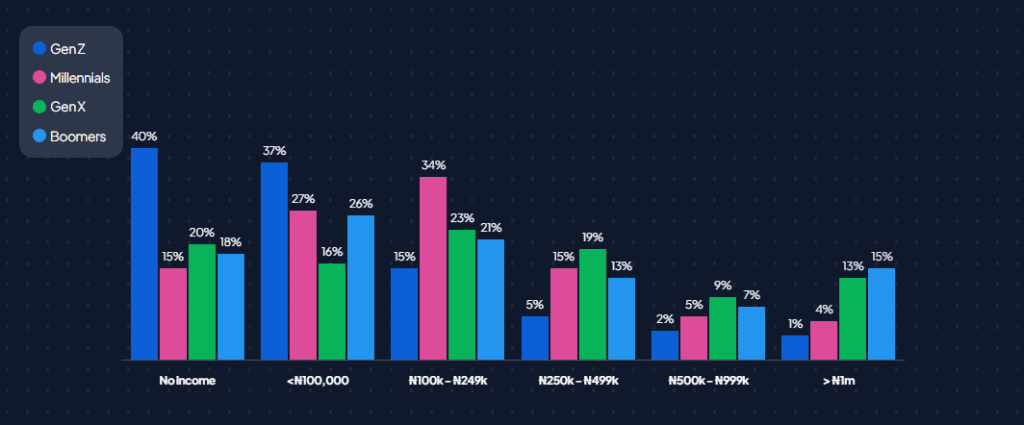
Gen Z Nigerians are the most likely to report having no monthly income or earning below NGN 100 K (~USD 70.00), reflecting their early position in the labour market and unstable employment conditions. Millennials show a more even income distribution, while Gen X and baby boomers are the most likely to appear in higher income brackets.

The generational divide extends to financial security. Older adults are significantly more likely to have emergency savings, with Gen X and boomers reporting the highest rates. Gen Z are the least financially protected, with only a small share holding any emergency funds. Overall, six in ten Nigerians have no funds set aside for unexpected expenses like medical bills or job loss.

Source: Piggyvest Savings Report 2025

Piggyvest, Nigeria’s foremost online savings and investment platform, says it arrived at the findings by deploying 90 data collectors across all six geopolitical zones in Nigeria to speak with 26,000+ Nigerians of different ages, genders, and income brackets about income, spending, debt, and savings. The company’s latest report is its biggest and most comprehensive study yet.

Nearly three in five Nigerians report having no monthly income or earning below NGN 100 K, the report finds, with the share of those earning nothing holding steady at 28 percent for the second consecutive year. While nominal incomes have risen in some brackets, purchasing power has not kept pace. Inflation remains elevated, and the number of poor Nigerians rose from 81 million in 2019 to 139 million by October 2025, according to World Bank data.

Savings habits have declined sharply. The share of Nigerians saving monthly fell from 64 percent in 2023 to 40 percent in 2025, while those who do not save more than doubled to 53 percent. Among those who do not save, 57 percent say they simply do not earn enough.

Family obligations compound the pressure. More than half of income earners provide financial support to extended family members, a burden carried most heavily by middle and oldest children.

Only 7 percent of Nigerians report feeling confident and ahead in their financial goals. More than one in three feel far behind or stuck. The gap between macroeconomic indicators and household reality remains wide. While headline inflation has slowed, prices remain significantly above pre-reform levels, and incomes have failed to keep up.