After years of circling the South African market from the sidelines, Walmart is finally ready to step into the spotlight under its own name. Later this year, South Africans will walk into the country’s very first Walmart-branded stores.
The company confirmed in a report that several store sites are under development in the country, with official opening dates expected to be announced in October. The outlets will sell a wide range of products, including fresh groceries, household essentials, apparel, and technology.
This move represents Walmart betting big on South Africa, and by extension, on Africa itself.
“This strategic move underscores Walmart’s commitment to making high-quality, affordable merchandise accessible to more customers,” the company said in a statement.
A Second Attempt, But a First Impression
Although this will be the first time the Walmart name appears on stores in South Africa, technically, Walmart has been in South Africa since 2011, when it bought a controlling stake in Massmart, the group behind Makro, Game, and Builders Warehouse for USD 2.4 B.
Walmart’s idea was to use Massmart as a springboard into Africa’s fast-growing consumer market. Bring its global supply chain muscle, its cost-cutting expertise, and its proven playbook to a region hungry for growth.
The execution, however, was anything but simple. South Africa’s economy slowed. Commodity markets slumped. The pandemic hit. And Walmart’s dream of fast expansion across Africa sputtered.
By 2022, Walmart was at a crossroads. But instead of pulling out, it has doubled down, buying the rest of Massmart for ZAR 6.4 B (USD 366 M) and taking complete control. The company was subsequently delisted from JSD in November 2022.
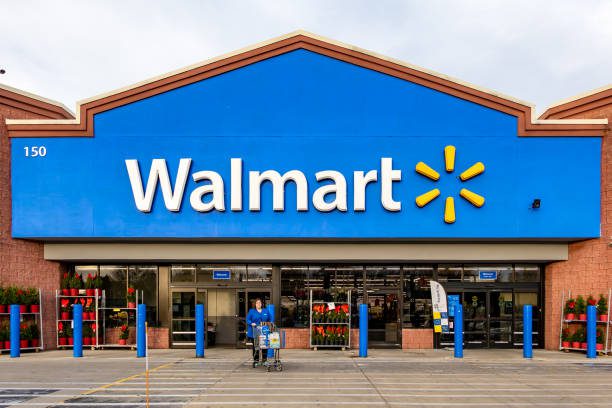
That decision set the stage for the moment now unfolding, the arrival of Walmart-branded stores in South Africa. For the first time, Walmart isn’t hiding behind subsidiaries. The name itself, big, blue, and unmistakable, will sit above the doors.
With the aim of firmly establishing the Walmart name as a brand within the region, the head start with Massmart is a definite advantage
That said, Walmart has a mountain to climb. It still has to go head-to-head with giants like Shoprite, Woolworths, and Pick n Pay, brands deeply embedded in South African retail culture.
Competitive Retail Battlefield
With names like this, the South African retail scene is no pushover. Shoprite, for example, claims around 32% of the country’s grocery market, with annual sales over ZAR 240.7 B (USD 13.7 B). Its wide-reaching network of brands, including USave and Checkers, has allowed it to capture a significant portion of the consumer market, giving it serious scale and consumer trust.
Meanwhile, there are other competitors like Woolworths that have a stronghold on the upper-middle-class shopper, and Pick n Pay, which occupies the middle ground with both traditional supermarkets and newer discount-focused formats.
And then there is the online fight. Although only 5-7% of total retail sales are currently online, according to a report by Boston Consulting Group, e-commerce is growing quickly in South Africa.
Digital heavyweight Takealot.com dominates the space with an estimated 15-20% hold of the e-commerce market, having spent years fine-tuning delivery systems and building brand loyalty. Checkers (via its Sixty60 and Hyper operations) sits at about 12-15%, with Woolworths at roughly 8-10% the report shows. Amazon, meanwhile, is quietly building up its local presence with plans to make a splash. Add online marketplaces like Temu and Shein to the lineup, and you have some more formidable names to go up against.
It’s a two-way, digital and physical fight that Walmart needs to win if it hopes to carve out a unique space in a crowded field.
A Playbook with Local Adjustments
However, South Africa’s booming e-commerce market presents a compelling case. Currently valued at USD 38.5 B in 2025, and projected to reach USD 61.5 B by 2030, at nearly a 10% CAGR, Walmart appears to have a series of strategies up its sleeve to seize a share of this market.
The backbone of Walmart’s strategy remains its “everyday low prices” model. The company is betting that if it can undercut competitors, South African shoppers, who are famously price-sensitive, will respond.
But executives know affordability alone won’t win the market. So to prevent the risk of looking like an American chain parachuted onto African soil, Walmart has emphasized that its stores will balance global reach with local roots. The conglomerate says it intends to work with African-based suppliers and entrepreneurs to stock its shelves and tailor offerings to the country’s diverse customer base.
“Walmart will also offer a variety of locally sourced products,” said Kath McLay, president and CEO of Walmart International. “By partnering with South African suppliers and entrepreneurs, we aim to bring our signature everyday low prices and global standards to the market while celebrating the country’s rich culture.”
Behind the scenes, the retailer has also been quietly building digital infrastructure at Massmart, expanding its technology team and introducing proprietary software to improve order processing and distribution. In a market where last-mile delivery is critical, this could be a linchpin.
Beyond retail operations, the company has been eager to frame its arrival as a contribution to the community, not just a retail rollout. Through the Walmart Foundation, it has pledged support for food security programs, disaster relief, entrepreneurship initiatives, and sustainability projects.
McLay has stressed that Walmart wants to build “lasting partnerships” with South African communities, a line that acknowledges how closely South Africans watch the social impact of big business.
Tough Road Ahead
Those pledges, reassuring as they are, don’t erase the challenges. Supply chains are complex, logistics are costly, and consumer trust is not won overnight.
Going up against these major challenges, including logistical hurdles and entrenched consumer loyalty to established domestic brands, means Walmart will need all the strength it can muster.
South African shoppers may love a bargain, but loyalty to local brands runs deep. Which begs the question: can Walmart translate its global playbook into a market this tough, or will it need to reinvent itself again to win over consumers?
For now, Walmart’s leadership remains upbeat despite these hurdles. “The challenges in Africa, I think we can overcome,” said Kieran Shanahan, Walmart’s U.S. chief operating officer.
The Stakes
Walmart’s decision to finally step forward under its own name is not just about signage. It is a test of whether the company can adapt its global model to one of the most competitive and complex retail landscapes in the world.
If successful, the move could provide a springboard for deeper expansion into Africa. If not, it risks becoming another reminder that global giants can struggle when local realities outweigh global muscle.
With the first stores expected to open before the year is out, South African consumers will soon have their say. They will decide whether Walmart feels like a welcome new competitor or an outsider trying to muscle in. And in that choice lies the answer to Walmart’s biggest question