By Ian Lessem, Managing Partner at HAVAÍC
African Venture Capital (VC) has entered a new era. The exuberance of the 2021 funding boom has given way to a more disciplined investment environment, where sustainable growth, operational excellence, and credible paths to liquidity matter more than headline valuations.
While some see this as a slowdown, we believe it marks the maturation of African VC. The question is no longer how quickly startups can raise capital, but how effectively they use it to build competitive businesses and create lasting value.
The African funding boom
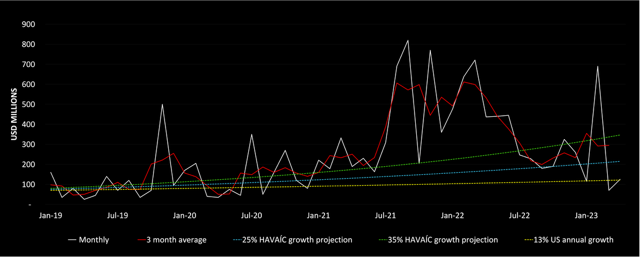
Let’s wind the clock back to 2021 for a moment. For nine months, starting in July of that year, African VC was pulling in an average of USD 600 M each month. Due to an over-supply of capital in global markets that found its way to frontier markets like Africa, our continent’s startups were now racking up enormous funding rounds and over-inflated valuations.
By August 2022, monthly VC funding had dropped to USD 240 M. By the end of 2022, with rising global inflation, higher interest rates, and tighter monetary policy, this had brought the funding boom to an abrupt end.
Viewed against our funding projections, the 2021–2022 boom stands out as a clear anomaly rather than a new baseline for African VC.
At the time, venture valuations in much of Africa had become disconnected from plausible growth and exit outcomes. And while the optimism was infectious, valuations were far exceeding the market’s capacity to generate returns.
In Kenya, for instance, startups attracted roughly USD 400 M in venture funding during 2021. Assuming investors acquired 10% to 20% equity stakes, those investments implied enterprise valuations of around USD 3 B in aggregate.
Even at the lower end of typical venture return expectations, investors would have needed exit opportunities worth approximately USD 15 B in total. Yet Kenya’s largest listed company was valued at just USD 8 B, while the next ten largest listed companies were worth less than USD 6 B combined. Who were the potential buyers? From a domestic buyer perspective, a profitable exit was unlikely.
The pattern
The world’s leading venture ecosystems have all experienced periods of exuberant capital inflows followed by valuation corrections that ultimately produced more disciplined investors and stronger, more competitive businesses.
The United States offers perhaps the best-known example of this cycle. The dot-com boom of the late 1990s drove venture investment to unprecedented levels as valuations became increasingly disconnected from business fundamentals. When the bubble burst, thousands of startups disappeared, and venture funding declined dramatically.
But the correction marked a turning point: investors became more disciplined, placing greater emphasis on sustainable and competitive business models, sound fundamentals, and long-term value creation. The result was a stronger venture ecosystem that went on to produce many of the world’s most successful technology companies.
China experienced a similar cycle. Between 2014 and 2020, abundant capital fuelled soaring valuations before regulatory crackdowns and a global funding slowdown triggered a sharp correction. As valuations reset, investors shifted from growth-at-all-costs to businesses with stronger fundamentals and clearer paths to profitability.
India followed a similar trajectory. Record funding during 2020 to 2021 gave way to a sharp correction from 2022 as capital became more expensive. Investors responded by prioritising sustainable growth, stronger unit economics, and capital efficiency.
Africa is now following the same trend. The correction may have been painful, but history suggests it is also a sign that the ecosystem is entering its next phase of maturity.
The correction
After the peak, funding fell sharply as valuations and growth assumptions were tested against the depth of local markets and the underlying economics of individual businesses. Investors were chasing growth at all costs, which typically meant buying topline revenue by lowering prices or overspending to acquire customers. The result is often fast growth but unsustainable unit economics in the long run.
The correction triggered a sharp change in investor sentiment. And the ecosystem slowly shifted from headline valuations to prioritising startups that are poised to deliver steady, sustainable growth and generate liquidity.
The market has stabilised with more measured valuations and appropriately sized funding rounds. As for exits, the trend is pointing in the right direction.
Two recent studies by the SA SME Fund, Endeavor South Africa, and SAVCA analysed almost 250 VC exits over the past 17 years, revealing an ecosystem that has evolved beyond isolated success stories to deliver meaningful investor returns and broader economic impact. They also show that the asset class is generating realised returns broadly consistent with more mature international VC markets.
In 2025, African VC exits reached a record 34, a 31% year-on-year increase. Compare this to 15 in 2021 at the peak of the funding boom (according to the Venture Capital in Africa Report 2025).
Within our own portfolio alone, recently we’ve been privileged to work on one of the largest tech deals in African history. In February 2025, RapidDeploy was acquired by US-listed Motorola Solutions for USD 250 M. This is a formidable global company backing an African-born startup, proving that with the right capital, our continent’s startups can scale and compete internationally.
If valuation discipline now defines African VC, what does that mean for founders and their management teams? Successful exits are built years before a sale through disciplined execution, operational maturity, and demonstrating a competitive, scalable, sustainable, and profitable business that appeals to sophisticated investors and acquirers.
HAVAÍC’s VC playbook
Building a business requires an experienced team, good timing, and smart capital. Beyond just access to money, smart capital builds the disciplines and capabilities that turn a promising product into a resilient company. When operating capability fails to keep up with growth, scale-ups tend to stall.
At HAVAÍC, we work alongside founders as active strategic shareholders to strengthen the operational foundations that are rarely a founder’s first priority. The test of smart capital is not how much advice is offered; it is whether the company executes the priorities that move enterprise value.
As companies mature, the focus shifts from proving the model to strengthening it, holding healthy unit economics as volume grows, building robust finance, tightening reporting and governance, and, eventually, mapping out likely exit paths and partners.
The following six fundamentals are mutually reinforcing, but they create value only when embedded in an organisation’s operating rhythm. The result is a company that is easier to finance, attracts higher valuations, and is more likely to exit successfully.
Our six fundamentals
One: Data structures
Implementing clean and connected systems that create a single source of truth across finance, operations, and sales. Reliable data enables management teams to make evidence-based decisions, improves forecasting, and gives investors confidence that the business understands its own performance.
These don’t need to be overly complicated or expensive systems. Used consistently, the right tools implemented by a team who understand the key drivers create that much-needed solid foundation all successful businesses are built on.
Two: KPI definition & strategic linkage
A small, consistent set of KPIs aligned to strategic objectives ensures every part of the organisation is working towards the same outcomes. Well-defined metrics help management identify problems early and keep growth aligned with true and sustainable value creation.
This helps advisors and board members to understand the business’ ‘North Star’ so they can help founders and management get there.
Three: Financial reporting
Financial reporting is not merely an accounting or compliance exercise. Timely, trusted management information should explain revenue quality, unit economics, cash conversion, runway, performance against plan, and the drivers of variance. Where relevant, this information should be analysed by product, customer, or market.
Done well, reporting becomes a tool for operating decisions and capital allocation, while building the discipline needed for future diligence.
Four: Strategic insights
Numbers become valuable when they change a decision. Forward-looking analysis should translate data into choices about pricing, product, hiring, market entry, partnerships, and capital allocation, while surfacing risks early enough to act.
This is where an engaged board and experienced shareholders can add perspective without displacing management ownership.
Five: People, capability & operating cadence
As businesses scale, leadership depth and organisational capability must scale with them. The right people, governance structures, incentives, and management routines create execution discipline across the organisation. Even strong people can constrain execution when roles, accountabilities, or capabilities no longer match the company’s stage.
Building the right internal capability creates leverage: good decisions and practices compound through the management team long after a board meeting ends.
Six: Seeing around the corner
Market shifts, whether driven by technology or regulation, create both risks and opportunities. Having investors, shareholders, and advisors who can anticipate these changes help businesses prepare for the future.
AI is a case in point. It has become an operational necessity. Practical adoption across finance, operations, and reporting can compress work that once took a week into a single day. In a capital-constrained market, that efficiency becomes a genuine competitive advantage.
The conclusion
Capital may start the journey, but it does not build an enduring company. Smart capital combines funding with judgement, operating discipline, and strategic access to help founders make better decisions, build stronger teams, and prepare for scale and eventual liquidity from day one.
In keeping with the maturing African VC market – and the new normal of building sustainable enterprise and shareholder value – HAVAÍC begins with a structured diagnostic. This informs a purpose-built plan across finance, reporting, governance, people, and the operational capabilities that matter most at each stage of a company’s growth. The result is businesses built to last.