The Ugandan Gig Work App That Took Off By Making Sign-Up Harder

By Henry Nzekwe  |  March 26, 2026

He used to walk door to door in Kampala as a university student, asking strangers if they had work he could do. Now Allan Tumuhimbise is building a platform for the millions of Ugandans who still start every week from zero.

His startup, ProGigFinder, launched in July 2025. has hit 4,000 users and more than 11,600 app downloads with zero paid marketing. The numbers may be small, but the problem it is trying to solve is not.

Uganda’s informal sector employs roughly 95 percent of the workforce, according to International Labour Organisation data. These are electricians, plumbers, cleaners, developers. They have skills. What they do not have is a digital presence. Global platforms like Upwork and Fiverr were not built for these kinds of work in mobile money economies on budget smartphones. So ProGigFinder is attempting to build something that fits the reality on the ground.

“Take a cleaner in Kampala,” Tumuhimbise tells WT. “Right now, their entire livelihood depends on word of mouth. Someone has to know someone who might recommend them. There is no profile, no track record, no scheduled bookings, no way to show what they have done or what they are worth.”

The platform integrates MTN and Airtel mobile money directly, so no bank account is required. It allows users to be both workers and hirers, a dual role that Tumuhimbise argues is natural in economies where people move fluidly between earning and spending.

“Someone can post a small gig to get their clothes washed or their compound cleared, and on the other side, someone who needs income today can respond, do the work, and have money on their mobile money account by the end of the day. No bank account needed. No laptop. Just a phone and a skill.”

But building a marketplace in a market like this is not straightforward. Two-sided platforms are famously hard to ignite, and some earlier efforts have faltered.

ProGigFinder has made deliberate choices that run counter to typical startup logic. It introduced a multi-tiered sign-up process that actually reduced daily registrations. “That’s a trade-off we’re willing to make to ensure quality,” Katungye said. Before service providers are approved, the team reaches out personally by phone or WhatsApp.

Payment is held in escrow and released only after the hirer leaves a review, creating accountability on both sides. The platform takes a 10 percent commission on completed gigs and bookings. “We only earn when our users earn,” Tumuhimbise says.

***

The deeper structural constraint ProGigFinder is trying to solve has less to do with technology and more to do with visibility. A cleaner in Kampala today has no work history, no way to show repeat clients, no system for scheduling. On the platform, that same person can build a track record, earn reviews, manage income. They move from being invisible to being discoverable.

“That is the gap we are closing,” Tumuhimbise said. “Not just connecting professionals to clients, but connecting the African economy to itself, across every level of work that actually happens here.”

The timing is crucial as Uganda is facing a severe employment crunch, with more than 40 percent of young people aged 15 to 24 neither in employment nor education, and roughly 150,000 graduates entering the workforce each year. The government has recognised the informal sector as a priority in its Third National Development Plan, but formal job creation has not kept pace.

Meanwhile, mobile money, the backbone of digital transactions in Uganda, now moves trillions of shillings annually across more than 43 million registered accounts. But there is also a tax burden on those same mobile money transactions that some analysts say is pushing users back toward cash.

A 0.5 percent excise duty on withdrawals, a 15 percent duty on telecom service fees, and a 10 percent withholding tax on agent commissions mean that sending and withdrawing UGX 1 M (~USD 269) can cost UGX 20 K (USD 5.38) shillings in fees and taxes. The physical transport cost to deliver the same cash between two Kampala suburbs is roughly UGX 6 K (USD 1.61).

So even when a platform builds the right product, the environment it operates in can pull in the opposite direction.

Tumuhimbise is not waiting for the environment to change, choosing to build with what exists. The platform now offers AI-powered CV support and interview preparation tools. It is focused on Uganda for now, building depth before expanding elsewhere. And it is deliberately ad-free, a choice he says reflects the belief that the workforce the platform serves deserves a clean, premium experience.

“Most platforms were built for people who already have structure around their work—a bank account, a professional profile, clients with clear budgets,” he says. “If you do not fit that picture, those platforms were not really built for you.”

ProGigFinder, he emphasises, is not trying to replace word of mouth as the aim is to give word of mouth a digital spine. The question is whether a platform built on trust and mobile money can scale in an economy where even sending money by phone has become a calculation of cost.

Tumuhimbise is betting, for now, that visibility matters more than speed. A cleaner who gets booked, reviewed, and paid through the platform is no longer starting from zero every week. That, he said, is the point.
Nigeria’s Youngest Adults Worst Hit By Financial Strain, Report Shows

By Henry Nzekwe  |  March 25, 2026

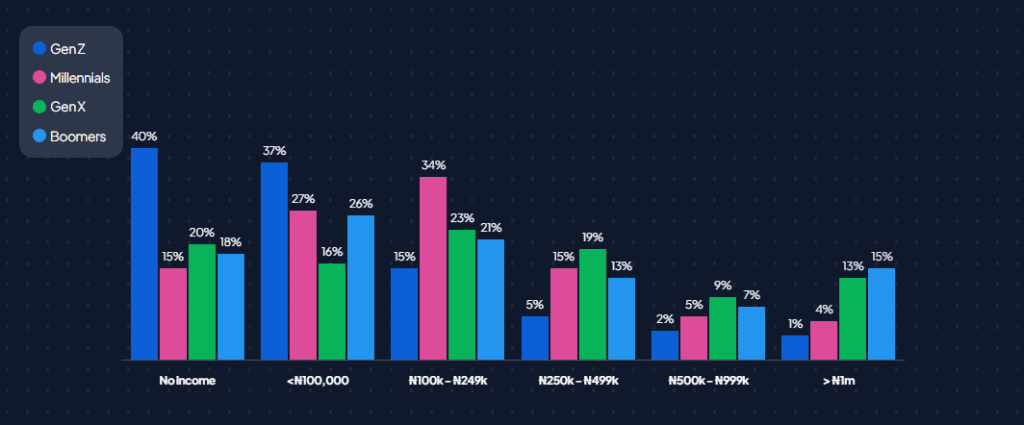
Nigeria’s youngest adults are bearing the heaviest burden of the country’s prolonged economic crisis, with most earning little or nothing and lacking any financial buffer against emergencies, according to the Piggyvest Savings Report 2025.

Gen Z Nigerians are the most likely to report having no monthly income or earning below NGN 100 K (~USD 70.00), reflecting their early position in the labour market and unstable employment conditions. Millennials show a more even income distribution, while Gen X and baby boomers are the most likely to appear in higher income brackets.

The generational divide extends to financial security. Older adults are significantly more likely to have emergency savings, with Gen X and boomers reporting the highest rates. Gen Z are the least financially protected, with only a small share holding any emergency funds. Overall, six in ten Nigerians have no funds set aside for unexpected expenses like medical bills or job loss.

Source: Piggyvest Savings Report 2025

Piggyvest, Nigeria’s foremost online savings and investment platform, says it arrived at the findings by deploying 90 data collectors across all six geopolitical zones in Nigeria to speak with 26,000+ Nigerians of different ages, genders, and income brackets about income, spending, debt, and savings. The company’s latest report is its biggest and most comprehensive study yet.

Nearly three in five Nigerians report having no monthly income or earning below NGN 100 K, the report finds, with the share of those earning nothing holding steady at 28 percent for the second consecutive year. While nominal incomes have risen in some brackets, purchasing power has not kept pace. Inflation remains elevated, and the number of poor Nigerians rose from 81 million in 2019 to 139 million by October 2025, according to World Bank data.

Savings habits have declined sharply. The share of Nigerians saving monthly fell from 64 percent in 2023 to 40 percent in 2025, while those who do not save more than doubled to 53 percent. Among those who do not save, 57 percent say they simply do not earn enough.

Family obligations compound the pressure. More than half of income earners provide financial support to extended family members, a burden carried most heavily by middle and oldest children.

Only 7 percent of Nigerians report feeling confident and ahead in their financial goals. More than one in three feel far behind or stuck. The gap between macroeconomic indicators and household reality remains wide. While headline inflation has slowed, prices remain significantly above pre-reform levels, and incomes have failed to keep up.

The Biggest Blindspot In African Fintech, According To The Woman Who Has To Fix It

By Henry Nzekwe  |  March 24, 2026

Neronie Arnagiri spends her days thinking about things most fintech founders tend to ignore until it is too late. Things like contradictory tax classifications across borders, unclear reporting obligations, and the quiet danger of building a billion-dollar company on ground that regulators might decide, tomorrow, does not belong to the occupant.

She is the Head of Tax at PawaPay, a mobile money aggregator that processed 2.5 billion transactions across 20 African markets last year with 100 percent uptime. That number alone makes her worth listening to. But the reason her voice matters right now is timing.

African fintech is entering what regulators are calling a year of maturity. The era of building first and asking for permission later is ending. In 2025, Nigeria raised capital requirements for payment service providers to NGN 5 B (~USD 3.6 M) and rejected nearly 40 percent of applicants.

Meanwhile, Ghana and Morocco began licensing crypto providers after years of watching citizens use them anyway. And last October, the Financial Action Task Force finally removed Nigeria and South Africa from its grey list, signalling that compliance is no longer optional.

Arnagiri has been watching this shift from inside one of the continent’s largest payment processors. When asked where fintechs most commonly cut corners on tax and compliance while scaling, she says the pressure to move quickly often outpaces the discipline needed to align legal structure, tax treatment, and local obligations.

“What usually gets underestimated is not the importance of compliance, but the complexity of keeping it consistent across markets,” she tells WT. The strongest operators, she adds, build tax and regulatory discipline into market entry and product design, rather than trying to retrofit it later.

That complexity becomes even sharper across borders. PawaPay operates in over 20 markets, and Arnagiri points to a central contradiction. “The same business activity can be viewed very differently from one jurisdiction to another,” she says.

A company may see one integrated payments model, but regulators and tax authorities in different markets may classify the risks, revenue flows, or reporting obligations differently. This creates tension between the need for group consistency and the reality of local legal interpretation. Managing that contradiction, she says, “is one of the core challenges of pan-African fintech.”

At PawaPay, she says the answer has been to build local entities that understand the intent of the law, not just the text. That kind of infrastructure is expensive and slow. But it is also becoming the difference between companies that survive enforcement waves and those that do not.

Nikolai Barnwell, PawaPay’s CEO, put it more bluntly in a recent interview. He said 2026 is the year African regulators will stop tolerating scale without operational control across critical digital infrastructure sectors, especially payments. As transaction volumes grow, digital payment rails will increasingly be treated as national infrastructure rather than high-growth tech products.

That shift is already visible in how investors behave. Arnagiri says governance weaknesses may not always show up publicly, but they surface during diligence, licensing discussions, and partnership reviews.

“Weak documentation, unclear responsibilities, inconsistent structures, or unresolved compliance issues can slow decisions, raise perceived risk, and lead to more conservative pricing or delayed expansion,” she says. “Investors increasingly want to see that growth is supported by substance, not just ambition.”

This is where her role intersects with a broader conversation about who gets to sit at the table. Arnagiri says the lack of women in technical governance roles is both a pipeline issue and a matter of structural barriers.

“In many fintechs, governance is still seen as a ‘gatekeeper’ role rather than a ‘growth’ role,” she says. “This perception can limit the influence of women in those seats.” Increasing representation, she argues, requires more than hiring. “It requires a leadership culture that recognises technical governance as integral to business performance.”

When asked which fintech models are most exposed to tightening enforcement over the next five years, she points to businesses built on complexity without enough clarity around accountability. Cross-border operations with complex settlement arrangements, she says, will face the greatest pressure.

“The most resilient businesses will be those that can clearly articulate their role in the value chain, the regulatory basis on which they operate, and the governance supporting their tax and compliance approach.”

In other words, the fintech winners of the next decade will not be the ones who moved fastest. They will be the ones who built their houses on ground the government already said was theirs to stand on. Arnagiri has been telling them this for years. Now the regulators are proving her right.

dLocal’s Ambitious USD 150 M Africa Deal Shrinks After FTX Lawsuit

By Henry Nzekwe  |  March 23, 2026

When Uruguayan payments firm dLocal finally closed its long-delayed acquisition of AZA Finance assets on February 27, the transaction bore little resemblance to the ambitious USD 150 M expansion plan it announced eight months earlier. The company acquired a single Cameroonian entity for about USD 23 M and paid almost no cash, converting debt into equity.

“[…]whilst the final scope of the deal was different to the original ambition, it is still an exciting moment for dLocal’s growth in the region,” the company said in a statement to WT. “The integration of AZA’s assets and capabilities will allow us to better serve our merchants across the region.”

That measured language masks a turbulent period triggered by the FTX bankruptcy estate. The original deal, announced in June 2025, was meant to give dLocal instant pan-African foreign-exchange and settlement capabilities through AZA Finance, a cross-border payments firm established in 2013 that had processed over 15 million transactions across the continent.

But just one month later, the FTX bankruptcy trust filed a USD 50 M lawsuit against AZA Finance, stemming from a USD 25 M investment made by Alameda Research, FTX’s trading arm, in 2022. AZA disputed the claim, which was eventually dismissed in December 2025, but the litigation froze the acquisition.

To keep the deal alive while shielding itself from legal exposure, dLocal extended two working capital credit facilities to AZA. A December 2024 tranche carried 7% interest; a second tranche in June 2025—the same month the acquisition was announced—came at 15%. By the end of 2025, the outstanding principal and interest totalled USD 24.1 M. dLocal structured the facilities with a call option but maintained no voting rights, ensuring AZA’s liabilities stayed off its books.

When the FTX suit was dismissed, dLocal exercised that call option. The final purchase was a Cameroon-based entity, Mint Code Solutions, for USD 23 M. The deal was settled almost entirely by forgiving the outstanding debt, with a nominal USD 1.00 paid in cash.

The compressed outcome raises questions about dLocal’s broader Africa push at a time when its only separately reported African market, Egypt, saw revenue drop 36% year-on-year in 2025, from USD 93.9 M to USD 59.7 M. dLocal’s overall revenue, however, crossed USD 1 B last year, and net income jumped 87% in the fourth quarter.

“dLocal’s ambitions in Africa remain focused on disciplined expansion, prioritising markets where we can build sustainable, long-term value,” the company said, pointing to its regulatory filings for further detail.

What began as a headline-grabbing pan-African takeover has become a narrow, cashless entry into Central Africa, illustrating how a crypto collapse can redraw corporate strategy years later.

South Africa’s Deepfake Fraud Rate Highest In Africa As Cheap AI Tools Fuel Scams

By Henry Nzekwe  |  March 19, 2026

South Africa is recording the highest share of deepfake-driven fraud in Africa, with 22% of cases involving AI-generated impersonation, according to the 2026 Digital Identity Fraud Report by identity verification company Smile ID.

The findings show that nearly nine in ten rejected verification attempts in the region are now linked to AI-assisted impersonation and spoofing during biometric checks.

Fraudsters are no longer focusing on fake documents. Instead, 47% of cases involve no-face-match impersonation, where the person verifying cannot be linked to the claimed identity, suggesting large-scale use of stolen personal information. Another 40% are spoofing attacks designed to defeat liveness detection and facial recognition systems.

The shift reflects how radically affordable AI tools have changed the game for criminals. What once required technical skill can now be done with free or cheap generative AI software that creates realistic fake videos, clones voices from social media clips, and generates synthetic faces that fool verification systems.

Smile ID detected more than 100,000 injection attacks per month in 2025, where fraudsters bypass device cameras entirely by feeding synthetic or pre-recorded media into verification systems through emulators and virtual cameras.

South African regulators and companies are already seeing the impact. The Financial Sector Conduct Authority has warned about deepfake videos impersonating high-profile figures, including President Cyril Ramaphosa and Patrice Motsepe, to promote fake investment opportunities. Momentum Group’s financial director, Risto Ketola, was impersonated in a scam involving an invite-only WhatsApp group in June last year, using a photo taken from LinkedIn.

The threat extends beyond individuals to businesses. Richard Ford, group CTO at Integrity360, says criminals now scrape audio from TikTok, Instagram, or Facebook to clone voices using inexpensive AI tools, then call employees pretending to be executives in distress. Finance administrators receive WhatsApp voice notes that sound exactly like their financial directors requesting urgent payments to new suppliers, exploiting what Ford calls a “subservient reflex” to obey senior figures.

“Fraud is no longer a ‘KYC’ problem — it is a continuous cybersecurity challenge,” Mark Straub, CEO of Smile ID, said. “AI enables fraudsters to operate at unprecedented scale and sophistication.”

Authentication-related fraud attempts are now five times more common than fraud at the point of account onboarding, Smile ID found from analysing anonymised data from more than 200 million identity verification checks it conducted in 2025, spanning 37 industries in over 35 countries.

Attackers are no longer focused on breaking in, the report suggests. They operate inside verified accounts, targeting login flows, password resets, device changes, and high-value transactions. Once inside, AI automation lets them reuse verified biometrics and move funds across platforms at scale.

Smile ID found more than 160,000 fraudulent verification attempts in a single month traced back to just 100 facial identities, with some faces appearing over 12,000 times across multiple platforms. Another case saw attackers use the same identity for more than a thousand account registration attempts within 30 minutes.

AI expert Johan Steyn says voice cloning, face swaps, and synthetic identity profiles have increased exponentially over the past year because the tools have become cheap, accessible, and convincing. He advises companies to treat identity as a continuous risk system rather than a one-off verification step, using device and behavioural signals to detect anomalies and requiring out-of-band confirmations for sensitive changes like beneficiary additions or high-value payments.

The 22% figure for South Africa is the highest in Africa, but the problem is continent-wide. In West Africa, 65% of fraud attempts involve biometric spoofing, BusinessDay reports. Across Africa, organisations face an average of 3,153 cyber attacks per week, 60% higher than the global average, according to Check Point Software Technologies.

“Effective defence now requires network intelligence: By leveraging these privacy-preserving indicators throughout the customer lifecycle, we enable real-time adaptation. Identity has entered the security era, where ecosystem-wide protection is essential to safeguarding the individual,” Straub said.

Feature Image Credits: Terovesalainen/Adobe Stock

Prediction Markets Quietly Invade Nigeria As Finance & Gambling Intersect

By Staff Reporter  |  March 17, 2026

Luno, the cryptocurrency platform that started out in South Africa over a decade ago, has launched a structured prediction markets product in Nigeria. The feature allows customers to bet on whether the price of major cryptocurrencies like Bitcoin and Ethereum will go up or down on any given day. Winners are paid in USDC, a stablecoin pegged to the United States dollar.

The move is the latest sign that prediction markets, a type of trading once confined to specialist forums and political betting sites that allows people to stake on just about anything (from major real-world events to random niche interests), are gaining ground in the continent’s economic heavyweight.

Luno’s product, powered by a firm called Limitless, focuses purely on price movements. Users do not buy the underlying asset. They simply predict if the price will be above or below a set level when the market settles at the end of the day.

Luno Nigeria CEO Ayotunde Alabi said the company is seeing a shift in how locals want to interact with crypto. Many users already follow charts and news closely, forming strong views on where prices are headed. The new feature gives them a structured way to put those views to work.

Luno is not alone in eyeing this space. Bayse Markets, a startup previously known as Gowagr, is also active in the local prediction markets arena, looking to reprise the rise of global players like Polymarket and Kalshi, amid ongoing debate about the regulation of a fledgling industry that critics have described as gambling in finance garb.

Nigeria remains one of the world’s most active crypto markets. A PwC report released in January noted that digital assets are now a major driver of adoption in the economy, with young, tech-savvy users pushing momentum deeper. Inflation and currency instability have made alternative financial tools attractive to everyday Nigerians, not just hardcore traders.

Luno is framing the product as educational. The company plans to offer “Learn and Earn” content explaining how markets work. It has also built in safeguards. Users must move funds into a separate wallet to participate. They cannot hold both sides of the same bet. And they have to acknowledge a risk disclosure before they start.

If a prediction is wrong, the customer loses all the capital they put in. That binary outcome is what makes these products different from holding assets long term. It is also what makes them appealing in an environment where quick returns are often prioritised over steady growth.

The broader shift reflects a maturing user base. For years, crypto adoption in Nigeria was largely about buying and holding or moving money across borders. Now platforms are rolling out more sophisticated tools. Busha has expanded into lending. Roqqu launched futures trading late last year. Luno itself has been pushing into staking and tokenised US stocks.

What remains unclear is how regulators will view this new wave of products. Nigeria’s Securities and Exchange Commission has been working to create clearer rules for digital assets. The Stakeholders in Blockchain Technology Association of Nigeria said in January that regulatory certainty and the adoption of stablecoins would be crucial for the sector in 2026.

Prediction markets, with their clear binary outcomes and daily settlements, may fit neatly into a regulated framework. Or they may attract closer scrutiny.

Luno’s launch gives thousands of Nigerian users a new way to engage with prices they already watch. And with the wave of interest in the space, activity and competition are likely to heat up.


Feature Image Credits: Cath Virginia / The Verge, Getty Images

Spotify’s Pay Gap Leaves Nigerian Artists With Billions In Streams, Peanuts In Pockets

By Staff Reporter  |  March 17, 2026

Nigerian musicians generated more than 30 billion streams on Spotify in 2025. Their earnings from those streams crossed NGN 60 B (approximately USD 44 M) for the first time. The numbers, released in Spotify’s annual Loud & Clear report, paint a picture of an industry on a rocket-powered trajectory.

But beneath the headline figures lies a math problem that troubles industry insiders.

One million streams on Spotify in Nigeria pays an artist approximately USD 300, one prominent industry figure revealed last year. The same million streams in Sweden pays up to USD 10 K, revealing a gap of more than 3,000 percent.

Spotify does not pay a flat rate per stream. The company operates a territorial model where subscription fees determine royalty pools. In Nigeria, a monthly premium subscription costs NGN 1.3 K, roughly USD 0.82. In Sweden, where Spotify is headquartered, the same subscription costs USD 13.8. In the U.S., it costs USD 12.99.

Revenue pools in each country are divided among artists streamed there. A listener in Lagos contributes to a smaller pool than a listener in Stockholm. When a Nigerian artist is streamed in Lagos, the payout reflects Nigerian subscription economics. When the same artist is streamed in Stockholm, the payout reflects Swedish economics.

Muyiwa Awoniyi, manager of Grammy-winning singer Tems, laid bare the arithmetic in an interview last year. “If my IP is anchored to a region where one million streams is USD 300.00, I am cooked,” he said.

Spotify’s 2025 Loud & Clear report shows Nigerian artist revenue grew more than 140 percent over two years. Independent artists and labels claimed 58 percent of all royalties generated by Nigerian musicians on the platform . Local consumption of Nigerian music jumped 170 percent year-on-year.

These are genuine gains. But they are gains within a system where the ceiling is lower than floors elsewhere.

Media expert Akíntúndé Babátúndé has previously framed the challenge bluntly: even an artist with 10 million fans in Nigeria could earn less than someone with 1 million fans in a high-income country. This is not about musical quality, he stressed. It is about the economic reality of audiences whose limited financial power restricts their ability to support artists through subscriptions, data purchases, or live events.

Some artists are finding a workaround. Nigerian migration patterns mean significant diaspora populations in Sweden, the Netherlands, the United States, and Britain. When Nigerians abroad stream homegrown music, those streams register in higher-paying territories.

This creates an odd dynamic. An artist’s success in wealthy markets often depends less on winning over local listeners than on Nigerians living there. The streams happen in Stockholm, but the audience remains Nigerian.

Spotify’s report noted that Nigerian artists were featured in nearly 320 million user playlists globally. The platform does not break down where those playlists originate. But the diaspora effect is visible in the data.

Spotify paid the music industry more than USD 11 B in 2025, with lifetime payouts reaching USD 70 B. More than 13,800 artists generated at least USD 100 K from the platform alone. Nigerian artists are increasingly part of that middle tier.

The question is whether they can climb higher without leaving home.

Babátúndé argues that artists have a stake in Nigeria’s broader economic health. “The growth of the creative industry depends on people being able to afford subscriptions, buy data, attend shows, and support their favourite artists without breaking the bank,” he said. His warning to musicians: if your fans stay broke, so do you.

Bad Blood Between Nigeria’s Creator Economy Rivals Spills Onto The Streets

By Staff Reporter  |  March 16, 2026

For three days in March, Lagos’ Landmark Event Centre was meant to be the epicentre of Africa’s creator economy. Mainstack, the sleek upstart positioning itself as the “operating system” for digital entrepreneurs, had poured resources into curating Moment 2026, an inaugural conference featuring panels, workshops, and a premium experience for over 4,000 attendees.

Instead, the conference delivered one of the messiest public feuds the Nigerian tech scene has seen this year.

Days before the event, attendees noticed something odd. Large, eye-catching billboards dotted the venue, carrying motivational taglines like “Create with intention” and “Create what sells,” each prominently featuring the logo of Selar, Mainstack’s biggest rival.

Selar CEO Douglas Kendyson later explained they’d disclosed the competitive nature to venue operators, who approved the placements after vetting. It was supposed to score points as classic guerrilla marketing, inserting Selar’s brand into a competitor’s spotlight without saying a word.

But Mainstack saw red and lodged complaints. Then the billboards came down. What could have ended as a cheeky anecdote instead exploded on X when former Selar Chief Marketing Officer Milton Tutu was unveiled as Mainstack’s new CMO right there at the event.

Tutu had spent four years at Selar, helping scale it from modest numbers to a continental force. When he announced his exit in October 2025 via a heartfelt Medium post titled “Leaving Selar, Not the Mission,” the departure appeared amicable. Then came Kendyson’s thread.

“He was fired,” Kendyson claimed on X, adding that concerns over Tutu’s team management and leadership style were a factor, in what was a bombshell response to a wave of near-identical posts he labelled a “cheap coordinated PR attack.” Screenshots showed multiple users tweeting variations of switching over to Mainstack with Tutu.

Kendyson added he’d given his blessings about Tutu’s new position when Mainstack called in December 2025, making the “scripted” campaign feel like a betrayal.

But Tutu, in a Medium response posted Monday, pushed back. “I’ve also heard claims that I was fired from Selar. While multiple factors influenced my exit, the final and only official documentation that marked my exit from the company is my resignation letter, which was acknowledged by the leadership team,” he wrote.

Selar, founded in 2016 by a former Paystack and Flutterwave engineer, has positioned itself as the reliable infrastructure of African creator monetisation. With over 2 million users and more than USD 26 M in payouts to creators, it remains the market incumbent. In 2025 alone, Selar says it paid out over NGN 18 B (USD 12.86 M) to nearly 400,000 creators.

Mainstack, founded in 2022 by Ayobami Oyaleke and Olamide Akinola, takes a different approach. It markets itself as an all-in-one aesthetic-heavy platform combining link-in-bio tools, booking calendars, and global payments; a lifestyle product for the modern digital entrepreneur.

Both are chasing a prize that’s only getting bigger. Africa’s creator economy is projected to grow from roughly USD 5 B in 2025 to nearly USD 30 B by 2032.

Reactions on X captured the divide. One user, Queens, cut through: “This is competition. Like Burger King v McDonald’s, Coke v Pepsi style. It’s done all over the world. It’s not some ‘friendly Kumbaya, let’s all get along’ vibe”.

Others were less charitable. Meanwhile, some industry observers urged de-escalation, noting Tutu had never spoken ill of Selar publicly.

For attendees, the drama likely overshadowed some sessions. But it also firmed up the reality that African creator economy is maturing, and with maturity comes competition. Talent poaching, event hijacking, and social media mudslinging become weapons when differentiation is tough. Whether it fuels better products or just more tweets remains to be seen.

African E-commerce Payment Gateways with a Fast Setup Process

By Partner Content  |  March 16, 2026

Launching an e-commerce business involves many moving parts. You need to think about product sourcing, website design, logistics, and marketing. Yet one of the most important steps is often overlooked until the last minute: setting up your payment gateway.

Your ability to accept online payments quickly can determine how fast your online store begins generating revenue. If payment gateway integration takes weeks or requires complicated technical work, you risk delaying your launch and losing early customers.

This is why many merchants prioritise e-commerce payment gateways with a fast setup process. 

This article will guide you in choosing the right payment gateway so you can start accepting digital payments without unnecessary delays.

What an E-commerce Payment Gateway Does

An e-commerce payment gateway is the technology that enables your customers to complete an online payment on your website or digital store.

When a customer places an order, the gateway securely sends the payment information to the appropriate financial networks. The payment processor then verifies the transaction, confirms the payment details, and determines whether the online transaction is approved.

In simple terms, the payment gateway acts as the bridge between your customer’s payment method and your e-commerce business’s payment system.

Features That Enable Fast Payment Gateway Setup

If you are searching for the best payment gateway for ecommerce with fast setup, here are the key features to consider:

Simple Merchant Onboarding

A good payment gateway should make it easy for you to create your merchant account and activate your payment system without unnecessary delays.

Look for providers that offer well-documented onboarding processes, clear setup guides, and a simple checklist of requirements. 

It is also important to choose a payment service provider with transparent pricing. Some gateways charge monthly fees, while others charge per transaction.

Easy Website Integration

Another important factor is payment gateway integration. With the right gateway, you can connect your payment system to your website without extensive development work.

Modern gateways provide plugins and APIs that make payment integration simple for popular platforms such as Shopify Payments, WooCommerce, or custom websites.

 This improves the overall user experience and ensures customers can complete their online transactions smoothly.

Hosted Checkout Pages and Payment Links

Some payment gateways offer a hosted checkout page, where customers can securely enter their payment details to complete a transaction.

You can also generate payment links and send them through email, messaging apps, or social media. 

This allows you to start accepting payments even before your online store or full payment integration is complete.

Payment Methods Your Gateway Should Support

Fast setup should not come at the cost of limited payment options. The right payment gateway should support multiple payment methods so your customers can pay however they prefer.

Research shows that more than 70% of online shoppers abandon their purchases when their preferred payment method is unavailable, underscoring the importance of flexible payment systems for e-commerce.

Across Southern Africa, the most common payment methods include:

Mobile payments and mobile money

Mobile money remains one of the most widely used digital payment systems in Sub-Saharan Africa. The region processes over $1 trillion in mobile payments annually, making it the global leader in mobile money adoption.

Card payments

Many consumers still rely on debit and credit cards for online purchases, particularly for cross-border purchases and global commerce. Visa and Mastercard are the most popular networks for secure card payments across Southern Africa.

Bank transfers

In South Africa, bank transfers are widely used for online purchases. Instant EFT accounts for about 25–30% of e-commerce transactions, allowing customers to complete payments directly from their bank accounts.

Because customers do not need to enter card details, many people see this option as safer and more trustworthy. It also helps reduce the perceived risk of online fraud.

The Best Payment Gateway for Southern African Businesses

If you operate an online commerce platform across Southern Africa, choosing a payment gateway that understands regional payment processing infrastructure is particularly important.

Platforms such as Zoyk demonstrate how a payment gateway can combine fast setup with reliable infrastructure designed for the SADC region.

Zoyk allows you to accept mobile payments, card payments, and bank transfers while managing every transaction through a centralised dashboard.

Its payment gateway supports simple API integrations, hosted checkout pages, and shareable payment links, allowing businesses to begin collecting online payments quickly. 

The platform also operates on secure, PCI DSS–aligned infrastructure with encryption and fraud monitoring to help protect sensitive payment data.

As Zoyk’s Co-Founder and Chief Executive Officer, Clive Nabale explains, consolidating payment processing, reporting, and settlement into a single payment solution, platforms like Zoyk help businesses simplify commerce operations while maintaining visibility into their transactions.

Conclusion

In modern commerce, speed matters. When your payment gateway setup is quick and reliable, you can launch your store faster and start accepting payments without unnecessary delays.

A strong payment gateway should provide fast onboarding, accommodate your customers’ preferred payment methods, offer secure payment processing, and deliver a seamless user experience.

Zoyk is a great example of a modern payment gateway that can support a faster launch while providing your e-commerce business with tools to manage payments, monitor transactions, and scale your operations.

Oil At $120 Should Be A Win For Nigeria — Verto CEO Says It’s Not So Simple

By Henry Nzekwe  |  March 12, 2026

There’s a troubling irony hitting Africa’s largest oil producer right now; the same Gulf crisis that has pushed global crude prices above USD 100.00, a windfall that should fill Nigeria’s coffers, is instead emptying the pockets of its citizens.

While economists calculate potential gains, workers in Lagos, Abuja and Kano are doing simpler math. Petrol now sells for between NGN 1.2 K and NGN 1.45 K per litre in many areas, up from around NGN 774.00 just weeks ago. Transport fares have quadrupled for commuters travelling from satellite towns into the capital. Some workers tell reporters they’re spending over 80% of their salaries just getting to their jobs.

“The current crisis is unprecedented in recent history,” Olowoyo Gbenga, secretary of the Nigeria Civil Service Union, said this week. “Commuting costs have quadrupled. For workers from satellite towns, it is almost impossible to reach work without spending the bulk of their salary on transport alone.”

How Oil Wealth Became a Burden

So why don’t higher oil prices mean cheaper things for Nigerians? Ola Oyetayo, CEO of Verto, a B2B fintech platform specialising in cross-border payments, FX, and multi-currency accounts, explains the contradiction in straightforward terms.

“Over the last 12 months or so, there has been a clear decoupling between global crude prices and Nigeria’s FX market,” Oyetayo tells WT.

Think of it this way: Nigeria still exports crude oil, sure. But the country also imports most of its refined petrol despite producing the raw stuff.

So when global tensions spike and oil prices jump, refined fuel costs rise immediately. Dangote Refinery has adjusted its prices multiple times within weeks, with retail petrol potentially heading toward NGN 2 K per litre if the crisis persists, according to industry warnings.

“The immediate short-term impact on higher oil prices will be an uptick in inflation due to high pump prices feeding into the food and agriculture sectors because of higher transportation costs,” Oyetayo explains.

To illustrate, farmers need diesel to move tomatoes and peppers to cities. When diesel hits NGN 1.62 K per litre, everything gets more expensive before it reaches one’s plate. The federal government acknowledged this week that the crisis is already driving up prices of fuel, diesel, cooking gas and fertiliser.

Oyetayo notes this creates a delicate balancing act. “This will be delicate to navigate, given that the current inflation trajectory is not something that the CBN and government would want to be derailed.”

The Hot Money Tightrope

Meanwhile, the naira has taken its own hit. The official rate slid from around NGN 1.36 K to NGN 1.425 K as foreign investors got jittery and pulled money out.

But Oyetayo pushes back on the idea that this signals something broken in Nigeria’s system.

“Nigeria is one of the most compelling frontier investment opportunities for emerging market-focused hedge funds at the moment, due to the ongoing strong economic recovery and strong current account surplus,” he says.

He points out that Nigeria is still attracting serious interest. Foreign inflows surged 151% to $1.6 billion in January, with most parked in fixed-income securities.

That flood of hot money had strengthened the naira and boosted external reserves to USD 50.45 B, their highest in 13 years. The Central Bank of Nigeria even had room to step back, contributing just USD 34 M to FX supply in January, down from USD 654 M in December.

But the Gulf crisis exposed the flip side. As Oyetayo puts it, Nigeria remains “exposed to hot-money flows, though, the recent outflows, he argues, were about global panic, not Nigeria specifically.

“Yes, this means Nigeria is exposed to hot-money flows, but it was one of several frontier corridors that saw outflows in the rush for hedges and safe-haven investments,” Oyetayo explains. “This is not symptomatic of any fragility in Nigeria’s FX framework.”

The Central Bank injected USD 200 M to calm things down, according to reports. And Oyetayo notes the CBN actually has room to do this now. “The CBN’s foreign reserves are as strong as ever thanks to prudent dollar purchases when NAFEM dropped well below NGN 1.4 K earlier in 2026, so there are no immediate fears of funds dwindling should the CBN look to inject more supply.”

What to Watch in the Coming Weeks

Oyetayo also flags something that may have been drowned out by the unfolding global upheavals: the March 31 bank recapitalisation deadline.

“With the global noise, attention has certainly turned away from the upcoming bank recapitalisation deadline at the end of March,” he says. “This is going to be a critical date in the diary as we may see a rush for local currency reserves from domestic banks.”

He explains the dynamic, stating that the recent rush for dollars may have actually helped local banks hold onto hard currency. But if sentiment reverses and foreign investors start buying naira assets again while banks are scrambling to meet capital requirements, “we may see some banks struggling to meet these cap requirements.”

Oyetayo doesn’t predict disaster. “This is unlikely to instill any shock in banking infrastructure, but it may incite some volatility in the coming weeks.”

For ordinary Nigerians, however, it’s a tough situation. Fuel drives transport, transport drives food prices, and both now point upward.

Oyetayo argues that a resolution in the Gulf would quickly restore foreign investor appetite and put the naira back on its appreciation track. But he’s realistic about what happens in the meantime.

“The relief on inflation concerns, combined with renewed appetite from foreign investors, will help re-establish the naira’s recent appreciation trend,” he says. But that’s a big “if” while the Gulf remains tense.

The paradox of Nigeria’s oil wealth remains evident in that when oil prices rise, the country’s accounts may look healthier on paper, but its citizens feel poorer in their wallets. And in this crisis, the distance between those two realities keeps growing.