USD 50 M Injection Keeps Jumia Alive But Unclear Whether It Can Breathe On Its Own

By Henry Nzekwe  |  August 14, 2026

Two years ago, Jumia was in trouble. The stock was cratering, and investors were fleeing as the narrative that African e-commerce was destined to follow the Chinese or Indian playbook had started to look like wishful thinking. The company had burned through billions chasing growth, and the market had run out of patience.

Then something shifted. The company stopped chasing gross merchandise volume at any cost and started protecting margins. As it became more disciplined about take rates and cost structure, the numbers started to improve.

This week, Jumia made headlines with somewhat surprising news that it has secured USD 50 M in fresh equity from the World Bank’s International Finance Corporation and its largest shareholder, Axian Group. The company also reported Q2 revenue of USD 52 M, up 14% year-over-year, with gross profit climbing 28% to USD 30.7 M. Its adjusted EBITDA loss narrowed 36% to USD 8.7 M.

The fresh capital injection comes on the back of Jumia finally calling time on chasing unprofitable gross merchandise volume growth and demonstrating it can grow while making each transaction more economically attractive. CEO Francis Dufay said the company deliberately chose to protect its margins and unit economics rather than chase GMV at the expense of profitability. The IFC’s USD 25 M cheque provides external validation of the turnaround thesis.

But there is a more uncomfortable interpretation that while the turnaround may be improving, Jumia still needs outside capital to survive long enough to prove it.

Jumia burned USD 11.8 M in operating cash during Q2. Its liquidity fell by USD 14.3 M during the quarter, dropping to USD 48.3 M at the end of June, down from USD 62.6 M at the end of March. That means the company is still consuming cash while trying to reach its profitability target.

The bear case is that the USD 50 M raise signals that Jumia is relying on outside capital to get to the point where the business model can sustain itself. Investors are buying about 9.1 million new American Depositary Shares at USD 5.52 each, a 7.7% discount to the last close. Existing shareholders are paying for the turnaround through dilution as well as waiting for profitability.

The reality probably sits between the two narratives. This is a positive financing event attached to a still-unproven turnaround. Previously, Jumia had the classic African e-commerce problem: push GMV, subsidise customers, maintain logistics infrastructure, burn cash, raise more money, repeat. The numbers now suggest management is becoming more disciplined about take rates, gross profit, cost structure and cash burn.

But USD 50 M sounds large until measured against the burn. At roughly USD 12 M of operating cash burn per quarter, USD 50 M does not provide an enormous amount of runway, and that is before considering working-capital movements, capex and other cash requirements.

Jumia’s stated trajectory targets Q4 2026 adjusted EBITDA breakeven and full-year profitability in 2027. The Q2 numbers suggest Jumia the company has a chance, but the real question is whether Jumia can reach positive free cash flow before this new capital gets materially depleted.

If the answer is yes, this USD 50 M could eventually look like the capital that bridged Jumia from structurally loss-making e-commerce company to a sustainable African marketplace. If the answer is no, today’s raise will look more like another capital injection into a business that has repeatedly struggled to make e-commerce economics work at scale.

South Africa’s Wearable Darling Faces Toughest Test Yet With Its Futuristic Payment Ring

By Staff Reporter  |  August 14, 2026

Two years ago, the idea that South Africans would pay for just about anything with a flick of their finger seemed like something out of a fantasy novel. A ring that never needs charging, works with any tap-to-pay terminal, and lets one leave their wallet and phone at home was the kind of pitch that would have been politely dismissed at a fintech meetup.

That ring is now on thousands of fingers across the country, and VezoPay, the startup behind it, has gone on a charm offensive to get the banks to play ball, and while it’s had some luck with some, several hold out. The startup now faces a tricky test to change that.

VezoPay has gone live with Investec and Absa, taking its roster of banking partners to four in under a year. A fifth major retail bank is expected to follow before the end of 2026. FNB and RMB Private Bank came on board in October last year. The company, founded by Jake Pinkus and Lawrence Baker, launched its first rings in July 2024.

VezoPay claims a waiting list of about 35,000 people whose banks are not yet supported. A large chunk of them are customers of an unnamed major retail bank due to launch later this year. It is a clear sign of demand, but also a constraint the company cannot control.

The founders say the bottleneck is not manufacturing or technology but bank onboarding. Each institution runs its own internal governance and approval process, followed by a separate South African Reserve Bank sign-off. FNB’s approval took roughly nine months; Investec’s took about four. And the process has gotten harder, not easier.

Banks are now asking for penetration and stress testing and, in some cases, live international transactions to demonstrate that funds can be traced end to end.

Investec’s rollout offered the clearest sign of demand. The bank ran a discount campaign for private clients, and VezoPay recorded hundreds of sales in the first few days, skewed unusually towards the premium gold models. That suggests the early adopters are not just tech enthusiasts but people who see the ring as a status symbol.

The product line-up now includes three families: the X, a ceramic ring; the Classic, in stainless steel; and the gold Signature, which has been reworked from 21-carat to 18-carat after buyers complained it caught between their fingers. Prices range from ZAR 2,999 for the ceramic X-Ring Slim to ZAR 9,250 for the gold Signature.

Beyond South Africa

VezoPay’s shareholder register tells its own story. Naspers South Africa CEO Phuti Mahanyele-Dabengwa invested early through the Three Birds group. PayFast founder Jonathan Smit came in as investor and adviser in early 2025. The most recent round brought in two former managing directors of listed cybersecurity firm Mimecast. The Three Birds investment is now carried at a multiple of roughly 10 times its original value.

Beyond South Africa, two banks in Mauritius are testing the product, with beta programmes under way in three other African markets. VezoPay says its relationships with Visa and Mastercard have opened doors to issuers elsewhere on the continent.

The fundamental question is whether VezoPay can convert its 35,000-person waiting list into actual revenue before the next wave of wearable payment competitors arrives. Apple has already launched Tap to Pay on iPhone in South Africa. Samsung Pay, Garmin Pay and Fitbit Pay already support Investec cards. The window for a standalone payment ring to establish itself as the default wearable payment method may not stay open indefinitely.

AI Turns African Cybercrime Into USD 484 M Industrial-Scale Machine

By Staff Reporter  |  August 14, 2026

Artificial intelligence is now implicated in 55% of reported cybercrimes across Africa, according to a recent INTERPOL report. Cyber-related financial losses have more than doubled since 2024, jumping from USD 192 M to USD 484 M. The number of confirmed victims rose from 35,000 to 87,000 over the same period.

The 40-page African Cyberthreat Assessment Report 2026, based on survey data from 36 African countries, suggests cybercrime has evolved from isolated incidents into an industrialised, borderless ecosystem. AI is automating every stage of an attack, from reconnaissance and phishing to extortion and evasion.

In 2025, South Africa accounted for 92% of all ransomware detections recorded by TrendAI, one of INTERPOL’s partners. The country also registered 213,523 distributed denial-of-service attacks and accounted for 70% of business email compromise detections. Nigeria recorded 5,822 ransomware detections, reflecting its dual role as both an origin and target of cybercrime. Cabo Verde recorded nearly 17,000 ransomware detections, the second highest in Africa.

Perhaps most concerning is the rise of synthetic identity fraud. Criminals are now combining genuine personal information with fabricated data to create entirely new identities capable of bypassing biometric verification systems. These AI-generated personas have been used to open bank accounts, secure mobile loans and register SIM cards under false names. The report identifies the absence of real-time data sharing between banks, telecoms and law enforcement as a dangerous blind spot that criminals are actively exploiting.

Digital sextortion and online harassment, often facilitated by AI-generated deepfakes, remained pervasive, with approximately 600,000 sextortion detections recorded. Business email compromise schemes have grown dramatically more sophisticated, with AI used to generate highly convincing email correspondence that mimics executive tone and internal jargon with near-perfect fidelity. Africa-based threat actors are now targeting victims in Europe and North America using infrastructure spread across multiple jurisdictions.

Neal Jetton, Director of INTERPOL’s Cybercrime unit, said: “Cybercrime has emerged as one of the most significant criminal threats to the region. AI is automating every stage of a cyberattack from reconnaissance and phishing to extortion and evasion”.

The response, however, remains fragmented. Cybercrime legislation across the continent is inconsistent, and AI readiness in law enforcement agencies is alarmingly low. In 2025, 17 countries enacted or amended cybercrime legislation, but the gap between digital adoption and cyber resilience continues to widen. With more than 1.1 billion mobile subscribers recorded in 2025, Africa’s digital transformation is expanding rapidly, but security frameworks are not keeping pace.

Four high-impact operations coordinated by INTERPOL – Serengeti 2.0, Contender 3.0, Sentinel and Red Card 2.0 – collectively led to more than 1,500 arrests and the recovery of over USD 100 M. But these successes highlight the scale of the problem rather than its solution. The industrialisation of cybercrime, powered by AI, is outpacing the capacity of African law enforcement to respond.

The report calls for standardised digital forensic capabilities, enhanced cross-border cooperation, investment in AI literacy among law enforcement officers and formal public-private partnerships. But the fundamental asymmetry remains as criminals deploy AI at machine speed while the institutions meant to stop them are still figuring out how to use it.

Morocco’s EV Charger Shortage Meets A Fledgling Startup’s Unlikely Early Gamble

By Staff Reporter  |  August 12, 2026

Morocco’s electric vehicle market is heating up. Fully electric car registrations nearly doubled in the first seven months of 2026, jumping 99% to 1,213 units. Electrified vehicles now account for 17% of new passenger car sales, up from 10.5% a year earlier.

The government wants 2,500 public charging points by year-end. But this is hamstrung by the reality that about 600 public stations currently exist, with fast chargers—the kind that make long-distance travel viable—still scarce.

Enter watt.ma, Morocco’s first comprehensive EV charging network platform built by a startup, WATTSC, that launched its Charge Point Management System (CPMS) this week. But the catch is that the company isn’t building chargers, but rather, the software for those who do.

The platform lets charging operators, site owners and fleet managers monitor stations, set tariffs, process payments and track revenue through a single interface. Built on the open OCPP 1.6J standard, it works with hardware from different manufacturers, meaning a hotel or shopping centre isn’t locked into one supplier. It also integrates local payment systems, a feature that sounds mundane but matters in a market where international payment rails don’t always fit.

“The challenge of electric mobility is not just about installing charging stations,” said Prince Marfo, a watt.ma spokesperson. “Our focus now is expanding adoption and helping charging operators, businesses and fleet owners build sustainable charging networks,” he told investors.

The startup has backing that lends credibility. It was selected for GreenUp Morocco, an incubation initiative backed by the Ministry of Energy Transition and Mohammed VI Polytechnic University. It also participated in the African Youth Climate Hub, the only Moroccan startup in its cohort.

The operator gap

The logic is that as more EVs hit Moroccan roads, more charging stations will be needed. And as more stations get installed, someone has to manage them. Watt.ma is betting that the operator layer—the software that turns a physical charger into a revenue-generating asset—is where value will be captured.

But there’s a tension here that’s worth watching. Morocco’s charging infrastructure remains embryonic. Fast-charging stations cost between MAD 250 K (~USD 27 K) and MAD 400 K (USD 43 K) to install, by some estimates, compared to about MAD 25 K (~USD 2.7 K) for a slow charger. Private sector players like Afriquia and TotalEnergies are moving in, but deployment remains fragmented. BYD’s vice-president recently warned that with only 600 public charging stations, Morocco is slowing down its own electric ambitions.

The platform doesn’t solve the hardware gap. It doesn’t install chargers where none exist. It doesn’t address the fact that vast territories lack reliable charging solutions. What it does is prepare the ground for when, and if, the network scales.

A bet on scale that hasn’t arrived yet

The platform-first model—SaaS fees and revenue-sharing with partners—only works if there’s enough charging activity to generate revenue. With just over 1,200 fully electric cars on the road in the first half of 2026, that’s a small pool. The broader electrified category (including hybrids) is larger at nearly 23,000 units, but hybrids don’t need charging networks the way pure EVs do.

Morocco has set ambitious targets: 60% of automotive exports to be electric by 2030, and a battery gigafactory is in the works, both of which show the industrial vision is clear. But infrastructure lags behind policy, and software platforms like watt.ma are essentially building the operating system for a network that doesn’t fully exist yet.

watt.ma is a solution that is, for now, looking for a problem that’s still emerging. That Morocco needs charging management software is a given. Whether the charging network will grow fast enough to make that software commercially viable before the startup runs out of runway is the conundrum.

The New African VC Playbook: Smart Capital Backing Businesses Built To Last

By Guest Post  |  August 11, 2026

By Ian Lessem, Managing Partner at HAVAÍC

African Venture Capital (VC) has entered a new era. The exuberance of the 2021 funding boom has given way to a more disciplined investment environment, where sustainable growth, operational excellence, and credible paths to liquidity matter more than headline valuations. 

While some see this as a slowdown, we believe it marks the maturation of African VC. The question is no longer how quickly startups can raise capital, but how effectively they use it to build competitive businesses and create lasting value. 

The African funding boom

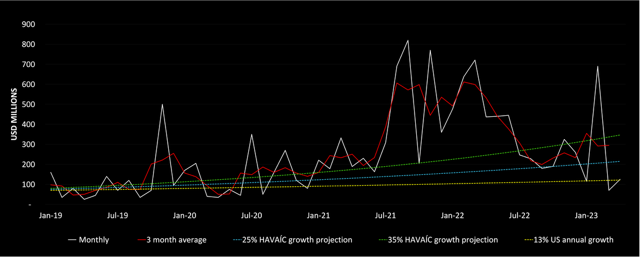
Let’s wind the clock back to 2021 for a moment. For nine months, starting in July of that year, African VC was pulling in an average of USD 600 M each month. Due to an over-supply of capital in global markets that found its way to frontier markets like Africa, our continent’s startups were now racking up enormous funding rounds and over-inflated valuations. 

By August 2022, monthly VC funding had dropped to USD 240 M. By the end of 2022, with rising global inflation, higher interest rates, and tighter monetary policy, this had brought the funding boom to an abrupt end.

Viewed against our funding projections, the 2021–2022 boom stands out as a clear anomaly rather than a new baseline for African VC.

At the time, venture valuations in much of Africa had become disconnected from plausible growth and exit outcomes. And while the optimism was infectious, valuations were far exceeding the market’s capacity to generate returns. 

In Kenya, for instance, startups attracted roughly USD 400 M in venture funding during 2021. Assuming investors acquired 10% to 20% equity stakes, those investments implied enterprise valuations of around USD 3 B in aggregate.

Even at the lower end of typical venture return expectations, investors would have needed exit opportunities worth approximately USD 15 B in total. Yet Kenya’s largest listed company was valued at just USD 8 B, while the next ten largest listed companies were worth less than USD 6 B combined. Who were the potential buyers? From a domestic buyer perspective, a profitable exit was unlikely.

The pattern

The world’s leading venture ecosystems have all experienced periods of exuberant capital inflows followed by valuation corrections that ultimately produced more disciplined investors and stronger, more competitive businesses.

The United States offers perhaps the best-known example of this cycle. The dot-com boom of the late 1990s drove venture investment to unprecedented levels as valuations became increasingly disconnected from business fundamentals. When the bubble burst, thousands of startups disappeared, and venture funding declined dramatically.

But the correction marked a turning point: investors became more disciplined, placing greater emphasis on sustainable and competitive business models, sound fundamentals, and long-term value creation. The result was a stronger venture ecosystem that went on to produce many of the world’s most successful technology companies.

China experienced a similar cycle. Between 2014 and 2020, abundant capital fuelled soaring valuations before regulatory crackdowns and a global funding slowdown triggered a sharp correction. As valuations reset, investors shifted from growth-at-all-costs to businesses with stronger fundamentals and clearer paths to profitability.

India followed a similar trajectory. Record funding during 2020 to 2021 gave way to a sharp correction from 2022 as capital became more expensive. Investors responded by prioritising sustainable growth, stronger unit economics, and capital efficiency.

Africa is now following the same trend. The correction may have been painful, but history suggests it is also a sign that the ecosystem is entering its next phase of maturity.

The correction

After the peak, funding fell sharply as valuations and growth assumptions were tested against the depth of local markets and the underlying economics of individual businesses. Investors were chasing growth at all costs, which typically meant buying topline revenue by lowering prices or overspending to acquire customers. The result is often fast growth but unsustainable unit economics in the long run. 

The correction triggered a sharp change in investor sentiment. And the ecosystem slowly shifted from headline valuations to prioritising startups that are poised to deliver steady, sustainable growth and generate liquidity. 

The market has stabilised with more measured valuations and appropriately sized funding rounds. As for exits, the trend is pointing in the right direction. 

Two recent studies by the SA SME Fund, Endeavor South Africa, and SAVCA analysed almost 250 VC exits over the past 17 years, revealing an ecosystem that has evolved beyond isolated success stories to deliver meaningful investor returns and broader economic impact. They also show that the asset class is generating realised returns broadly consistent with more mature international VC markets.

In 2025, African VC exits reached a record 34, a 31% year-on-year increase. Compare this to 15 in 2021 at the peak of the funding boom (according to the Venture Capital in Africa Report 2025).

Within our own portfolio alone, recently we’ve been privileged to work on one of the largest tech deals in African history. In February 2025, RapidDeploy was acquired by US-listed Motorola Solutions for USD 250 M. This is a formidable global company backing an African-born startup, proving that with the right capital, our continent’s startups can scale and compete internationally. 

If valuation discipline now defines African VC, what does that mean for founders and their management teams? Successful exits are built years before a sale through disciplined execution, operational maturity, and demonstrating a competitive, scalable, sustainable, and profitable business that appeals to sophisticated investors and acquirers.

HAVAÍC’s VC playbook

Building a business requires an experienced team, good timing, and smart capital. Beyond just access to money, smart capital builds the disciplines and capabilities that turn a promising product into a resilient company. When operating capability fails to keep up with growth, scale-ups tend to stall. 

At HAVAÍC, we work alongside founders as active strategic shareholders to strengthen the operational foundations that are rarely a founder’s first priority. The test of smart capital is not how much advice is offered; it is whether the company executes the priorities that move enterprise value. 

As companies mature, the focus shifts from proving the model to strengthening it, holding healthy unit economics as volume grows, building robust finance, tightening reporting and governance, and, eventually, mapping out likely exit paths and partners. 

The following six fundamentals are mutually reinforcing, but they create value only when embedded in an organisation’s operating rhythm. The result is a company that is easier to finance, attracts higher valuations, and is more likely to exit successfully. 

Our six fundamentals

One: Data structures

Implementing clean and connected systems that create a single source of truth across finance, operations, and sales. Reliable data enables management teams to make evidence-based decisions, improves forecasting, and gives investors confidence that the business understands its own performance. 

These don’t need to be overly complicated or expensive systems. Used consistently, the right tools implemented by a team who understand the key drivers create that much-needed solid foundation all successful businesses are built on. 

Two: KPI definition & strategic linkage

A small, consistent set of KPIs aligned to strategic objectives ensures every part of the organisation is working towards the same outcomes. Well-defined metrics help management identify problems early and keep growth aligned with true and sustainable value creation. 

This helps advisors and board members to understand the business’ ‘North Star’ so they can help founders and management get there.

Three: Financial reporting

Financial reporting is not merely an accounting or compliance exercise. Timely, trusted management information should explain revenue quality, unit economics, cash conversion, runway, performance against plan, and the drivers of variance. Where relevant, this information should be analysed by product, customer, or market.

Done well, reporting becomes a tool for operating decisions and capital allocation, while building the discipline needed for future diligence.

Four: Strategic insights

Numbers become valuable when they change a decision. Forward-looking analysis should translate data into choices about pricing, product, hiring, market entry, partnerships, and capital allocation, while surfacing risks early enough to act. 

This is where an engaged board and experienced shareholders can add perspective without displacing management ownership. 

Five: People, capability & operating cadence

As businesses scale, leadership depth and organisational capability must scale with them. The right people, governance structures, incentives, and management routines create execution discipline across the organisation. Even strong people can constrain execution when roles, accountabilities, or capabilities no longer match the company’s stage. 

Building the right internal capability creates leverage: good decisions and practices compound through the management team long after a board meeting ends. 

Six: Seeing around the corner

Market shifts, whether driven by technology or regulation, create both risks and opportunities. Having investors, shareholders, and advisors who can anticipate these changes help businesses prepare for the future.

AI is a case in point. It has become an operational necessity. Practical adoption across finance, operations, and reporting can compress work that once took a week into a single day. In a capital-constrained market, that efficiency becomes a genuine competitive advantage.

The conclusion

Capital may start the journey, but it does not build an enduring company. Smart capital combines funding with judgement, operating discipline, and strategic access to help founders make better decisions, build stronger teams, and prepare for scale and eventual liquidity from day one.

In keeping with the maturing African VC market – and the new normal of building sustainable enterprise and shareholder value – HAVAÍC begins with a structured diagnostic. This informs a purpose-built plan across finance, reporting, governance, people, and the operational capabilities that matter most at each stage of a company’s growth. The result is businesses built to last.


Nigeria’s USD 92 B Crypto Market Stung By New Tax Rules That Operators Call Suffocating

By Staff Reporter  |  August 11, 2026

Nigeria’s multi-billion-dollar virtual asset market, the largest in Sub-Saharan Africa, risks being suffocated and driven offshore by new tax guidelines that charge levies on transactions regardless of whether users make a profit, an industry coalition has warned.

The Digital Assets Coalition (DAC), representing digital asset operators and stakeholders in Nigeria, is urging the Nigeria Revenue Service to review the framework that took effect on August 3, taking a formal position that fears the new rules are an albatross to the sector.

The coalition’s concerns centre on three provisions. First, a 1.5% stamp duty on every conversion between naira and digital assets, never refunded and charged whether a person gains or loses. Second, a 1% withholding tax deducted from the total value of every digital asset sale, even where investors incur losses. Third, a requirement to remit taxes in digital tokens rather than naira, which the coalition says conflicts with Section 39 of the Nigeria Tax Administration Act, 2025, mandating tax payments in recognised currency.

“We support the taxation of virtual assets without qualification,” said Obinna Iwuno, spokesperson of the Digital Assets Coalition. “Our concern is with a design choice that taxes the movement of money itself. This charge falls on a remittance to a student abroad, on a freelancer converting earnings already taxed as income, and on a trader in a year they lost money. That is not a tax on profit. It is a toll on participation.”

The burden falls hardest on young Nigerians, who built the USD 92 B market into working infrastructure for global earnings, family remittances and savings that survive naira volatility. Because young users transact small amounts frequently, the levies compound fastest against their pattern of use, biting even below the NGN 10 M threshold the Nigeria Tax Act itself exempts and within the NGN 800 K income band taxed at zero.

“The framework is anti-youth in effect, even if not in intent,” Iwuno said. “You cannot tax your way into the future by taxing the people building it.”

The coalition points to international precedent. India’s 1% transaction withholding tax saw regulated exchanges lose 81% of trading volume within four months, with over 90% of trading moving offshore within a year, according to the Esya Centre. Kenya repealed its 3% transaction tax in 2025 after determining it generated limited returns, and Turkey withdrew a similar levy in 2026.

“The traders did not stop trading; they simply moved to platforms beyond the reach of regulators,” Iwuno said.

Nigeria formally legalised digital assets in March 2025 when President Bola Tinubu signed the Investments and Securities Act into law. The country processed USD 92.1 B in cryptocurrency transactions between July 2024 and June 2025, nearly three times that of South Africa, according to PwC. Despite regulatory uncertainty, Nigeria has become one of the world’s most active retail crypto markets.

The coalition maintains it is not opposed to taxation. It backs taxing realised gains, registering platforms, verifying customers and requiring full transaction reporting, in line with standards in the United Kingdom, South Africa and Brazil. But it warns that taxing transaction volumes rather than profits will shrink economic participation and ultimately reduce government revenue.

“This is not a fight against taxation. It is a request for a design that works for citizens and the Revenue Service alike,” Iwuno said.

The coalition has called on the NRS to suspend implementation, consult publicly, tax real gains rather than movement, collect taxes in naira, protect small earners with a de minimis exemption, and ensure tax rates are set only by the National Assembly.

African Developers Are Snubbing Silicon Valley For China’s Cheap AI Models

By Staff Reporter  |  August 10, 2026

Ugandan developer Ernest Mwebaze spent much of the past year testing both U.S. and Chinese AI tools to build a system for his country’s dozens of local languages. The Chinese models won.

Mwebaze, a former Google research scientist, ultimately chose Alibaba’s Qwen. It handled Ugandan languages better than Meta’s or Google’s offerings, cost a fraction of the price, and let him fine-tune it with his own data, he told The New York Times. His system, Sunflower, is now being used by Ugandan farmers to receive weather and planting advice in their native tongues.

Mwebaze is not alone. Across Africa, thousands of developers have made the same choice over the past year. In Kenya, entrepreneurs are deploying Chinese models to optimise legal and business services. In Nigeria, developers are building teaching tools for high school students. In Ghana, locally-built chatbots are popping up.

According to The New York Times‘ recent analysis of user data from OpenRouter, a platform that aggregates 400 AI models, Chinese open-source models now account for roughly half of total usage, up from less than a quarter just a year ago. On Hugging Face, the AI community platform, 19 of the 25 most-downloaded open-source systems are now Chinese.

Developers reckon using a Chinese model is like owning your own house, whereas a U.S. model is like long-term renting. Nairobi-based entrepreneur Moses Kemibaro mentioned that when you factor in compute infrastructure and other costs, Chinese models can be up to 90% cheaper.

That cost differential is magnified in African markets. U.S. models from OpenAI and Anthropic are closed-source and fee-based. China’s DeepSeek, Qwen, Kimi, and others can be downloaded and modified for free, with no approval process. It’s a no-brainer for African developers with limited hardware resources; it offers a system that runs reliably on modest infrastructure, which to them, matters far more than being “cutting-edge.”

Chinese firms are also actively courting the continent. Developers say Chinese companies offer free compute credits and direct engineering support, treating African teams as core customers, while U.S. vendors barely have a local presence. Joining Anthropic’s developer programme requires a lengthy approval process, while joining Alibaba’s takes minutes.

The geopolitical undertones are hard to miss. Last month, seven African nations, including Kenya, Ethiopia, and South Africa, signed AI cooperation agreements with China. U.S. chip export restrictions on China have paradoxically accelerated the trend as Chinese AI firms, unable to compete head-to-head on compute power, are leveraging open-source models to expand their ecosystem and capture emerging markets.

But African developers don’t see themselves as geopolitical pawns.”I don’t think people should worry so much about who built it, ” one Kenyan developer, Michael Michie, was quoted as saying. “What matters is whether it provides the capabilities you need.”

The race is far from over. Many African developers still use U.S. models for programming and other technical tasks. But as Kenyan tech entrepreneur Bernard Momanyi Nyagaka noted, Chinese models are catching up “really, really fast.”

As it turns out, while Silicon Valley debates whose technology is superior, developers in Africa have already voted with their feet.

The Startup That Built Its Name On Gig Drivers Is Now Betting On A Future Without Drivers At All

By Henry Nzekwe  |  August 7, 2026

When Moove launched in Lagos in 2020, its simple pitch was to help Nigerian drivers get cars. The company would finance vehicles, drivers would repay from their Uber earnings, and eventually they’d own the metal.

Six years and 42,000 vehicles later, Moove is Africa’s most valuable mobility startup at USD 2.1 B. But its latest USD 250 M Series C round, led by Abu Dhabi’s Mubadala, has Africa’s newest unicorn shaping up to escape arguably the very thing that made Moove: drivers.

The company’s autonomous vehicle push, which began in early 2023, is built on a brutally shrewd observation that nobody in the robotaxi ecosystem wants to own the cars. AV developers like Waymo are software companies, and marketplaces like Uber are matchmakers.

Neither wants to deal with charging, cleaning, maintenance, or lost property, Moove’s co-founder, Ladi Delano, pointed out, resolving to “create a product where we own, operate, and orchestrate autonomous vehicles”.

Moove is now Waymo’s fleet operations partner in Phoenix, Miami, and soon London. It plans to grow its autonomous vehicle workforce from 150 to 500 people by year-end and is developing robotics-enabled depots called “Nests” to automate charging and maintenance around the clock. The company claims it already owns robotaxis from an undisclosed AV developer and ultimately wants to own “hundreds of thousands of vehicles”.

The irony is evident in Lagos, Moove’s original market, where the “drive-to-own” model that built the company has become a source of intense conflict. Last year, the Amalgamated Union of App-Based Transporters of Nigeria threatened indefinite industrial action against Uber and Moove over alleged exploitative practices.

Drivers have accused the company of seizing vehicles and manipulating repayment records. The Nigeria Labour Congress has weighed in, planning what it called the “mother of all protests”. Uber has publicly distanced itself, saying the decisions rest with Moove alone.

The autonomous vehicle play notably sidesteps all of this. Moove’s hard-won operational discipline, learned in the chaos of Lagos traffic, currency volatility, and drivers with no credit history, is exactly what robotaxi rollouts demand. But the company that emerged from those streets is now deploying its capital almost entirely outside Africa, targeting the US, Europe, and Asia.

Moove insists its traditional mobility business is on track to reach full profitability this year. It generates USD 420 M in annual recurring revenue and operates across 29 cities in 13 countries. But the company is betting that the real prize, and the real capital, is elsewhere. The Series C funds will scale autonomous fleet ownership and “Nest” infrastructure globally, not expand car financing for gig workers in Nigeria and similar markets.

“Every major technology revolution becomes an infrastructure race,” Delano said in a statement. “Autonomy requires fleets, charging, maintenance, data systems and 24/7 operations in every city,” which are only feasible in markets outside Africa at present.

Mubadala’s Ali Eid AlMheiri put it more bluntly: “As autonomous mobility moves from innovation to scaled deployment, the infrastructure supporting it becomes increasingly important”.

Moove would now look to double down on applying the lessons learned in African markets to a more lucrative geography, gradually leaving behind the very drivers who taught them. The company that built its reputation on putting drivers behind the wheel is now betting that the future of mobility has no drivers at all.

Nigeria Gives Banks & Fintechs Deadline To Bring Payment Data Home & Make USD 850 M Cloud Spending Local

By Henry Nzekwe  |  August 7, 2026

On paper, Nigeria’s ten largest banks look like they’re investing heavily in their future. They spent NGN 177.91 B (~USD 130 M) on technology in the first quarter of 2026 alone, up nearly 31% from the same period last year. But a substantial chunk of that money never stays in Nigeria.

It flows out as recurring payments to foreign cloud platforms like Amazon Web Services, Microsoft Azure and Google Cloud, where most of the country’s financial data currently sits.

Industry estimates suggest Nigerian enterprises spend as much as USD 850 M annually on foreign cloud infrastructure, capital that leaves the economy and places sensitive Nigerian data under foreign legal jurisdiction. That era is ending. And Nigeria’s banks are running out of time.

On 15 June 2026, the Central Bank of Nigeria issued a circular requiring all payment transaction data generated in the country to be stored and managed locally from 1 January 2027. The directive applies to deposit money banks, microfinance banks, mobile money operators, switching companies and payment service providers.

While the obligation was clear, the mechanism for proving compliance was not, at least until now.

A new mechanism

On 4 August 2026, NITDA, Nigeria’s federal technology regulator, signed three regulatory instruments establishing the National Sovereign Cloud Initiative: the National Cloud Computing Guideline, the National Cloud Technical Guideline, and the National Digital Infrastructure Assurance Framework, alongside a National Cloud Investment Strategy.

From October 2026, a national digital regulatory platform will go live as the central portal for onboarding, registration, technical assessment and certification of cloud providers, data centre operators, systems integrators, managed service providers and AI infrastructure operators. A public register of certified providers will follow.

“The same technical standard will apply to Nigerian companies and global hyperscalers,” NITDA Director General Kashifu Inuwa Abdullahi said at the signing ceremony. “Certainty attracts investment. Ambiguity deters it.”

The scramble

The timeline is tight for Nigeria’s banks and even tighter for fintechs. According to Krishnan Ranganath, CEO of UniCloud Africa, most Tier-1 and Tier-2 commercial banks have already localised their transaction data. But fintech companies, digital banks and other financial institutions that still host data overseas are racing against time.

“Many fintech firms have existing long-term agreements with international cloud providers, making migration expensive and operationally complex,” Ranganath told BusinessDay. “There is also a major trust factor. Institutions want assurance around infrastructure resilience and cybersecurity”.

Industry estimates suggest more than 90% of regulated businesses in Nigeria currently host data on foreign cloud platforms. Migrating critical applications and infrastructure within six months will require substantial investment, operational adjustment and technical redesign.

Opportunity beckons

The CBN directive has effectively turned a policy aspiration into a demand signal. Temitope Osunrinde, executive director of Africa Hyperscalers, described it as “one of the strongest demand signals yet for local data centres, cloud platforms and interconnection services”.

Nigeria currently has about 26 data centre facilities, with installed capacity estimated between 65 and 86 megawatts. Industry projections suggest that could climb beyond 400 megawatts within the next three to five years as new facilities come online. Local providers like Galaxy Backbone are already positioning themselves to serve banks and fintechs through sovereign cloud platforms.

Ayotunde Coker, CEO of Open Access Data Centres, told a media briefing in June that “we’ve spent years building reliable, world-class data centres that allow banks and other businesses to host their systems in Nigeria”.

Beyond enforcing data localisation rules, Nigeria is building an assurance framework that turns a regulatory burden into a structured market. Banks and fintechs now have a clear path to compliance. Providers, both foreign and domestic, have a single published standard against which they will be assessed.

It’s now a question of whether the infrastructure, the capital and the technical capacity can scale fast enough to meet demand before the January deadline.

Africa’s Top-Funded Defencetech Upstart Turns To University To Solve Its Talent Problem

By Henry Nzekwe  |  July 31, 2026

Terra Industries, the Nigerian defence technology startup that has raised USD 34 M this year from investors including Palantir-linked 8VC and Lux Capital, is partnering with Miva Open University to build robotics and drone laboratories across the university’s learning centres, starting with a pilot in Abuja.

Under the agreement, Miva students will learn to design, assemble, test and fly drones as part of their academic programmes. Terra will run hands-on workshops, train faculty, and offer internships and jobs to top performers.

The company says the partnership was borne out of the simple calculation that Nigeria’s drone industry cannot scale without the engineers to build it.

Terra operates a 15,000-square-foot manufacturing facility in Abuja, the largest drone factory in Africa, and is constructing a 34,000-square-foot plant in Ghana. The company’s autonomous systems already protect infrastructure assets valued at roughly USD 11 B across eight African countries. But hardware alone is not enough.

“We are building tools designed for the realities on the ground,” Terra CEO Nathan Nwachuku said in February, after the company’s second funding round. “Security technology should not always be imported when local innovation can respond faster and more effectively.”

That local innovation depends on a pipeline of trained talent. Nigeria’s defence sector has historically relied on imported systems with limited technology transfer. The Nigerian Army has publicly acknowledged constraints caused by “inadequate skilled manpower” in drone warfare and armament development.

Miva, Nigeria’s first private open university, graduated 1,280 students at its maiden convocation in June. The institution has since launched a bachelor’s degree in Artificial Intelligence and announced plans to expand into robotics and drone laboratories.

“By mastering autonomous systems, aerial robotics, and hardware engineering, our students are preparing to solve real-world Nigerian challenges,” Miva Chancellor Sim Shayaga said at the convocation.

The Terra-Miva partnership mirrors a strategy unfolding elsewhere in Nigeria’s emerging defence sector. In May, Terra’s CEO committed NGN 40 M (~USD 29 K) to support the South-East Maths Olympiad, with summer internships at Terra for winners.

In February, Terra signed a joint venture agreement with the Defence Industries Corporation of Nigeria (DICON) to establish local production lines for drones, robotics and cybersecurity systems. That agreement explicitly includes “training programmes for staff from both organisations”.

This suggests the willingness of Terra to not only build drones but also the ecosystem that will sustain them.

There’s a sense of urgency kicking in on that front. Nigeria’s House of Representatives this month called for a “National Drone Industrialisation Policy” to transform the country’s drone manufacturing sector “from its current entrepreneurial stage to a structured, state-supported strategic industry”. Lawmakers noted that Nigeria possesses “a pool of engineering talent, a growing technology entrepreneurship ecosystem”, but lacks the structured policy and capital to match.

The Miva partnership offers a direct line to that talent pool for Terra while providing students with hands-on experience in a sector that is attracting global capital.

“We are shifting the narrative from consuming technology to actively engineering it,” Shayaga said.

Nigeria’s On-Demand Delivery Graveyard Claims Latest Victim Of A Model That Can’t Survive

By Henry Nzekwe  |  July 30, 2026

On July 29, GoLemon stopped accepting orders. The Lagos-based grocery delivery startup, founded by former Paystack employees, will shut down its customer support on August 2, and dozens of employees will lose their jobs. The company had moved over NGN 2 B (`USD 1.4 M) worth of groceries across Lagos in 28 months and had 40,000 registered customers. None of that was enough.

“Despite our efforts to raise additional funding, we couldn’t find a sustainable path forward within the time available to us,” GoLemon said in its shutdown statement. The company claims individual orders were profitable; the average basket size was around NGN 43.7 K. But it never hit the volume needed to cover warehouses, engineering, logistics and supply chain overhead. When the next funding round didn’t arrive, the runway ended.

GoLemon is not an isolated case. It’s the latest tombstone in a graveyard that keeps growing.

Jumia Food shut down in Nigeria and six other African countries in December 2023. Jumia said market conditions made the business “unsustainable”. Bolt Food exited Nigeria the same month. “We have made the difficult decision to discontinue our food delivery operations in Nigeria due to business reasons,” Bolt said.

FoodCourt, a Y Combinator-backed cloud kitchen startup, paused operations in March 2026 after staff strikes over unpaid wages and mounting debt. Eden Life, which offered food delivery among other home services, paused its consumer business in February 2026 to refocus on corporate clients. That’s five major players gone or paused in under three years.

Nigeria’s online food delivery market hit USD 1.14 B in 2025 and is projected to reach USD 2.73 B by 2034. The demand is real. But demand doesn’t always translate to enough paying customers to sustain a business. One analysis pointed out that at its NGN 43.7 K average basket size and over NGN 2 B in orders, for instance, GoLemon processed around 57,000 orders over two years, or about 80 daily on average, which is considerably way off where it needs to be to have a shot at profitability.

GoLemon and FoodCourt shared the same “control everything” operating philosophy. FoodCourt owned central kitchens, cooked meals under multiple virtual restaurant brands and managed fulfilment. GoLemon sourced directly from farmers, operated warehouses, built its own tech platform and handled deliveries. This “full-stack” approach promised better quality and lower prices. What it actually delivered was enormous fixed costs.

“The full-stack cost trap” is how some analysts describe it. Several of the largest African startup failures shared this operating architecture. It proved lethal in the inflationary, currency-volatile conditions of 2023–2026.

In Nigeria, inflation has been running at multi-decade highs, diesel prices remain elevated, and consumer spending is under pressure. A business model that requires warehouses, kitchens, inventory and large operational teams becomes extremely difficult to sustain when every input cost continues to rise.

The survivors are doing the opposite

The contrast with Nigeria’s surviving delivery companies is visible. Chowdeck and Glovo largely operate as technology marketplaces that connect customers with existing restaurants, supermarkets and riders. They don’t own the kitchens or the inventory. Their asset-light structures allow them to scale without carrying the heavy burden of physical infrastructure.

Chowdeck, backed by Y Combinator, hit one million monthly orders in October 2025. It raised a USD 9 M Series A in August 2025. By late 2025, it had crossed into profitability.

GoLemon likely saw this coming. In December 2025, it partnered with Chowdeck, letting customers order GoLemon groceries through the Chowdeck app while GoLemon handled sourcing and fulfilment. The arrangement expanded its reach and reduced delivery complexity.

But it wasn’t enough. The fixed costs were already too high, and the funding didn’t arrive in time, as investors likely baulked at the grim unit economics and niche play without enough of a defensible moat.

This isn’t just a Nigeria problem

The struggles in Nigeria mirror what’s happening globally. Deliveroo slipped back to a GBP 19.2 M (USD 25.6 M) loss in the first half of 2025. Just Eat Takeaway missed earnings expectations in the first half of 2025, pressured by falling order volumes. The company cut about 450 jobs as it integrated automation. And on-demand platforms like Uber, Deliveroo and Foodora have operated for over a decade and still haven’t achieved consistent profitability.

The food delivery business is brutally difficult everywhere. Thin margins, high logistics costs and price-sensitive customers make profitability elusive. The difference is that in Nigeria, the operating environment is even harder, featuring poor road networks, erratic power supply, currency volatility and a venture capital market that has become far more selective.

During the 2021–2022 venture capital boom, investors funded rapid expansion in expectation of future profits. That era is over and funders are increasingly choosing sustainable unit economics over user numbers. Consumer startups that require heavy physical infrastructure have found the transition particularly painful.

The back-to-back failures of GoLemon and FoodCourt are likely to reinforce a shift already underway as investors favour backing asset-light platforms over businesses trying to own the entire value chain.