Morocco Accelerates Infrastructure Investment Ahead Of AFCON 2025 And 2030 World Cup
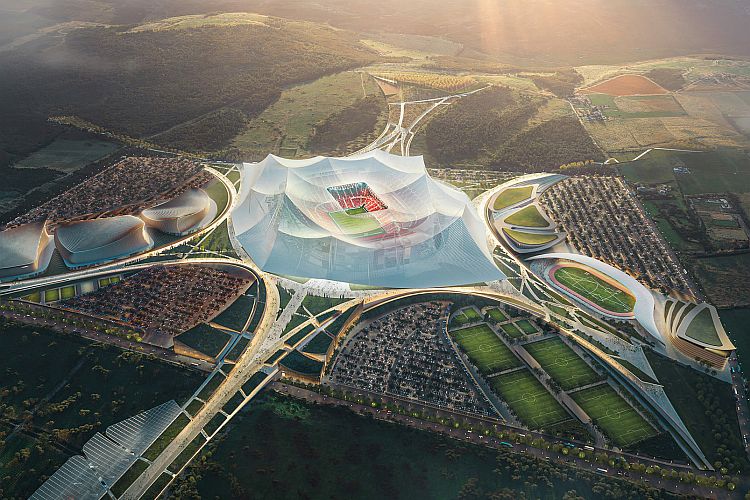
Morocco is embarking on a colossal investment and development drive as it prepares to host two major football tournaments: the 2025 Africa Cup of Nations (AFCON) and, subsequently, co-host the 2030 FIFA World Cup with Spain and Portugal.
Beyond sport, Morocco’s government is positioning these events as a strategic catalyst for an ambitious national urban and economic transformation.
While Morocco’s share of the total 2030 World Cup capital cost is estimated to be between USD 5 B and USD 6 B of a total tri-nation cost projected up to USD 15-USD 20 B, this figure anchors a much broader, continuous national investment. The focus is on ensuring every dirham spent on AFCON provides a lasting asset for the World Cup.
The investment in the tournament will form part of a broader national spending program on infrastructure, with total commitments reported to be around USD 15 B across multiple sectors over the coming years.
Sports and Urban Infrastructure Investment
However, the immediate financial commitment is concentrated on sports and transport infrastructure, which are strategically intertwined to serve both upcoming tournaments.




Massive capital is currently flowing into stadiums and training facilities. Officials are overseeing the renovation and expansion of key venues, such as the Adrar stadium in Agadir, alongside the development of approximately 60 world-class training centres.
Efforts to solve logistical challenges by connecting the host cities are also underway. To manage the expected influx of global visitors, authorities are aggressively expanding national airport capacity with a USD 2.8 B investment, aiming to nearly double it from 38 million to 80 million passengers annually by 2030. Major expansion projects are targeting Casablanca’s Mohammed V International Airport, among others.
Simultaneously, billions are being poured into upgrading road networks (USD 1.3 B), accelerating the extension of the high-speed rail (USD 9.6 B) to ensure seamless travel between the urban centres and upgrading and expanding its 27 ports (USD 7.5 B)
Economic Vision: Tourism and Job Creation
The ultimate reward for this unprecedented expenditure is a sustained economic dividend, with the tourism sector pegged as the biggest winner.
Already a strong sector, Morocco is capitalising on the global spotlight to push toward a target of 26 million visitors by 2030.
This follows a record-breaking performance that saw the country welcome 17.4 million tourist arrivals in 2024, firmly establishing it as North Africa’s most visited nation.
The results are already evident in cities like Agadir- one of the host cities, which has seen international arrivals surge toward 1.5 million, reflected by the increased flight traffic from key European markets.
This momentum has also created significant opportunities, particularly in the construction sector, where jobs are being created at a rapid pace. As Rachid Boukhenfer, vice president of Souss Massa’s regional council, recently noted, the dual-hosting responsibilities have spurred a fresh wave of public and private investment, leading to rapid job creation in construction and related service sectors.
Beyond increasing infrastructure capacity, the economic strategy behind these investments also involves diversifying the tourism product by promoting cultural experiences, water sports, and services for digital nomads.
This massive investment is being financed under an innovative, strategic structure that utilises public-private partnerships and specialised funding mechanisms to protect the general state budget.
Tarek Najem, General Secretary of the Royal Moroccan Football Federation, confirmed the investment is aimed at delivering a complete and exemplary experience—logistically and securely—for players, fans, and media professionals.
The 2025 Africa Cup of Nations, scheduled for late December next year, will serve as a crucial organisational dry run. The ultimate goal remains the 2030 World Cup, which Morocco will co-host with Spain and Portugal.
By linking its dual-hosting role, which also marks the World Cup’s centenary, Morocco is signalling a clear intent: to utilise football’s biggest stage to drive a lasting legacy of economic and territorial transformation, cementing its role as a competitive economic and regional hub.