‘Made In Africa’- This Engineer’s Invention Is Mending ‘Broken Hearts’ In Cameroon And Beyond

By Henry Nzekwe  |  December 29, 2018

Marc Arthur Zang was fresh out of grad school when he pulled off something of an unlikely feat. The then 24-year-old who had just completed a Masters Degree Program at the National Advanced School of Engineering, Yaounde, created a ripple when he single-handedly put together a working cardiological device. And this was designed from his only form of instructional aid – random information resources he got off the internet.

Now 29, the young Cameroonian ‘techpreneur’ is credited with the invention of a device that is considered the very first ‘Made-in-Africa’ medical tablet. And when he first rolled out this invention over six years ago, he got ‘tech birds’ both home and abroad chirping nonstop for months.

Zang aptly called his creation ‘Cardiopad’. He specifically tailored the device for the needs of healthcare workers in rural areas who are faced with an enormous challenge when it comes to performing cardiac diagnosis in those places due to the lack of adequate equipment. Cardiopad provides healthcare personnel in conventional communities with the means to perform cardiac tests and send results to cardio specialists via mobile devices.

For a country like Cameroon occupied by nearly 25 million inhabitants, it makes for gloomy reading that the state can only lay claim to a handful qualified and capable heart surgeons.

And the only thing more disturbing than the apparent scarcity of heart specialists in the country is that most of the few available are concentrated in Yaounde and Douala; the country’s two major cities.

This puts people living in the country’s rural communities in a dire situation as they are unable to access prompt response for something as troubling as heart conditions. Due to the severe deficit of specialists in the cardiology field, many locals with various heart ailments are forced to make long trips to avail themselves of heart examinations and consultations. More often than not, the exertions of such arduous journeys are known to even exacerbate the situation by aggravating the ailment.

More so, because of the shortage of capable hands, many of these patients have to join a long waiting list to get proper diagnosis and treatment for heart ailments of varying degrees, even when they make appointments months in advance. Disturbingly, a number of those patients never make it to the examination room as they are unfortunately struck down by the ailment before it gets around to their turn. In addition to losing an uncle to a stroke, putting an end to some of these problems can be thought to have spurred Zang on towards bringing his idea to life.
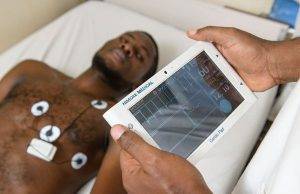
How The Cardiopad Works
Image Source: RisingAfrica

Zang’s Cardiopad is a touch-sensitive medical tablet that allows for heart examinations such as electrocardiogram (ECG) to be carried out in remote, rural locations. And if you think that’s all the device does, think again.

Cardiopad also functions to wirelessly transmit test results to specialists who possess the skills to interpret the variables obtained from the test and recommend treatments. For people living in rural Cameroon, Zang’s creation would come as a breath of fresh air as gone are those days of having to cover several miles to get to urban centers in the name of seeking a medical examination.

As culled from Radio Netherlands which created the earliest buzz on Arthur Zang’s Cardiopad, the young Cameroonian inventor described his invention as the “first fully touch-screen medical tablet made in Cameroon and Africa.” He also expressed the belief that his creation could help save numerous lives while hinting at the accuracy of the device holding steady at an impressive 97.5 percent.

Zang enthused that Cardiopad was borne out of the need to facilitate the treatment of patients with heart diseases across parts of Cameroon and Africa. Since becoming public, the device is known to have proven its mettle in carrying out several cardiac tests with satisfactory results as validated by the Cameroonian scientific community.

And this has only seen Zang’s invention gain even more acceptance as Cardiopad sees use in a number of rural communities including Mbankono; a small village located some 25 kilometers away from Yaounde, the Cameroonian capital.

When he spoke about his creation back in 2014, Zang let his interviewers in on the inspiration behind his invention. From his words in that interview, it could value that Zang was troubled by the dearth of capable hands in the area of cardiology in Cameroon – he even cited figures which suggested that there were less than 50 cardiologists in the country at the time; a poor figure considering the country’s population was somewhere around 20 million.

Zang also revealed that he was well aware of the difficulties associated with getting heart examinations for people living outside Yaounde or Douala as the limited number of heart experts were all holed up in both cities.

According to him, for this set of people, getting the needed medical attention was an expensive and time-consuming ordeal, and follow-ups were even more difficult.

In an effort to help lighten the burden, Zang patented his brainchild – Cardiopad, which comes complete with a full diagnostic kit. With this device, health workers located in rural locations and who are not prototyping skilled specialists in cardiology, are enabled to perform cardiac examinations on patients.

After the examinations, the health personnel could also use the device to send the test results to heart specialists in various parts of Cameroon for diagnosis and recommendation. His creation mainly puts paid to the concerns of many patients with heart ailments who would be otherwise inconvenienced by frequent trips to Yaounde or Douala.

Arthur Zang Holding A Cardiopad
Image Source: CNN

Complete with a diagnostic kit, Cardiopad is something of a miniature EKG, or perhaps even better than the regular device given that is portable and very accurate. And it works in a rather straightforward fashion.

It all begins with attaching a wire set of four electrodes and a sensor to the patient. Then, a signal is transmitted via Bluetooth to the Cardiopad. This signal is essentially a digitized ECG reading of the heart function of the patient. What then follows is the transmission of the information gotten from the procedure to a national data center.


It is through that data center that qualified cardiologists working from health centers in urban areas can receive the ECG, make a diagnosis, and revert to the health worker with appropriate recommendations and prescription instructions. Cardiopad is also furnished with a built-in software which allows the doctor to give a computer-assisted diagnosis.

Zang’s Cardiopad is an original creation, and it makes it possible for doctors to make an accurate diagnosis of patients without necessarily coming in contact with them. And for the patients, it comes as a plus that they no longer have to worry about traveling long distances to get medical attention.

Although each unit of the Cardiopad costs a rather steep USD 1 K to manufacture, it could cost significantly less if some of the electronic components can be sourced locally. Zang currently sources most of the electronic components from China before putting the product together in Cameroon. And this somewhat places a burden on the pricing as electronic components designed for the medical field are known to be quite expensive. Hence, the device current sales price of USD 4 K.

In any case, the Cameroonian entrepreneur is quite optimistic about the prospect of having the product entirely manufactured locally in the future. Once possible, Zang sees the device being put out on sale for around USD 3 K by his company, Himore Medical. And if that figure still made you wince, squirm, or shudder, perhaps it might help to note that similar, yet less portable systems, currently cost nearly triple that amount. Compared to all other devices that perform the same function, Cardiopad can be thought of as a very portable and low-cost alternative.
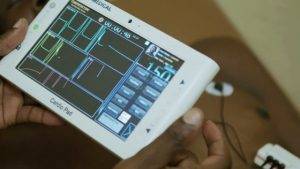
The Cardiopad, Image Source: vimeo.com

What started as a whiff of an idea has now been brought to life by a stroke of genius. Having obtained a bachelor’s degree in computer science from the University of Yaounde in 2007, Zang’s insatiable test for knowledge led him to enroll for a Masters Degree program two years later. And it was during this period that he had his own ‘lightbulb moment.’

In 2009, Zang had just completed his postgraduate course and was keen on applying his knowledge of engineering to the development of solutions in the medical sphere. In his quest to identify which areas a computer engineering application could do a solid to the field of medicine, he began to pick the brains of medical experts both formally and informally.

It was on one of such discussions with a cardiologist who pointed out the challenges that hamper people living in rural areas from getting required cardiac examinations that Zang got his interest piqued. From that moment, he set out to work on a solution.

The young engineer sought out possible solutions to the problems until he stumbled upon what seems to have checked all the boxes. He opted to put together a portable medical solution. But being only a computer scientist with very little by way of medical electronics know-how, he always had his work cut out for him with regards to brushing up on his knowledge.

How he went about that, though, was unconventional and somewhat audacious. As there weren’t many engineering schools where one can learn medical electronics and biomedical engineering in his home country, Zang made the internet his tutor. Essentially, he designed the Cardiopad by teaching himself medical electronics with online resources.

For up to six months, he watched clips and consumed texts on the subject that he had gotten off the internet. Soon, he was beginning to get the hang of it despite how daunting a challenge it seemed initially. Now armed with the required knowledge, Zang came up with a good design for the Cardiopad. His faith in the internet as a useful learning tool appeared to have paid off.

And then came the next hurdle: finding funding for the prototype. This proved quite the stumbling block as banks are not known to jump at the idea of giving out cash on loan to a student without guarantees. So he turned to family and friends.

The mother of the Cameroonian inventor was able to procure a loan worth USD 1.3 K from a bank, and it was with these funds that Zang financed the prototype of the Cardiopad. After building the initial prototype, he took to social media platforms like Facebook to promote his invention, and this helped him raise further funding.


Cameroonian President, Paul Biya, offered the young techie a grant worth USD 30 K to fund the project and with the new injection of capital, Zang manufactured the first 20 devices. After that, he made another video demonstration of the product and submitted it as an entry for an international innovation competition known as the Rolex Awards For Enterprise. And his stock has only risen since then.

Arthur Zang Receiving His Prize At The Event In Dar Es Salaam
Image Source: BBC

Rolex named Zang amongst four others selected from various parts of the globe as its Young Laureates for 2014. In 2015, he was the recipient of an award in the Applied Technology category. In the year that followed, Zang won a USD 37 K cash prize for his invention having clinched the Africa Prize for Engineering Innovation organized by the UK’s Royal Academy of Engineering at a ceremony in the Tanzanian city of Dar es Salaam.

Additionally, with his new-found fame and acclaim, Zang has also been able to garner up to USD 55 K in funding for the production of 100 medical tablets, with each of Cameroon’s 10 provinces expected to be served by 10 of his devices. The device is also known to have gone on sale in some other countries including Gabon, India, and Nepal.

Going forward, Zang’s Himore Medical has its sights trained on manufacturing a number of other medical devices, including a piece of ultrasound equipment that will be designed for medical examinations in economically-disadvantaged locales.

Arthur Zang’s journey thus far can serve as a lesson to Africa’s teeming entrepreneurial population to make good use of whatever is available to them in trying to come up with solutions to some of the continent’s problems. It also stresses the need to break from the conventional both in approach and thinking.

How M-KOPA Put 5,000+ Electric Bikes On Kenyan Roads—Fast

By Henry Nzekwe  |  March 5, 2026

It’s a Thursday morning in Nairobi’s CBD, and the matatu stage is unusually quiet. Not because there are fewer bikes—there are plenty—but because the deafening roar of two-stroke engines is absent as the soft hum of electric motors soothes the air.

On one corner, a rider in a yellow helmet unlocks his Roam Air from a swap station. On another, a Bolt passenger climbs onto an Ampersand, barely noticing the absence of vibrations shaking her spine. This is the sound of Kenya’s electric vehicle revolution. And it’s moving faster than anyone predicted.

From a paltry 700 EVs in 2022, Kenya now boasts nearly 25,000 registered electric vehicles, according to the just-launched National Electric Mobility Policy. That’s a 3,000 percent explosion in three years. Most of these are motorcycles, the ubiquitous boda bodas that form the circulatory system of Kenya’s economy.

The government wants credit, and to be fair, it has earned some. Zero VAT on electric bikes and lithium-ion batteries. Reduced import duties. And, as of February 2026, green number plates that make EVs instantly recognisable.

“If you’re an electric bike in a stage, there’s a higher likelihood a customer will go for it,” Brian Njao, General Manager of M-KOPA Mobility, told WT. Visibility, it turns out, matters.

But beneath the feel-good environmental narrative lurks a paradox that keeps policymakers awake. The same revolution saving riders money is quietly blowing a hole in Kenya’s budget.

The maths of more money in your pocket

Here’s the part that matters to the man on the bike: electric works because it pays, not necessarily because it’s better for the environment, though that’s a welcome coincidence.

Njao, who formerly led Uber’s East Africa operations, breaks it down without jargon. A boda boda rider on a petrol bike typically pockets USD 20.00 to USD 40.00 a day before expenses. Switch to electric, and after financing repayments, swap fees, and everything else, the take-home jumps by an extra five dollars daily. Over a month, that’s groceries, school fees, or, in one rider’s case, moving a child to a better school.

M-KOPA has financed over 5,000 e-bikes since 2023 through its pay-as-you-go model, the same approach that put solar panels in millions of homes. Riders pay daily via mobile money. Miss a day, the bike locks. No accumulation of crippling debt.

“If that bike is not active on the road, that customer will not pay us,” Njao said. “We have a symbiotic relationship.”

He also shared that the repayment rates on the e-bike book sit above the market average, which is in line with M-KOPA’s other product lines. “That tells us the credit model we have built translates well into electric mobility,” he said.

Where the charger meets the policy

Bolt, the ride-hailing giant, now has 5,808 EVs on its platform, accounting for nearly a quarter of all electric vehicles in Kenya. More strikingly, 40 percent of Bolt’s two-wheeler fleet is already electric.

Njao described M-KOPA’s partnership with Bolt as straightforward; riders on the platform pay less for their loans, Bolt gets guaranteed supply, and the customer wins twice via lower asset costs and steady trip income.

Yet the infrastructure keeping those wheels turning belongs to the OEMs. Roam, Ampersand, and Spiro. They own the swap stations. They manage the batteries. M-KOPA just finances the bikes.

This division of labour creates a delicate dance. “It’s a chicken and egg scenario,” Njao admitted. “If you bring a thousand bikes without swapping stations, you’re stuck. If you spend on a thousand stations without bikes, your capex is gone.” The balance is precarious, and right now, demand is outpacing both.

The billion-dollar question nobody’s answering

Now for the part the government doesn’t put in press releases.

Kenya funds its roads through a fuel levy, KES 25.00 (19 cents) per litre of petrol. More EVs mean less fuel consumption. Less fuel consumption means collapsing revenue. The numbers suggest the EV transition already caused a KES 2 B (USD 15.4 M) shortfall in 2025. By 2043, that gap balloons to KES 89.5 B (~USD 688 M).

The Ministry of Roads projects fuel tax collections will start declining by 2037, just as the government needs more money for the very roads these EVs use. It’s a structural conundrum. Every electric bike Kenya celebrates inches the country closer to a fiscal cliff.

Transport Caninet Secretary Davis Chirchir acknowledges the problem, vaguely promising “alternatives” like road-use charges or electricity levies. But for now, the policy framework accelerating EV adoption contains no concrete plan for replacing the fuel money evaporating with every swapped battery.

Can Nairobi scale without breaking?

Njao is pragmatic. When asked about replicating Kenya’s model across Africa, he didn’t mention tax breaks or green plates first. He said: “Policy consistency. If governments commit to long-term local assembly incentives that hold for ten years or more, that would be transformative.”

The translation is that investors can survive high taxes, but not governments changing rules every budget cycle.

M-KOPA’s next moves are already mapped towards densifying Nairobi, launching Mombasa properly, then eyeing Uganda, Nigeria, and Ghana. The solar and smartphone business proved that the pay-as-you-go model works across borders. Njao believes mobility will follow.

“If we can have smartphones working in five countries, we can have electric mobility working there too,” he said.

Kenya’s mobility revolution is afoot. Thousands of EVs, USD 108 M in economic activity from ride-hailing platforms, thousands of riders earning more. The green transition is happening on muddy roads and crowded stages.

But revolutions consume their parents. The fuel taxes that maintain Kenya’s roads are evaporating, and no one has admitted what will replace them. The country is racing toward an electric future with a revenue model built for petrol.

For the rest of Africa watching—Nigeria with its oil addiction, Ghana with its gradual pilots, Ethiopia with its radical combustion engine ban—the task is to solve for tomorrow’s problems while celebrating today’s growth.

Njao is aware that riders aren’t thinking about fiscal policy, however. They’re calculating daily earnings, watching their savings climb, and quietly moving children to better schools. That’s the revolution they see.

The other revolution—the one involving USD 688 M in missing road money—will announce itself soon enough. By 2042, when Kenya projects EV sales will match petrol vehicles, the music stops. The question is whether anyone will have built a new chair.

Canal+ Pulls Plug On Showmax As African Streaming Losses Mount

By Henry Nzekwe  |  March 5, 2026

When African pay-TV giant, MultiChoice, relaunched its streaming platform, Showmax, in February 2024, the pitch was bold. Backed by Comcast’s NBCUniversal and powered by the same technology as Peacock, Africa’s homegrown streaming champion would finally take on Netflix on equal footing. The target was USD 1 B in revenue within five years.

Two years later, the plug has been pulled. MultiChoice announced Thursday it will discontinue Showmax following a “comprehensive review” by its board, citing “substantial annual losses” that proved unsustainable. The decision, first reported by Variety, ends an 11-year run that began in 2015 as a modest DStv companion and ended as a money pit that swallowed over ZAR 3 B (~USD 182 M) in investment.

For the 2025 financial year, Showmax recorded a trading loss of ZAR 4.9 B (USD 297 M), an 88% worsening from the previous year. Revenue, which peaked at ZAR 1 B (USD 60 M) in 2024, fell back to ZAR 800 M (USD 48.5), miles from the ZAR 18 B (USD 1 B) target executives had promised investors. Subscriber growth, while hitting 44% year-on-year, never translated into dollars.

“The substantial annual losses experienced by the Showmax business have proved unsustainable,” the company said in a statement, adding that no job cuts would result from the closure.

MultiChoice Group CEO David Mignot offered a blunt diagnosis earlier this year. “Financially speaking, business-wise speaking, the thing is not flying”.

Africa has roughly 600 million smartphones, he noted, but the economics of mobile streaming simply don’t work given data costs. Barely 4-5% of the continent’s electrified, TV-owning households have access to fibre. The streaming future executives had envisioned collided with market reality.

Canal+, which acquired MultiChoice in a USD 2 B deal last September, had telegraphed this outcome. CEO Maxime Saada told investors in January that Showmax was “not a commercial success—it’s quite obvious”. The platform’s losses were “not acceptable,” CFO Amandine Ferré added, as the French media giant pivoted toward cost synergies rather than streaming growth.

The group is targeting EUR 400 M (USD 463 M) in annual savings by 2030, and Showmax had become a prime candidate for cuts. NBCUniversal, which held a 30% stake in the joint venture, will now exit alongside MultiChoice.

The closure leaves African filmmakers and audiences grappling with another narrowed window, echoing moves by global streamers, such as Netflix and Prime Video, to pare down investments on the continent.

One South African director who produced multiple series for Showmax described the loss as devastating. “Showmax was one of the only platforms available to us that was willing to back stories that were bold and authentic… Losing Showmax is a huge blow to the local industry”.

MultiChoice says streaming remains “central to our strategy” and that it will continue investing in premium content. Canal+ is expected to expand its existing partnership with Netflix, which already bundles the streamer into pay-TV offerings across 24 African countries. A “super app” combining the group’s video services is reportedly in development.

But for the African streaming market, Showmax’s demise carries a sobering lesson. What was once positioned as Africa’s last great frontier for streaming growth became one of its most costly experiments.

Meta’s Smart Glasses Send Intimate User Footage To Kenyan Contractors, Investigation Finds

By Staff Reporter  |  March 4, 2026

When one sets down their Ray-Ban Meta glasses on the nightstand, the camera might still be recording. And halfway across the world, a contract worker in Nairobi could be watching.

An investigation by Swedish newspapers Svenska Dagbladet and Göteborgs-Posten has revealed that intimate footage captured by Meta’s AI-powered smart glasses—including people undressing, using the bathroom, having sex, and entering credit card details—is being reviewed by data annotators at Sama, a Kenyan outsourcing firm hired to train the company’s artificial intelligence systems.

The AI feature that enables this data collection cannot be disabled, the investigation claims. Users who activate the glasses’ assistant must agree to have their video and audio processed by Meta’s servers, where it may be forwarded for manual human review; a detail buried in terms of service that one worker said most users never read.

“In some videos, you can see someone going to the toilet, or getting undressed,” one Sama employee told journalists. “I don’t think they know, because if they knew, they wouldn’t be recording”.

Meta sold approximately 7 million pairs of the glasses in 2025, up from 2 million in 2023 and 2024 combined. The company has positioned the device as an “AI-powered assistant” that can translate languages, describe surroundings, and capture hands-free moments. What the marketing does not emphasise is that those moments may end up on a screen in Nairobi, annotated by workers earning wages far below Silicon Valley rates.

Sama, which has previously faced scrutiny over working conditions for content moderators reviewing Facebook posts, requires employees to sign strict non-disclosure agreements. Workers told Swedish media that Meta’s automatic blurring and anonymisation tools often fail in complex lighting, leaving faces and bodies exposed.

“With cameras in your house, you know where they are,” one annotator said. “These are glasses you wear on your face that keep recording when you take them off and set them on your nightstand”.

The revelations have reached European regulators. A group of 17 Members of the European Parliament from four political groups has formally questioned the European Commission about whether Meta’s practices comply with the General Data Protection Regulation (GDPR), which requires clear consent and transparency for data collection.

Under GDPR, companies exporting EU user data to countries like Kenya, which has not been granted “adequacy” status by the Commission, must implement additional contractual safeguards.

Sweden’s Civil Minister Erik Slottner has demanded answers, warning that the combination of location data and intimate imagery could create serious safety risks if mishandled.

Meta declined to answer specific questions from Swedish media but directed attention to its privacy policy, which states that “in some cases” human review may occur.

A spokesperson told The Telegraph: “When people share content with Meta AI, like other companies, we sometimes use contractors to review this data to improve people’s experience with the glasses, as stated in our privacy policy. This data is first filtered to protect people’s privacy”.

For the Kenyan workers who see these images daily, the psychological toll is compounded by contractual silence. Sama has previously been sued by a South African former employee, Daniel Motaung, who alleged that reviewing traumatic content for Facebook led to post-traumatic stress disorder. That case, which could establish Meta’s liability for conditions at outsourcing partners, is ongoing in Kenya’s Employment and Labour Relations Court.

“The day I found out my glasses were sending video to Kenya, I stopped wearing them,” one early adopter posted on social media. The post was viewed 2 million times.

Featured Image Credits: Svenska Dagbladet

Breadfast Co-Founder Breaks Protracted Silence Amid Investor Controversy

By Henry Nzekwe  |  March 3, 2026

For nine years, Muhammad Habib built Breadfast without ever writing a public post about the company. Not for marketing. Not for defence. “Not my style,” he said. But this week, the co-founder and COO of one of Egypt’s most valuable startups broke his silence.

In a lengthy Facebook statement posted Sunday, Habib addressed a controversy that has engulfed the e-grocery platform since it announced a USD 50 M pre-Series C funding round in February.

Critics on social media targeted Japanese investor SBI Investment, citing its ties to Vertex Israel, a Tel Aviv-based venture firm, arguing that companies operating in Arab markets should avoid indirect financial links to Israel amid the ongoing war in Gaza.

“We have refused money more than once when it conflicted with our moral boundaries,” Habib wrote, revealing that Breadfast had previously turned down capital from investors directly connected to the Israeli state. Those decisions, he said, were made unanimously by the founders in locked rooms where no one was watching.

The statement offered a rare window into the ethical calculations facing startups in a region where geopolitics and venture capital increasingly collide. Habib argued that international funds operate diversified portfolios across hundreds of countries and sectors, funding hospitals in Brazil, tech companies in India, and infrastructure in Europe.

When they invest in Egypt, he said, it signals confidence in the Egyptian market, not endorsement of a political position.

He also drew a distinction often lost in online boycott campaigns. “A boycott is for a company that has servers directly operating the occupation army, a company providing surveillance technology used against Palestinians, or a company with factories in settlements,” he wrote. “These companies directly contribute to the killings and displacements.”

Breadfast, founded in 2017 by Habib, Mostafa Amin, and Abdallah Nofal, has grown from a subscription bread delivery service into a vertically integrated commerce platform offering groceries, pharmaceuticals, and financial services. Private-label goods now account for roughly 40% of grocery sales, a strategy that has helped the company improve margins in Egypt’s high-inflation environment.

The USD 50 M round, led by Novastar Ventures through its People and Planet Fund III, included backing from Mubadala Investment Company, The Olayan Group, SBI Investment, Asia Africa Investment & Consulting, Y Combinator, IFC, EBRD, and 4DX Ventures. According to disclosures from Swedish investment firm VNV Global, which holds a 7.5% stake, Breadfast’s valuation has risen to approximately USD 403 M.

Habib emphasised that all investors hold minority stakes and that the company remains founder-led and Egyptian-controlled. “If you want Egypt to take its place in the world economy,” he wrote, “we must accept that global capital moves in an interconnected network.”

The controversy arrives at a sensitive moment for Egypt’s startup ecosystem. Over the past two years, currency devaluations, inflation, and reduced global venture appetite have created funding slowdowns and valuation pressure across North Africa [citation. Against that backdrop, Breadfast’s raise, and its reported valuation growth, stands out as a rare bright spot.

Breadfast is not alone in facing scrutiny over its investor lineup. In January, Nigerian defence-technology startup Terra Industries announced an USD 11.75 M seed round led by 8VC, the Silicon Valley firm co-founded by Joe Lonsdale, a co-founder of Palantir Technologies; a data-analytics company whose software is widely used by Western military and intelligence agencies. Alex Moore, a defence partner at 8VC and a Palantir board member, joined Terra’s board shortly after .

The connection drew criticism on social media, with some questioning whether a Nigerian company protecting critical infrastructure, including hydropower plants, mines, and industrial assets valued at approximately USD 11 B, should accept capital from investors with deep ties to U.S. defence and intelligence establishments.

Critics argued that foreign board members gain insight into Nigeria’s security vulnerabilities, infrastructure locations, and surveillance data, creating potential strategic vulnerabilities.

Terra’s co-founder and CEO Nathan Nwachuku has spoken about building “sovereign intelligence” and reducing African dependence on Western powers for security support.

Yet the company’s reliance on capital with ties to foreign intelligence, including an additional USD 22 M extension in February that brought total funding to USD 34 M, with participation from Flutterwave CEO Olugbenga Agboola, has sparked debate about whether financial sovereignty can coexist with foreign investor control

Habib acknowledged that not everyone will agree with his position. “I understand that everyone can look at this subject differently, and I completely respect this,” he wrote. “Each of us has a conscience and makes his decisions based on what he sees is right. My conscience is comfortable: I believe before God that what we are doing is the right thing.”

The company plans to use the funding to expand across Egypt, strengthen supply chain infrastructure, and explore new markets in North and West Africa, ahead of a larger Series C round expected in the first half of 2026. A potential global IPO remains a long-term ambition.

MTN’s Rebound In Nigeria Masks Growing Pains In Fintech Push

By Staff Reporter  |  March 2, 2026

MTN Nigeria has staged a dramatic financial recovery, reporting a full-year profit after tax of NGN 1.11 T (USD 810 B) for 2025, reversing the NGN 400 B (USD 292 M) loss it suffered the previous year.

The telecom giant’s revenue surged 54.9 percent to NGN 5.2 T (USD 3.79 B), fueled by a landmark 50 percent tariff hike approved in January 2025 and a long-awaited swing to foreign exchange gains.

For the first time since 2022, MTN posted a net foreign exchange gain—NGN 90.27 B (USD 66 M) for the full year, a sharp reversal from the NGN 925 B (USD 675 M) loss that had battered its books in 2024.

The naira’s relative stability, appreciating from NGN 1.535 K per dollar in December 2024 to NGN 1.475 K by September 2025, provided breathing room for a company long exposed to currency volatility.

“The 2025 financial year was described as a remarkable period of recovery and resilience for the firm,” CEO Karl Toriola said, noting that the turnaround enabled “accelerated network investment to enhance quality of service.” MTN invested over NGN 1 T in capital expenditure during the year, expanding base stations and fibre infrastructure.

But beneath the headline recovery, the company’s fintech ambitions tell a more complicated story.

On paper, MTN’s fintech division, which houses MoMo Payment Service Bank, appears to be firing on all cylinders. Revenue surged 72.5 percent in the first nine months of 2025 to NGN 131.6 B, roughly NGN 43 B per quarter. If spun off as a standalone entity, analysts noted, the unit would already command unicorn valuation.

Yet the growth in revenue has not translated seamlessly into user engagement. Active MoMo wallets declined 6.1 percent to 2.7 million in the first half of 2025 compared to December 2024, raising questions about the stickiness of the company’s financial services. The decline was even steeper earlier in the year; active wallets fell to just 2.1 million in the first quarter, a 55.6 percent year-on-year drop.

While the company added approximately 562,000 new wallets in the second quarter, suggesting a rebound, the dip exposed the challenge of converting MTN’s massive subscriber base—85.4 million customers and 51.1 million active data users—into habitual fintech users.

The fintech revenue growth itself requires closer examination. Industry analysts note that nearly all of the increase is driven by Xtratime, an airtime lending product where MTN lends subscribers credit to make calls when they run out. While classified as fintech revenue, it functions more as a high-margin convenience loan than a disruptive payment service.

Once airtime lending is stripped out, the rest of the fintech business—the part meant to compete with dominant players like Moniepoint and OPay—brought in just NGN 6.8 B in the first nine months of 2025. For a company reporting NGN 5.2 T in total revenue, that figure is hardly significant.

Notably, MTN’s mobile money business operates with restrictions. Its Payment Service Bank license allows it to accept deposits and move money but not to lend, the profitable core of fintech economics. This limitation puts MoMo at a structural disadvantage against pure consumer fintech competitors.

For the average Nigerian, the investment numbers matter less than the bars on their phone. A year after the 50 percent tariff hike, service quality remains erratic. Operators recorded over 40,000 network disruptions in 2025, including 19,000 fibre cuts and 3,200 equipment thefts.

“Last year, I spent NGN 5 K a month on data. Today, I spend NGN 8 K for the same volume, yet I still have to stand on my balcony to make a clear WhatsApp call,” Tunde Adeoye, a digital entrepreneur in Yaba, told The Guardian recently.

NCC Executive Vice Chairman Aminu Maida has signalled that 2026 will be “the year of consequences,” moving from encouraging investment to enforcing performance.

Moniepoint’s Mammoth Lending Machine Meets Messy Reality Of Two Big Defaults

By Henry Nzekwe  |  February 27, 2026

In January 2025, Alerzo, one of Nigeria’s most prominent B2B e-commerce startups, secured a NGN 5 B (~USD 3.6 M) working capital loan from Moniepoint Microfinance Bank.

The logic was sound. Moniepoint processes over 80% of in-person payments nationwide. Its terminals sit inside thousands of shops that Alerzo supplies. The fintech could see the merchants’ cash flows in real time: revenue, frequency, velocity. If data ever guaranteed a loan, this was it.

Twelve months later, Moniepoint was in court seeking permission to freeze Alerzo’s accounts. The outstanding balance stood at NGN 4.38 B (~USD 3.2 M), with interest still accruing. A Federal High Court in Lagos granted a Mareva injunction restraining every bank from releasing funds linked to the company or its principals. Videos surfaced online showing rows of Alerzo-branded vehicles parked at its Ibadan facility, reportedly being prepared for sale.

The founder, Adewale Opaleye, insists the company remains in operation and that only faulty vehicles are being cleared. “In fact, we still have over 400 vehicles that we are currently running,” he told local media. But when a court orders account freezes and asset disclosures, even routine fleet maintenance begins to look like triage.

Alerzo is not alone. Around the same time, Moniepoint’s microfinance arm quietly went to court seeking an order restraining every bank from dealing with funds held by Retail Supermarkets Limited, owners of the ShopRite franchise in Nigeria, over a NGN 2.4 B (~USD 1.7 M) working capital facility that had gone unpaid, notable tech insider Olumuyiwa Olowogboyega revealed.

That case, which unfolded late last year with far less public attention, targeted one of the country’s most recognisable retail chains with physical stores, steady foot traffic, and years of operating history.

Two borrowers, two different models, one lender now in court for both.

Moniepoint’s position is complicated. The unicorn, which raised over USD 200 M in its Series C round last year from investors including Development Partners International, Google’s Africa Investment Fund, and Visa, has built its lending model around payment data.

It disbursed more than NGN 1 T (~USD 735 M) in loans to small businesses in 2025, targeting provision stores, supermarkets, and building material traders that traditional banks typically ignore. Businesses that accessed credit, the company claims, recorded average growth of 36% after receiving loans.

The logic, analysts point out, is that if Moniepoint process a merchant’s payments, it knows their cash flow. If it knows their cash flow, it can lend against it. Payment data reveals capacity to repay.

But capacity is only half the equation. The other half, as Olowogboyega points out insightfully, is priority: whether, under pressure, a borrower will repay before other obligations.

“Payment data shows what merchants want you to see. It does not show what they route through other banks, what they owe elsewhere, or how a founder’s personal spending habits might drain the business when margins tighten,” he writes. In the ShopRite case, a well-known retail brand with decades of history still found itself unable to meet its obligations to a lender that had visibility into its operations.

Alerzo built its model on high-volume, low-margin distribution, supplying inventory directly to small retailers across Lagos, Oyo, and Ogun states.

The company raised roughly USD 20 M during the funding boom of 2020–2022, expanding aggressively. But B2B commerce in Nigeria is unforgiving. Maintaining hundreds of vehicles, paying drivers, warehousing goods, and absorbing fuel volatility created a cost base that proved difficult to sustain once venture funding slowed and the economy soured.

By 2023, Alerzo had laid off staff. By 2025, it needed bank debt to survive. Now, it faces a legal battle that will determine whether restructuring is possible or whether the company becomes another cautionary tale about the limits of debt in Nigeria’s startup economy.

Meanwhile, Moniepoint, while declining to comment, seems unlikely to soften its recovery stance. Allowing a high-profile default to slide would weaken its credit culture and invite similar behaviour from other borrowers.

The company continues to lend across retail, food services, and trade sectors. But each new loan carries the risk that the data powering the decision might be the ultimate until the moment it isn’t.

Alerzo insists it will release an official statement soon. Retail Supermarkets has not publicly commented on its case. With accounts frozen and assets under scrutiny, the question hanging over both borrowers is whether Moniepoint’s data-driven lending model can survive contact with the messy, unpredictable reality of Nigerian business.

Controversial Crypto Founder In Yet Another Ouster Echoing Past Scandals

By Henry Nzekwe  |  February 27, 2026

Ray Youssef, the controversial cryptocurrency entrepreneur who built two of Africa’s notable peer-to-peer trading platforms, has stepped down as CEO of NoOnes just over two years after founding it, the company confirmed this week, citing ongoing legal matters that remain undisclosed.

NoOnes, which Youssef launched in 2023 following the collapse of his previous venture, Paxful, announced on Thursday that its founder “does not participate in the management, operations, or decision-making of the platform.” The statement emphasised that “any legal matters involving Ray Youssef are personal and unrelated to NoOnes,” without elaborating on the nature of the proceedings.

Youssef had first announced his exit a week earlier on X, describing it as a difficult decision but offering no explanation. When contacted for comment, he had not responded to requests.

The departure marks the second time in three years that Youssef has left a company he founded under opaque circumstances. Paxful, once one of the world’s largest peer-to-peer bitcoin marketplaces boasting 1.5 million Nigerian users and USD 1.5 B in annual trade volume, shut down abruptly in 2023 amid regulatory scrutiny and a bitter legal battle with co-founder Artur Schaback.

At the time, Youssef blamed “key staff departures” and intensifying U.S. regulatory pressure on the peer-to-peer sector. But court filings later revealed a lawsuit between the co-founders, with allegations including mismanagement and governance failures. U.S. regulators, including FinCEN and the Department of Justice, subsequently fined Paxful for compliance lapses and handling transactions linked to suspicious activity.

The controversies surrounding Youssef extend beyond corporate governance. In 2016, he and a co-founder were arrested on charges of possessing firearms and cocaine, though the long-term disposition of that case remains unclear. Industry observers have also noted past allegations of substance use affecting leadership decisions, claims Youssef has never publicly addressed.

Since leaving Paxful, Youssef positioned NoOnes as a fresh start, a community-driven trading ecosystem targeting Africa, Latin America, and Southeast Asia, where currency instability and limited banking access fuel demand for crypto alternatives. The platform grew rapidly, reporting over 2 million users and recording more than USD 4 M in daily trading volume shortly before his departure.

But in recent months, Youssef’s X feed has taken a markedly different turn. His posts have shifted toward overtly political and religious themes, including warnings about U.S.-Iran tensions, anti-Israel rhetoric, and references to divine protection, leading to questions about whether his focus had drifted from the company’s operations.

NoOnes has not named a successor or detailed its strategic direction post-Youssef. In a brief statement, the company said it remains “focused on delivering innovative crypto trading products while maintaining a secure, reliable, and user-centric environment.”

For the millions of African users who relied on Youssef’s platforms to move money across borders, the exit carries an uncomfortable echo. Paxful’s collapse left many scrambling for alternatives. Whether NoOnes can sustain its trajectory without its founder, and what legal clouds may yet surface, remains uncertain.

Cash Is Dying In Nigeria’s Nightlife Where Moniepoint Processed Over USD 600 M

By Henry Nzekwe  |  February 25, 2026

On a recent Sunday night at Amuludun Kitchen in Ipaja, a Lagos suburb, the plastic tables filled early. Olorunrinu, who owns the spot, watched her staff move between packed benches, delivering plates of pepper soup and cold bottles of water.

She had spent years building this spot into one of the neighbourhood’s busiest nightlife venues, but what she noticed now had less to do with food and more with how people paid.

“It’s rare to see cash,” she said. “We prefer transfer, or you can make payments with your card. The cash kind of exposes the staff to theft and all that.”

Her experience is increasingly the norm across Nigeria’s sprawling community nightlife sector. A new data-driven study by Moniepoint Inc., drawn from transaction records of more than 27,000 clubs, bars, and lounges on its payment network, reveals a sharp reversal of the wider informal economy’s cash dependency. While about half of all payments in Nigeria’s informal sector are still made in cash, the nightlife economy has gone digital.

In 2025, Moniepoint processed over NGN 900 B (~USD 665 M) for clubs, bars, and lounges, revealing the scale of the economic life that begins after sunset.

According to its latest study, bank transfers now dominate payments during peak nighttime hours, outpacing card transactions by nearly two million across Moniepoint’s network. Cash is actively discouraged, driven largely by operators’ security concerns. After dark, when crowds gather and attention scatters, carrying currency becomes a liability.

***

The data also reveals a precise rhythm to spending. Transaction volumes climb sharply from 8 p.m., peak before midnight, and then decline steadily even as venues remain full. For operators, the economic night ends earlier than the social one. The most critical window for staffing, restocking, and cash flow management falls between midnight and 6 a.m., when purchasing has already slowed but operational demands continue.

At De Synergi Lounge in Akonwonjo, manager Richard sees this pattern play out weekly. On usual nights, the existing team handles the flow. But during December, when crowds swell, “we get like two or three extra people to serve.” Across Nigeria, conservative estimates suggest at least 54,000 people work in nightlife-related roles every night, with local bars expanding their workforce by 30 to 50 percent on peak nights.

The sector’s geography defies easy assumptions. Lagos leads with 4,856 nightlife establishments on the network, followed by the Federal Capital Territory, Rivers, Delta, and Edo. But Katsina records the highest payment value for nighttime food trucks, pulling in over NGN 130 M (~USD 96 K) in the past year, while Kwara leads in transaction count. Nigeria’s night economy, the study shows, is distributed rather than concentrated in elite urban enclaves.

Tosin Eniolorunda, co-founder and group CEO of Moniepoint, said the findings should reshape how the sector is viewed. “Nigeria’s local bars and nighttime operators are not peripheral to the economy; they are a critical part of its architecture,” he said. “We see a substantial and sustained economic sector that employs hundreds of thousands of Nigerians every night and deserves the same attention we give to agriculture, healthcare, and retail”.

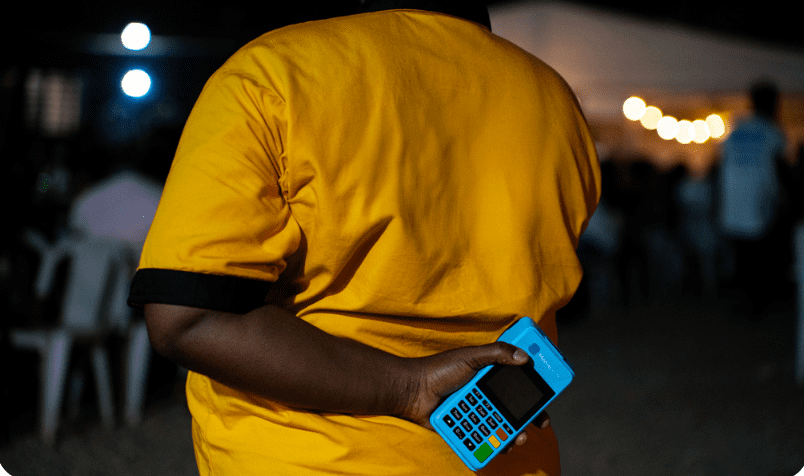
For operators like Olorunrinu, the shift to digital payments has also brought unexpected clarity. Real-time settlements mean she can track revenue as it happens, and Moniepoint’s POS terminals, each assigned a dedicated bank account number, provide instant audio confirmation when payments land, as there are no screenshots to verify, no alerts to wait for.

“That small ping changes everything,” the report highlights. The night can continue.

PayPal Promised Nigerians A Fresh Start — Users Say It Feels Like The Past

By Henry Nzekwe  |  February 24, 2026

When Precious received a USD 380.00 payment from a client in mid-February, she thought the long wait was finally over. The data analyst had linked her PayPal account to Paga weeks earlier, after the Nigerian fintech pioneer announced a landmark partnership with the U.S. payments giant, finally allowing users in the country to receive money after two decades of restrictions.

Then PayPal restricted her account.

“After filling everything, when money came in, PayPal still restricted the account,” Precious, who goes by @Prithee_p on X, posted on Feb. 19. “Now, they said they would hold the money till March 9 before releasing it despite filling out all their paperwork.”

She shared screenshots of her PayPal dashboard showing the hold. Her warning to fellow freelancers was blunt. “Avoid PayPal and Paga at all costs. Not only will you encounter unexpected issues, you’re at the risk of never receiving your funds.”

The same week, another user, Abdulaziz, who posts as @Utdpunter, received USD 290.00 from a client. PayPal closed his account immediately. When he appealed, the decision was final. His account was permanently deactivated, and his funds were caught in the company’s compliance machinery.

Tayo Oviosu, Paga’s founder and group CEO, responded directly to Abdulaziz on X. “We’ve had the opportunity to review with PayPal what happened and the decision made. While we cannot share the exact reasons, we are satisfied that the decision is a valid risk-based decision due to the behaviour observed on the account.”

For many Nigerians watching this unfold, the pattern felt painfully familiar.

PayPal first restricted Nigerian users in 2004, citing fraud concerns. For 22 years, Nigerians could only send money, never receive it; a policy that shut countless freelancers, digital creatives, and small businesses out of the global economy.

Over that period, workarounds emerged. Some used VPNs to mask their location. Others relied on friends abroad to receive payments and send funds through informal channels. Many simply lost opportunities.

The company attempted re-entry before. A 2014 partnership with First Bank enabled only outbound payments. A 2021 integration with Flutterwave helped businesses, but left individual users untouched.

This time, the company partnered with Paga, a 16-year-old Nigerian fintech that processed NGN 17 T (USD 12 B) in transactions in 2025. The promise was that Nigerians could finally link their PayPal accounts to a local wallet, receive international payments, and withdraw in naira. Oviosu had first pitched the idea to PayPal in 2013. It took 13 years to materialise.

Within hours of the January 27 launch, users reported the same problems that have plagued PayPal’s Africa operations for two decades. One user described logging in to test with a one-dollar payment. His account was immediately restricted. Another claimed to have submitted verification documents and was banned for life. Yet another described losing thousands of dollars between 2019 and 2021 after PayPal held his funds.

Oviosu pushed back against claims that the problems are widespread. “There is no widespread issue,” he told WT. “The complaints we’ve received so far largely relate to verification hiccups or immediate restrictions following initial deposits. In many cases, this suggests that PayPal’s internal compliance checks and automated risk monitoring systems are flagging certain activities for review.”

He noted that tens of thousands of users have successfully linked accounts and transacted without issue. “The average user has already withdrawn twice in just a few weeks,” he said. “The results are exceeding the initial expectations set by both our companies.”

***

Paga has set up a dedicated email address for fully verified users experiencing issues. “We’re working with the PayPal team to support users who have unresolved issues actively,” Oviosu said.

The fintech vet also pointed out that the dual compliance process requiring both PayPal and Paga verification is designed to reduce risk flags while keeping the platform aligned with local regulations. PayPal’s global risk-scoring systems remain in operation, he added, as an industry-standard measure to protect users.

“Users experiencing blocks are usually prompted to submit documents and complete identity verification steps inside the PayPal app or dashboard. One of the issues we have seen are people taking the picture of an image of an ID versus the physical ID itself. That action is seen to be dubious and we are educating the public to not do so,” he told WT. In a separate post, he admonished users to desist from requesting money from strangers.

He added that Paga is investing in user education, and both companies have created dedicated resolution teams. For fully verified users with unresolved issues, the company is working with PayPal to escalate cases. Oviosu encouraged impacted customers to reach out via email for assistance.

But for some users, the damage is already done. “PayPal should be transparent with their procedures,” Precious, the data analyst from earlier, wrote. “Don’t make users think their account is okay, then limit or hold funds once received.”

The frustration is amplified by context. During PayPal’s long absence, Nigerian fintech companies built systems that work without mass account freezes. Paystack, which Stripe acquired for USD 200 M in 2020, processes billions in payments. Flutterwave, now valued at over USD 3 B, powers cross-border transactions across the continent. These companies filled the gap PayPal left behind.

Oviosu acknowledged the scepticism but defended the partnership. “Payment companies do their best to balance security and access, but this can sometimes result in unintended difficulties,” he said in a public note. “This partnership is about building a better path forward.”

For now, the path forward remains uneven. Some users are moving money smoothly. Others are watching funds sit frozen, waiting for a resolution that, based on two decades of history, may be slow to come.

Feature Image Credit:  NurPhoto via Getty Images

Nigeria’s Banks Finally Clear Massive USSD Debt After Four-Year War With Telcos

By Henry Nzekwe  |  February 23, 2026

Nigeria’s banks have fully repaid nearly NGN 300 B (~USD 200 M) in outstanding debt to telecommunications operators for Unstructured Supplementary Service Data (USSD) services, closing a four-year dispute that threatened the stability of the country’s digital financial ecosystem, the Association of Licensed Telecommunications Operators of Nigeria said.

The resolution removes a long-running friction point between two of Nigeria’s most vital sectors. USSD codes—the short numbers like *123# that allow mobile phone users to transfer money, check balances, and pay bills without smartphones or internet access—have become essential infrastructure for financial inclusion in Africa’s most populous nation.

At its peak, the unpaid debt had grown into a systemic risk, according to ALTON Chairman Gbenga Adebayo, who credited Nigerian Communications Commission leadership with steering both industries toward resolution.

“When Dr. Maida assumed office, he inherited significant industry challenges. One of the most difficult was the USSD debt crisis—a debt burden that grew over four years to nearly NGN 300 B,” Adebayo said during a visit to NCC Chairman Idris Olorunnimbe. “It had become a systemic risk to our sector and the digital financial ecosystem. Through firm leadership, structured engagement, and decisive coordination, Dr. Maida and his team resolved this issue”.

The debt clearance was achieved alongside a fundamental restructuring of how USSD services are paid for. Under the new End-User Billing model implemented in mid-2025, the 6.98 naira charge per 120-second session is now deducted directly from users’ mobile airtime rather than from bank accounts, removing banks from the payment chain entirely.

Previously, banks collected charges from customers but often failed to remit them to telecom operators. By June 2025, 13 banks had cleared 95 percent of the debt, totalling about NGN 171 B, with the remaining balance now fully settled.

The resolution coincides with stabilising foreign exchange conditions and follows last year’s approval of a 50 percent tariff adjustment, the first major pricing review in 13 years, which operators argued was necessary to offset inflation, currency depreciation, and rising energy costs.

“For 13 years, the industry maintained static pricing despite rising inflation, currency volatility, ageing infrastructure, and escalating energy costs,” Adebayo said. “Our tariffs fell significantly below cost. Investment slowed”.

Industry observers say the debt clearance removes a significant overhang from operator balance sheets and restores predictability to a sector critical to Nigeria’s digital economy. “When investors see stability in cash flow and policy direction, confidence follows,” Adebayo noted.

NCC Chairman Olorunnimbe pledged continued regulatory consistency, stating that “investors commit capital where rules are transparent, decisions are data-driven, and the regulatory environment is predictable”.

For ordinary Nigerians who rely on USSD codes for banking, particularly those without smartphones, the new model offers clearer billing with consent prompts before each deduction and safeguards against double-charging.

While some consumer advocates have expressed concern about the impact on low-income users, operators maintain that the previous system was unsustainable and that the new framework ensures the long-term availability of USSD services critical to financial inclusion.

The resolution marks the end of years of accusations and counter-accusations between banks and telecom operators that had threatened service continuity for millions of Nigerians dependent on mobile money.