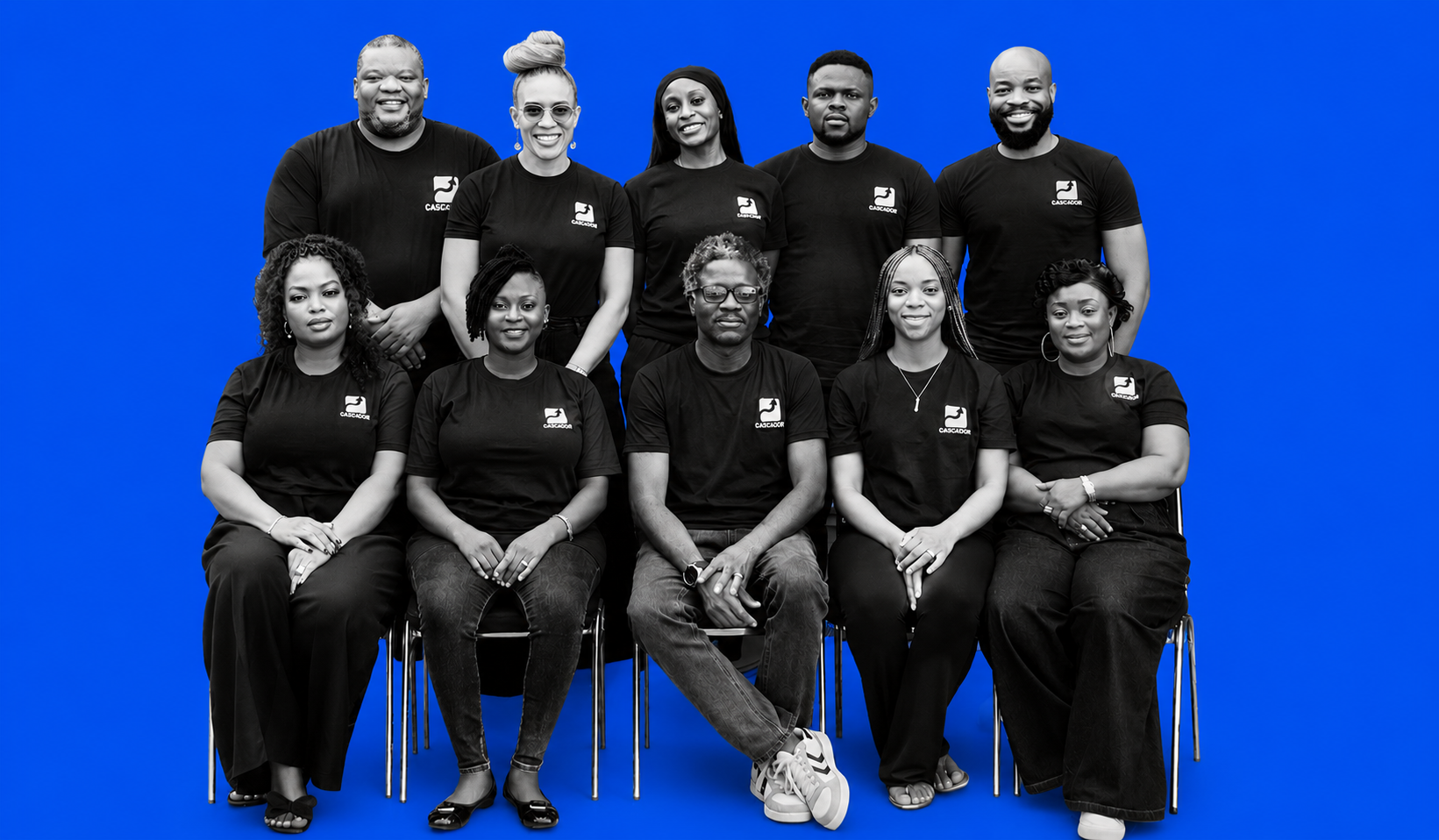
One of the ten startups picked to scale this year bakes bread at an industrial level. Another manages a beachfront resort. A third is digging into the wholesale metals trade.
They are precisely the kind of businesses that rarely feature in the splashy headlines about African fintech darlings, and that, according to Cascador COO Oyin Solebo, is exactly the point. Sifting through over 1,000 applications for its 2026 ScaleUp cohort, the Nigeria-focused platform helping growth-stage founders scale deliberately sidestepped the pure-play tech hype cycle to bet on the gritty, tangible economy.
The final ten, which include ColdHubs (solar cold storage), EHA Clinics (primary healthcare), and SunFi (solar financing), represent a quiet rebellion against a venture capital playbook that has historically struggled to price risk outside of digital payments. For Solebo, the overwhelming volume of applications, more than double last year’s pool, revealed a deeper truth that Nigeria’s pipeline of scalable businesses is hiding in plain sight, built not on venture dollars but on customer receipts, supplier credit, and sheer operational grit.
“We received more than 1,000 qualified applications,” Solebo tells WT. “What surprised us most was how much entrepreneurial depth exists beyond the part of the Nigerian ecosystem that typically gets the headlines. Many of these founders may never describe themselves as ‘startup founders’ and may never have raised institutional venture capital.”
The scale trap
Cascador’s focus on “growth-stage” rather than early-stage ventures forces a difficult reckoning for founders. Solebo argues that many Nigerian entrepreneurs stumble at the transition from proving a business works to actually scaling it, largely because they confuse growth with scale.
“Growth is doing more, the same way. Scaling requires doing things differently so that the business can achieve exponential growth without costs and complexity increasing at the same rate,” she explains.
Solebo adds that the hustle, improvisation, and relationship-based problem-solving that get a company off the ground become constraints when you are trying to build an institution. “Capital can accelerate a strong organisation, but it can just as easily amplify the weaknesses in an unprepared one.”
This philosophy explains why some applicants that looked impressive on paper were rejected. “Sometimes deeper diligence exposed weak unit economics, financial or governance concerns,” Solebo admits. In other cases, the rejection came down to coachability, a harder-to-measure quality. “We simply were not convinced that the founder would absorb and act on what the programme had to offer.”
Cascador calls these ideal participants “learning multipliers”; founders who absorb ideas, challenge their own assumptions, and translate insights into better decisions. Over time, they build “resource multipliers” capable of creating disproportionate value from the capital and networks around them.
A costly mismatch often ignored
Perhaps the most contrarian insight from Solebo concerns financing. She argues that Nigeria’s growth-stage funding gap is not primarily a shortage of dry powder, but a structural mismatch between what capital providers offer and what businesses actually need.
“A profitable company that needs working capital to fulfil confirmed orders shouldn’t necessarily sell permanent equity to finance a short-term, self-liquidating need,” she says. “Equally, a company entering an untested market probably shouldn’t finance that uncertainty with expensive short-term debt.”
Yet for years, that binary choice—expensive commercial debt or venture-style equity—was the only game in town for many founders. Cascador’s Catalytic Fund, which deploys up to USD 5 M annually in partnership with Sterling Bank, tries to reverse that equation by asking what instrument actually fits the business constraint, whether it is local-currency debt, guarantees, or a blended structure. Sometimes, Solebo notes, the right answer is to not raise at all.
The cohort itself reflects this pragmatic, sector-agnostic approach. With 60% women-led businesses and founders from five of Nigeria’s six geopolitical regions, the 2026 class spans healthcare, agriculture, clean energy, food manufacturing, beauty, fitness, tourism, property tech, and critical minerals. Venco, Beauty Hut Africa, BEYOND Fitness, Ziba Beach Resort, Tulay Africa, Maanj Africa, and Finger Chops make up the rest of the cohort.
“Finger Chops has been able to grow from a catering service into a trusted full-scale bakery serving communities and businesses. But our vision does not stop there; we want to build a leading African food manufacturing company rooted in quality, locally sourced products and operational excellence. Being selected for Cascador’s 2026 ScaleUp Program brings us closer to making that vision a reality, and we look forward to all the opportunities it brings,” Adenike (Oyebola) Fetuga, CEO of Finger Chops, said in a press release.
Since 2019, Cascador has supported 70 ventures that have collectively raised over USD 125 M and, in 2025 alone, delivered essential products to more than 1.7 million customers. But Solebo is careful not to overstate the role of capital in that success. “Two businesses given exactly the same amount of money can produce completely different outcomes,” she says. “What often differentiates them is the quality of the judgement applied to that capital.”
That judgement sometimes means doing less, not more. “Progress is not always synonymous with expansion,” she adds. “Sometimes the best decision a founder can make is to narrow the target customer, abandon a product, or delay entering a new market.”
Solebo admits that Cascador itself has had to evolve. In its early years, the program gave outsized weight to classroom-style education. Today, the emphasis has shifted toward hands-on execution support, governance structures, and hiring strong leadership teams. “For our founders to grow as leaders, durable support structures must be in place as they execute on the knowledge gained,” she says.
It’s all well and good that the latest cohort steers clear of abstract digital experiments and focuses on what touches lives day to day: the cold rooms keeping tomatoes from rotting, the clinics offering primary care, or the solar panels powering small businesses. But whether the financial machinery can finally catch up to the reality on the ground is the next big question.