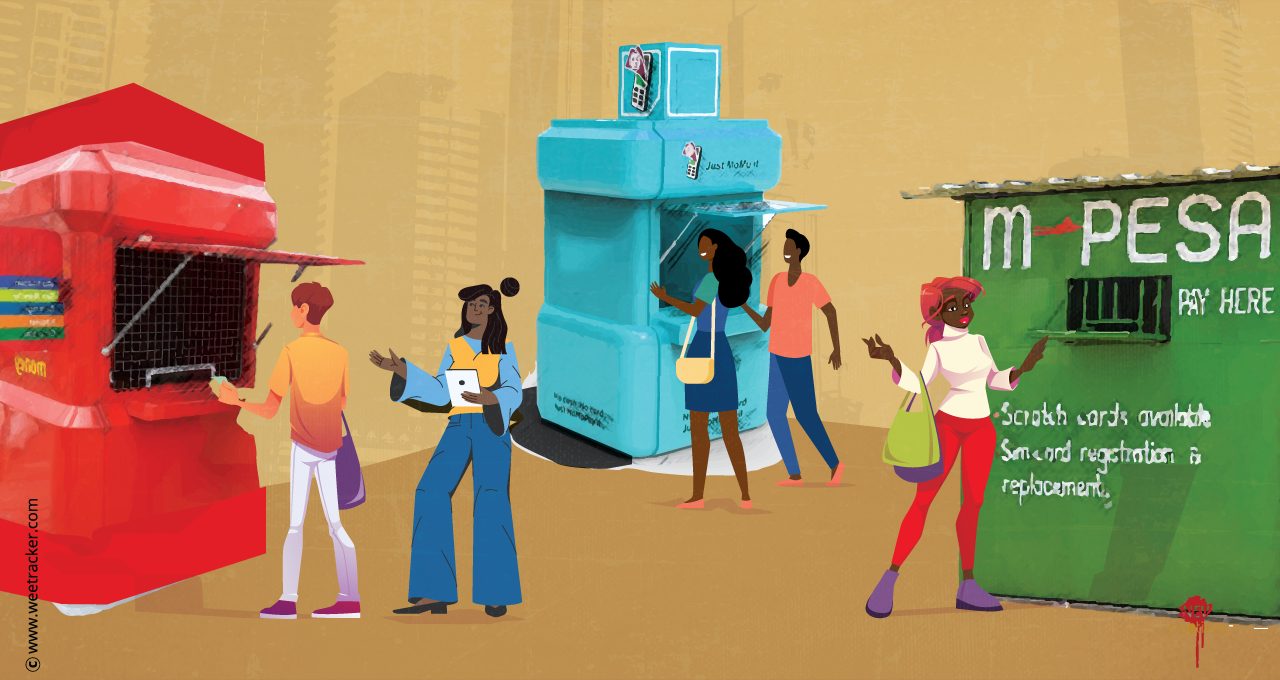
It’s not uncommon to hear that Kenya’s mobile money revolution has about as much to do with technology as with hundreds of thousands of small shops, kiosks, and street corners where a generation of Kenyans learned to trust digital money, one deposit and withdrawal at a time. That network is now shrinking.
Communications Authority of Kenya data show registered mobile money agents fell 5.6% between March and June, from 602,470 to 568,463. The decline came even as mobile money subscriptions climbed to 54.01 million, pushing penetration to 101.3%. More Kenyans are using mobile money than ever, but fewer are using agents to do it.
The two numbers tell the same story from opposite ends. Mobile money is succeeding so thoroughly that it is beginning to make its own physical infrastructure redundant. For nearly two decades, agents were the human API connecting cash to digital wallets, especially where bank branches were scarce. Now smartphones, interoperability, and merchant payment systems are letting customers bypass that step entirely.
Central Bank of Kenya data show active agents processed 212.45 million cash-in and cash-out transactions worth KES 682.46 B (~USD 5.26 B) in June alone. That is still a lot of money moving through the agent network. But the direction of travel is changing.
The value of cash handled by agents fell by a record KES 430.3 B (USD 3.3 B) in the first eleven months of 2025, the sharpest drop in Kenya’s history. The Central Bank attributed the decline to shifting usage patterns rather than reduced relevance, noting that users increasingly consolidated transfers into fewer, higher-value payments and adopted merchant payment channels instead of withdrawing cash.
***
The economics of being an agent are also getting harder at exactly the moment the network has grown more crowded. Safaricom’s M-Pesa agent base expanded 11.4% to 333,011 in the year to March 2026. Total commissions paid to agents rose just 0.3% to KES 37.4 B (USD 288.6 M) over the same period. Average annual commission per agent fell 10% to KES 112.2 K (USD 866.41), or roughly KES 9.353 K (USD 72.20) a month.
The commission pot is growing at 1.3% while the agent count grows at 20%. That dilution is the quiet crisis beneath the headline decline. “The average agent is now generating gross revenue of less than KES 10 K per month,” noted one analysis of Safaricom’s half-year disclosures. “For a standalone shop paying rent and electricity, this is statistically a loss-making venture.”
When M-Pesa launched in 2007, agents were the only way to convert cash into digital value. Interoperability between networks since 2022 has weakened the lock-in that once made a single agent’s location a competitive moat.
Merchant payment systems like Lipa na M-Pesa and Pochi la Biashara now let customers pay directly from their wallets without withdrawing cash first. Pochi la Biashara revenue grew 86% in the year to March 2026, while withdrawal revenue actually declined 0.7% even as total M-Pesa revenue grew 14%.
Agents are processing more transactions for less money. Total M-Pesa transaction volume grew 26.5% in the same half-year period, but transaction value grew only 5%. More small transactions mean more time serving customers and more liquidity rebalancing trips, without a proportional increase in commission income.
Some agents are adapting. A growing number now offer agency banking services for institutions like Equity Bank, KCB, and Co-operative Bank alongside mobile money, and others operate both M-Pesa and Airtel Money outlets to widen their customer base.
The Central Bank’s planned 57% cut in mobile money transfer fees by 2028, part of its National Financial Inclusion Strategy, will further compress the commission pool unless transaction volumes rise enough to compensate. Analysts at FSD Kenya estimate that 90,000 agents could close, mainly in sparsely populated regions.