Nigeria’s national grid collapsed at least four times in 2025, and another two times in the first two months of 2026. In January alone, it failed twice within a week. Power generation crashed from 3,825 megawatts to 39 megawatts in minutes, plunging a country of over 200 million people into darkness yet again.
By one count, the grid has collapsed more than 100 times over the past decade. The national grid, a patchwork of ageing infrastructure and insufficient generation, has failed so often that its collapses are barely newsworthy anymore.
But for a growing number of Nigerians, the grid’s fragility is no longer the crisis it once was, thanks to the emergence of battery rentals, a new kind of alternative that is being embraced in parts of the country.
MOPO, an Africa-focused battery rental company backed by Octopus Energy Group, just announced a USD 75 M agreement with Nigeria’s Rural Electrification Agency to expand its pay-per-use battery rental operations nationwide by 2030. The deal begins with a pilot program this year before scaling across the country over the next four years.
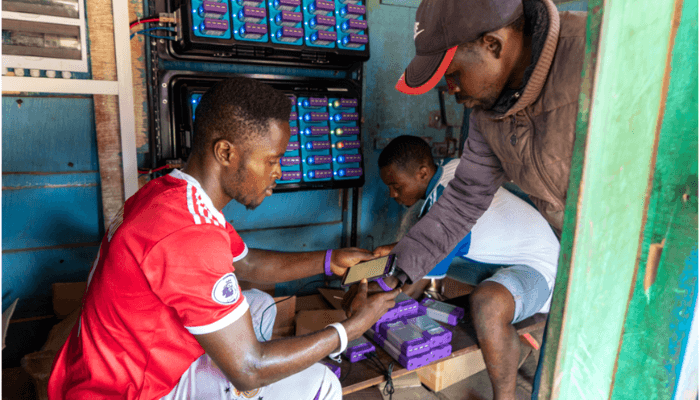
MOPO, which calls itself the largest battery rental provider on the continent, operates solar-powered charging hubs managed by local agents. Customers rent rechargeable batteries by the hour or day, use them to power phones, lights, televisions, fans and small appliances, then return them when depleted. In Lagos, residents rent power banks for just NGN 300.00 (USD 0.22) daily.
The model enables people to pay for electricity when they need it, for as long as they need it, without resorting to expensive solar panels and inverters, or generators guzzling petrol at well over NGN 1 K naira per litre these days.
Battery rental services are not a long-term solution to Nigeria’s energy crisis but a pragmatic response to an immediate problem. Some might say they are painkillers, not vitamins; treating a chronic condition rather than curing it.
“We solve a lot of the problems that mini-grids and solar home systems struggle with,” MOPO Chief Operating Officer Luke Burras told Bloomberg. “We rent batteries to customers for hours. We’re not asking them to buy an asset in the case of solar home systems, and we’re not asking investors to place a huge bet on their future usage as with mini-grids”.
Solar home systems require a significant upfront investment, often beyond the reach of low-income households. Mini-grids demand long-term commitment and sustained demand. Battery rental requires neither. It offers immediate, flexible and affordable access to electricity, priced in units that match how people actually earn and spend.
***
MOPO has completed more than 32 million battery rentals across six countries, including Nigeria and the Democratic Republic of Congo. The company grew from 67 employees in 2022 to 126 by July 2026. It has attracted investment from Octopus Energy, Norway’s Norfund and the International Finance Corporation.
Other players are entering the market. In May, bPOWERd expanded into Lagos, launching battery rental hubs at Mobil fuel stations. Daily rates start from NGN 1.5 K (USD 1.10) for a 300Wh battery and NGN 3 K (USD 2.19) for a 1,000Wh battery, enough to power essential household appliances. The company claims its service is 70% cheaper than running a petrol generator.
Nigeria has the world’s largest electricity access deficit. Despite being one of Africa’s biggest economies, the country’s grid is unreliable and underfunded. Generators have become the default backup for millions, but fuel costs have risen sharply, making them increasingly unaffordable. Meanwhile, the adoption of home solar power systems remains hamstrung by huge upfront costs.
Battery rental sits in the gap between the grid and the generator. Providers say it offers reliability without ownership, flexibility without commitment, and clean energy without the emissions.
The market seems to agree. Climate tech has surpassed fintech as Africa’s top venture-funding sector, accounting for nearly 40% of annual investment in 2025. Battery rental is one of the clearest expressions of that shift. And while it’s hardly a cure for Nigeria’s energy crisis, it’s proving useful for millions of Nigerians who see it as a reliable source of power in a country where the grid fails as often as it works.