Covid-19’s Attempt To Snuff Out African Tobacco Is Going Up In Flames

By Andrew Christian  |  May 29, 2020

At the end of March, South Africa had imposed the most severe and controversial lockdown in Africa. To add to its combating efforts against the coronavirus, the nation included a ban on the sale of alcohol and tobacco.

The effects rang throughout Southern Africa, the unofficial capital of the continent’s tobacco business. In as much as Covid-19 presented a challenge for the industry, there is reason to believe that the later would be greater than the present.

Developing Africa has become an attractive market for the tobacco industry due to its increases in its income, growing population size, foreign direct investment (FDI), and improved life expectancy.

A Ban That Backfired

South Africa plans to ease its nationwide lockdown as from June 1, allowing limited alcohol sales and the reopening of bars. But, the government does not show signs of lifting the ban on tobacco products like vapes and snus.

The initial, controversial plan was to reduce the rate of tobacco and alcohol-related health emergencies in a bid to free up hospital beds for coronavirus patients. Nonetheless, the prohibition, which has been frowned upon as an unnecessary move dipped in unexplainable dubious governance, is pointless.

At least, that is according to a fresh study from the University of Cape Town which surveyed over 16,000 people about how they’ve been affected by the country’s cigarette ban.

The highlight of the study is that the ban on the sales of cigar is failing more than it is succeeding. Its original aim was to support the health of South Africa’s public, but the current downsides are beating the advantages to the game. Most of all, smokers are illicitly getting cigars in even larger quantities, giving unusual brands a shot at mattering.

41 percent of the persons considered in the survey made attempts to quit smoking, with only 39 percent being successful. 61 percent said they did not bother to wean themselves off cigars, while 12 percent of the actual quitters said they’d pick back up once the ban is lifted.

In April 2020 alone, South Africa’s government lost an estimated USD 16 Mn in taxes due to the tobacco prohibition. It is this large because the industry is worth over USD 1.7 Bn (ZAR 30 Bn) and is supported by 8 million adult consumers. Nevertheless, it continues to be seriously affected by the rampant growth in illicit cigarettes.

The industry contributed ZAR 10.9 Bn (USD 622,548,050) in excise duty to the fiscus in 2017/2018, but illegal trade grew to 33 percent of the total market in 2018, according to an industry report from Research and Markets.
Comeback Foreseen

Africa can produce its own tobacco, sell it within and consume within— for such an uncertain period in history, that is a good thing.

The present challenges are much, but there is much to be gotten post-lock down. Bongani Cigars, a Mozambique-headquartered producer of Cuban-style luxury cigars in Africa, is being affected because supply chains have been dried up, thanks to travel restrictions and border closures.

“Nevertheless, we are seeing strong demand that should be enough to offset the months of idleness in the business,” Kamal Moukheiber, founder and CEO of Bongani, told WeeTracker.

According to the Lebanese entrepreneur, clients have been affected by the pandemic, but everyone expects for things to go back to more than normal after the lockdown, especially in South Africa where the industry is more pronounced.

Kamal added: “Local currencies have gone down compared to the United States dollar. It would be hard to get materials from abroad for the meantime, but there are ready distributors and consumers. Once the restrictions are eased and supply chains are rejuvenated, we can easily make up for lost time.”

In Zimbabwe, the Covid-19 regulations mandated by TIMB demands for the decentralization of tobacco auction floors for the current season. It has turned out to be a blessing in disguise for farmers whose movements have become cheaper and sales proven more productive.

Every year, tobacco farmers in Zimbabwe make long trips to Harare to deliver their produce. They risk spending days at the auction floors and falling prey to thieves in the capital.

But, thanks to Covid-19, they need not go through the stress and have the opportunity to earn a lot more. Well, only 15 percent of tobacco sales in 2019 were conducted outside Harare.

Even Inside The Lockdown

Presently, South Africa is not the only country whose tobacco industry is being swayed by the novel pandemic. In Malawi, where tobacco accounts for 11 percent of GDP and more than 60 percent of its export earnings, the Covid-19 situation has pretty much disrupted its usual auctions where it gets a huge chunk of money.

Meanwhile, the United States had restricted the importation of tobacco from Malawi, and issued a withhold release order over child labor practices. Still, there is a 4.5 percent increase in tobacco sales against USD 37.7 Mn dollars made during the same period in 2019.

The 5-week USD 39.4 Bn sales value validates the optimism of Malawi’s Minister of Agriculture and Irrigation, Francis Kasaila, who felt that the market will be good despite the pandemic.

In Zimbabwe, also, farmers complain of tight restrictions on movement introduced since the emergence of the pandemic, making it difficult to sell their produce. This month (May), the country’s tobacco season was already one month due. As it is, farmers are struggling to reach the auction house in the country’s capital, Harare.

Social distancing measures made the government promise to decongest the main auction center by setting up exchanges elsewhere. But those plans are yet to materialize.

Despite this, Zimbabwe has raked in USD 64.4 Mn from the sale of 28.2 million kilograms of tobacco in a matter of 16 days, according to the Tobacco Industry and Marketing Board (TIMB). Out of the 97 percent of contract-crop tobacco that was delivered, only 3 percent went to auction floors.

That means, Covid-19 is giving contract floors an emergency boost, as buyers offered a highest price of USD 6.60 kilograms, while auctions remained at USD 4.99 per kilogram.

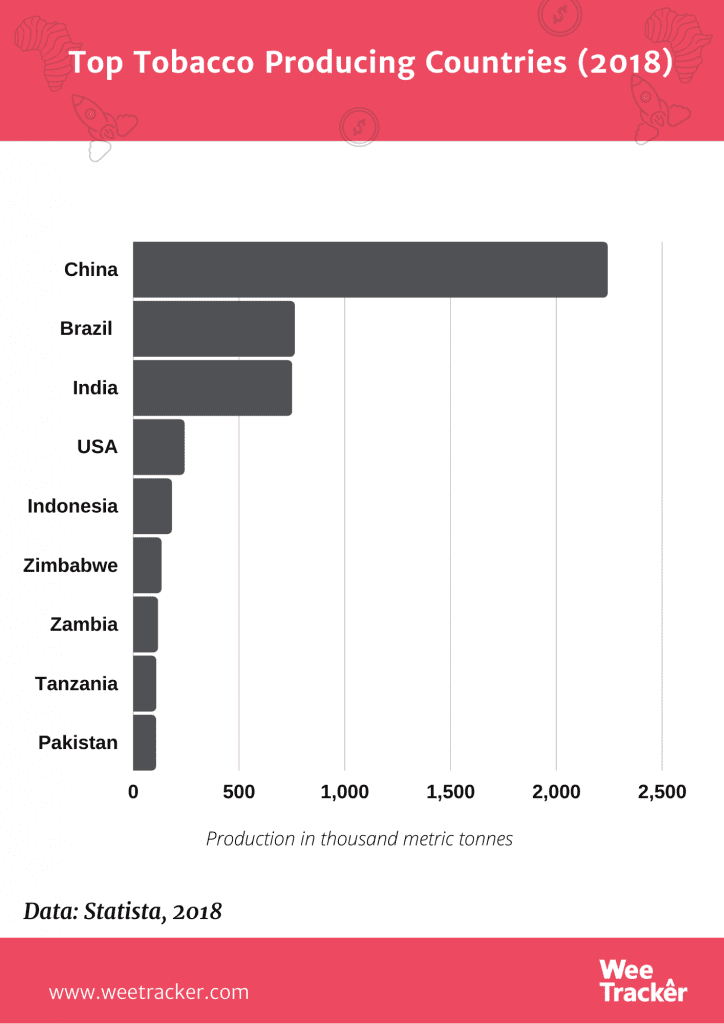
As tobacco production increases in Africa, so too does consumption. A study examined cigarette consumption in 22 countries, which host 80 percent of the continent’s population. It found that between 1990 and 2012, cigarette consumption increased from 165.6 billion to 238.5 billion cigarettes, or by 44 percent.

Photo by Kilian Via Unsplash.

How Nigeria Made Its Ugly Inflation Problem Look Less So With New Math

By Henry Nzekwe  |  January 16, 2026

Nigeria’s official inflation rate has undergone a statistical transformation, a technical process that has drastically changed the headline number millions use to gauge their cost of living.

The latest data from the National Bureau of Statistics (NBS) reported that inflation fell sharply to 15.15% in December. This was down from 34.80% a year earlier and seemed to signal a dramatic cooling of prices. But the journey to this number involved more than just prices coming down; it came about by changing the ruler used to measure them.

At the heart of this change is a process called “rebasing.” Simply put, Nigeria had been measuring price changes for a 2025 economy using a shopping list and spending habits from 2009. After 15 years—far beyond the recommended five-year update cycle—that list no longer reflected reality.

In a nationwide survey, the NBS discovered Nigerians no longer bought 201 outdated items. Gone from the official inflation basket are relics like black-and-white televisions and Nokia 3310 phones. In their place, statisticians added 404 new products and services that people actually spend money on today, expanding the total basket to 934 items from about 740. This update, based on 2023 spending patterns, aims to make the index mirror modern life.

The new math, which was adopted at the start of last year, promptly saw Nigeria’s headline inflation drop to 24.48% in January 2025 (from 34.80% in December 2024) after the methodology and base year were changed. That headline metric largely eased throughout last year as some measure of stability was achieved. It is worth noting, however, that even as the wild price shocks from the period prior subsided, prices remained elevated.

Updating the basket was just one step

The NBS then faced a mathematical hurdle. By setting the new base year to 2024, comparing December 2025 directly to December 2024 would have created a misleading spike. Officials projected that under the old calculation, inflation would have appeared to jump to 31.2%. The NBS described this as an “artificial spike” caused by the base effect’ a technical distortion, not a real surge in prices.

To avoid this, the bureau changed its calculation method. Instead of comparing this month to the same month last year, it used a 12-month average of 2024 prices as its reference point. This “normalised” the figure and prevented the one-off distortion, resulting in the reported 15.15%.

The government and international bodies have endorsed the overhaul. The International Monetary Fund (IMF) stated the new method aligns Nigeria with international best practices and the ECOWAS framework. Central Bank Deputy Governor Muhammad Sani Abdullahi called it a fix for a “purely mathematical issue,” not an attempt to disguise higher prices.

However, the sudden shift has drawn scrutiny from prominent economists. Yemi Kale, who led Nigeria’s statistical agency for a decade, warned the transition may have been rushed, creating a gap in year-on-year comparisons that undermines analysis.

“How do you calculate year-on-year when you say the previous numbers are not comparable?” he asked, highlighting concerns about consistency and transparency.

For the average Nigerian, the disconnect between the new, lower headline rate and daily market prices remains palpable.

While the NBS reports a significant drop in food inflation to 10.84%, the cost-of-living pressure cited by groups like the Nigerian Economic Summit Group (NESG) has not disappeared overnight. The new math provides a revised benchmark, but for many, the feeling in their wallet is the ultimate measure.

South Africa’s 20% Online Gambling Tax Faces Backlash Amid Fears Of Blowbacks

By Henry Nzekwe  |  January 16, 2026

South Africa’s National Treasury has been forced to extend a public consultation on a proposed 20% national online gambling tax after facing a fierce backlash from industry and legal experts who warn the plan is unconstitutional and could backfire by pushing bettors to unregulated offshore sites.

The deadline for comment has been pushed back by nearly a month to February 27 after stakeholders requested more time to dissect the contentious proposal. The move comes as critics, including a prominent policy institute, label the tax a “naked revenue grab” that “threatens the very existence of the legal gambling market”.

The Treasury’s draft discussion paper, published in late 2025, proposes a 20% levy on the gross gambling revenue of all online betting operators. This would be a national tax, layered on top of existing provincial gambling taxes of 6% to 9%. The rationale is twofold: to curb the “social harms” of problem gambling and to capture revenue from a sector experiencing explosive growth.

Data from the National Gambling Board shows the immense scale of the market. In the 2024/25 financial year, approximately ZAR 1.5 T (USD 92 B) was wagered in South Africa, a surge of almost one-third from the previous year. The Treasury estimates the new tax could generate over ZAR 10 B annually for government coffers.

The core of the opposition lies in a potential constitutional clash. Gambling regulation is primarily a provincial competence in South Africa. Legal analysts argue that imposing a separate national tax on the same revenue base illegally centralises fiscal power.

Ayanda Zulu, a political studies graduate commenting for the Free Market Foundation, told Focus Africa that the proposal “should not see the light of day” and “undermines democratic practice due to the lack of meaningful consultation”.

Industry bodies, including the South African Bookmakers’ Association (SABA) and the South African Responsible Gambling Organisation (SAROGA), warn the combined tax burden could make licensed operators uncompetitive. They fear it will inadvertently bolster illegal offshore platforms, which offer better odds and operate outside South Africa’s consumer protection and anti-money laundering frameworks.

This is not the government’s first attempt to tax gambling revenue. Past proposals, including a 15% withholding tax on winnings in 2011 and a 1% national levy in 2012, were abandoned after consultations revealed enforcement complexities. Critics note the current proposal is particularly fraught as it seeks to tax interactive gambling (like online casinos), which remains technically illegal under South African law due to an un-promulgated 2008 act.

The Treasury defends its approach, arguing that online gambling, unlike physical casinos, creates few local jobs or infrastructure benefits and is “easily available… almost anywhere and at any time,” necessitating a unified national response.

With the extended deadline, the battle lines are drawn. The government is betting on a new revenue stream and social policy tool, while the industry and legal experts are calling the play, warning it risks undermining the rule of law and the viability of the very market it seeks to control.

Feature Image Credits: iGaming Afrika

Uganda Falls Silent Online, But A New ‘Bluetooth’ Lifeline Rises From The Streets

By Henry Nzekwe  |  January 15, 2026

On Tuesday, January 13, as the sun set over Kampala, Uganda’s digital heartbeat flatlined. Following a directive from the state regulator, the Uganda Communications Commission (UCC), mobile network operators were ordered to suspend public internet access nationwide from 6 p.m., plunging approximately 27 million users into online silence just 48 hours before a pivotal presidential election.

The official justification, citing the prevention of “misinformation, disinformation, [and] electoral fraud,” was a stark reversal of the government’s own assurances. Only a week prior, on January 5, senior officials had held a press briefing to label rumours of a shutdown as “false and misleading,” intended to cause “unnecessary fear and tension”. This pattern of pre-election blackouts is now a familiar one; a similar five-day shutdown marred the 2021 election.

For the opposition, led by pop star-turned-politician Bobi Wine, the move was a predictable act of repression aimed at stifling organisation and independent verification of results. It was a move they had anticipated and, crucially, had prepared for.

Offline Messenger Becomes Lifeline

In the weeks leading up to the vote, Bobi Wine had a recurring message for his supporters: “HAVE YOU DOWNLOADED BITCHAT YET?”. His advocacy triggered a digital scramble. According to the app’s developer, downloads in Uganda surged past 400,000 as the blackout loomed, making it the country’s most downloaded application.

Bitchat, a “weekend experiment” launched in July 2025 by Twitter (now X) co-founder Jack Dorsey, is a peer-to-peer encrypted messenger with one defining feature: it requires no internet connection.

Instead, it uses Bluetooth Low Energy (BLE) to create a “mesh network.” A message on one phone can hop to another device within a 30-meter range, which then relays it onward, potentially weaving a communication web across a city block or a protest crowd without ever touching a cell tower.

This makes it a powerful tool for censorship resistance. As Human Rights Watch and other watchdogs condemned Uganda’s shutdown as a violation of fundamental rights, Bitchat offered a technological workaround. UCC Executive Director Nyombi Thembo downplayed the app as “a small thing,” but its developer fired back: “You can’t stop Bitchat. You can’t stop us”.

The Unstoppable Signal

Uganda is not an isolated case. Bitchat and similar apps are becoming standard tools for communication in the most restrictive environments. The technology itself is not new; apps like FireChat and Bridgefy pioneered offline mesh networking years ago.

Their utility has been proven repeatedly; in Hong Kong during the 2019-2020 protests, and in Myanmar following the 2021 military coup, where Bridgefy saw over a million downloads. More recently, in Nepal and Madagascar during 2025 civil unrest, where Bitchat downloads spiked by tens of thousands as protesters sought ways to organise.

The showdown in Uganda is a microcosm of a global conflict between state control and decentralised technology. While governments can flick the switch on centralised internet infrastructure, they cannot as easily disable the short-range, ad-hoc networks that form between devices in a crowd.

The shutdown in Uganda, part of a broader crackdown that included the suspension of critical NGOs, may achieve its immediate goal of disrupting the online flow of information. However, the explosive rise of Bitchat demonstrates a determined public will to communicate.

Feature Image Credits: AFP/Getty Images/I. Kasamani

The Jobs Every Kenyan Company Is Hiring For (And The Ones They Aren’t)

By Staff Reporter  |  January 15, 2026

Kenya’s job market was a mixed bag in 2025, as the data suggests more companies are hiring but filling fewer positions. According to MyJobMag’s latest 2026 Kenya Job Search Report, a record 3,145 companies actively recruited last year, a 7.7% jump from 2024.

However, total job postings grew at less than half that rate (3.3%), meaning the hiring pie is being spread thinner. The result is a fiercely competitive landscape where certain roles are in hot demand, while others are facing a severe downturn. Here’s a breakdown of the winners and losers.

How the Data Was Collected

This report is based on a real-time analysis of 41,792 job listings posted on notable career and job website, MyJobMag Kenya, between January 1st and December 31st, 2025. The data captures active hiring demand directly from employers, providing a snapshot of where opportunities are growing and shrinking.

The Most Sought-After Jobs in Kenya

1. Accountants


Finance remains the backbone of hiring. Accountants were the single most-advertised role, accounting for a massive 15% of all top job postings. This underscores the perennial need for financial oversight and management across all sectors.

2. Sales & Business Development Executives


If you can sell, you’re in demand. Combined, roles like Sales Executives and Business Development Managers accounted for nearly 23% of the top advertised jobs. This trend points to a market focused on growth, customer acquisition, and revenue generation above all else.

3. Education & Teaching


Reflecting a national push for skills development, postings for Education and Teaching roles skyrocketed by 52.8% year-on-year. This was the highest growth among major fields, signalling a boom in opportunities from primary schools to tertiary institutions.

4. Insurance & Science Specialists


Two fields saw explosive demand from a smaller base. Job postings in Insurance surged by 47.5%, while Science roles jumped by 50.5%. These sectors are recruiting specialists to manage evolving risks and drive innovation.

5. Building/Construction


While starting from a small base, the Building and Construction sector posted a jaw-dropping 776.2% increase in job postings. This signals a major infrastructure and development push, creating new career paths for skilled professionals.

The Least Sought-After Jobs in Kenya

1. NGO & Non-Profit Roles


International funding cuts have hit hard. NGO and Non-Profit job postings collapsed by 58.5% in 2025, the steepest decline of any field. The sector posted only 187 jobs, down from 451 in 2024.

2. Research & HSE Roles


Opportunities for Researchers plummeted by 45.1%, and postings for Safety and Environment (HSE) officers fell by 46.0%. This suggests companies are pulling back on non-core, specialised functions in a tighter market.

3. Remote Work


The dream of working from home is fading in the Kenyan market. Dedicated remote roles dropped by about 34%. The market is overwhelmingly dominated by full-time, on-site positions, which made up 88% of all postings.

4. Project Management & Data Analysis


Businesses are streamlining. Project Management roles saw a stark 33.4% drop in postings, while Data, Business Analysis, and AI roles fell by 27.3%. This indicates a shift away from project-heavy and analytical overhead toward direct revenue-generating activities.

5. ICT & Healthcare


Even typically resilient sectors faced headwinds. ICT/Computer job growth was a modest 3.0%, while the broader ICT/Telecommunications industry actually shrank by 16.8%. Healthcare/Medical postings also declined by 15.4%, reflecting shifting organisational priorities.

Overall, the data indicates Kenya’s job market is becoming more selective and commercial. Employers are prioritising roles that directly drive sales, manage finances, or build essential skills. For job seekers, the shrewd strategy is to align skills with high-growth, revenue-focused sectors like sales, finance, education, and the booming construction industry.

Meanwhile, it would also be expedient to prepare for fierce competition in social sector roles and a return to the office, as remote work opportunities dry up.

Feature Image Credits: FKE-Kenya

Paystack’s Foray Beyond Payments Faces Rugged Rivals In Belated Push

By Henry Nzekwe  |  January 14, 2026

After a decade as the quiet backbone of Nigeria’s online payments, Stripe-owned Paystack is making a shrewd and decisive pivot into banking, as part of a broader recent foray beyond business payments, while hoping it’s not too late to the party.

Its latest move; the acquisition of Ladder Microfinance Bank, which has birthed a new separate company Paystack MFB—along with previous moves that saw it fold consumer play Zap into its stack and pick up assets like business banking startup Brass—communicates reinvention.

Industry analysts reckon Paystack, which has seen some shakeup recently with the controversial exit of co-founder/CTO Ezra Olubi, is keen to capture the higher-margin segments, including lending and deposits.

However, this move plunges the once-niche payments processor into a brutally competitive arena where rugged competitors like Moniepoint, Kuda, and OPay have spent years building formidable, scaled ecosystems. Paystack’s infrastructure-first approach is elegant, but the question is whether its technical prowess can compensate for being late to a party already in full swing.

Paystack’s strategy is a classic infrastructure-up gambit. For ten years, it perfected the “pipes,” processing trillions of Naira monthly for 300,000 businesses. Now, it wants to control the “tank” too.

***

By acquiring a microfinance bank (MFB) license, Paystack gains the regulatory cover to hold deposits, offer loans, and provide banking-as-a-service (BaaS). Its core advantage is data: real-time visibility into merchant revenue flows allows for sharper credit underwriting and tailored products like merchant cash advances.

This expansion is part of a necessary evolution. As one industry analyst notes, African fintech is in a “mid-life crisis,” moving from a hype-driven “First Life” to a “Second Life” where boring, profitable infrastructure and depth matter more than vanity metrics. For Paystack, payments—increasingly a commoditised service—are no longer enough. The new frontier is becoming a “financial operating system” for businesses.

However, Paystack’s conceptual advantage meets a hard reality of scaled incumbents. Its new MFB will compete with a dizzying array of players: traditional lenders, digital-first banks, and embedded finance giants. The competitive gap is significant, as shown by the scale of the leading incumbents.

Moniepoint powers a vast portion of Nigeria’s POS transactions, serving over 10 million businesses and individuals, processing USD 22 B+ monthly. Others, such as OPay (50M+ users and merchants), PalmPay (40M+ users and merchants), and FairMoney (5M+ users), have built massive consumer networks that feed into their merchant services. They have moved beyond customer acquisition into the deep, complex work of unit economics and cross-selling—the very game Paystack is now trying to join.

***

Paystack’s belated push raises several critical questions. First, can it convert its base of 300,000 businesses into active banking clients? Trust as a payment processor is different from trust as a deposit holder.

Second, does it have the distribution muscle? Its competitors have thousands of agents and consumer-facing brands; Paystack’s brand is largely B2B. Third, can it navigate the regulatory and operational complexities of lending? A recent NGN 250 M fine for its consumer app Zap shows the regulatory tightrope it must walk.

The company is betting that its technical reliability, data insights, and focus on elegant APIs for developers will carve out a premium niche. In an industry shifting toward resilience and profit, this infrastructure-play has merit. However, it is entering a market where the winners are already scaling toward profitability—OPay recently announced its first monthly profit—and the small business financing gap, while large at an estimated USD 32 B, is already being contested by many well-funded players.

Paystack’s new chapter is a bold attempt to write a second act as it trades the comfort of being a specialist for the treacherous opportunity of being a generalist. The next few years will test whether Paystack’s infrastructural elegance can disrupt a market ruled by scaled, street-smart giants.

Uganda Orders Internet Blackout Ahead Of Vote, Reversing Earlier Shutdown Denials

By Staff Reporter  |  January 13, 2026

The Ugandan government has ordered a comprehensive shutdown of public internet access and key telecommunications services, a measure taking effect just 48 hours before a presidential election where President Yoweri Museveni aims to extend his four-decade rule.

The directive from the Uganda Communications Commission (UCC), issued on January 13 and effective from 6 p.m., instructs all mobile operators and internet service providers to suspend services until further notice. The regulator stated the blackout was a “necessary” step following a “strong recommendation” from security agencies to prevent the spread of misinformation, electoral fraud, and incitement of violence.

Beyond blocking access to social media, messaging apps, and general web browsing, it also halts the sale of new SIM cards, suspends outbound roaming to neighbouring countries, and instructs operators to disable mobile Virtual Private Networks (VPNs) used to circumvent restrictions. The measures affect all connection types, from mobile data to fibre optics and satellite services.

Crucially, the government had denied any such plans just over a week earlier. On January 5, the Ministry of ICT and the UCC held a joint briefing to label rumours of an imminent shutdown as “false and misleading,” stating no decision had been made.

The shutdown directly impacts an estimated 10.6 million internet users in Uganda and occurs as the country’s 21.6 million registered voters prepare to cast their ballots on January 15. While essential services like core banking, healthcare systems, and government portals are exempted, ordinary citizens and businesses are cut off from the global internet.

This action follows a familiar pattern. During the disputed 2021 general election, authorities imposed a near-total internet blackout lasting approximately 100 hours. A report by internet research group TOP10VPN estimated that shutdown cost the Ugandan economy roughly UGX 390 B, placing it among the world’s top five for economic losses from such actions.

President Museveni, 81, faces seven challengers, including his main rival from the last election, opposition leader Bobi Wine. Campaigning has been tense, with the opposition reporting hundreds of arrests among its members.

Digital rights advocates condemn the move as an erosion of fundamental freedoms. A similar shutdown in 2021 was criticised by groups like CIPESA for curtailing access to information and hindering independent election monitoring during a crucial democratic process.

Feature Image Credits: Unwanted Witness

Nigeria Moves To Enforce Strict AI Rules Amid Adoption Challenges

By Staff Reporter  |  January 13, 2026

Nigeria is on track to pass landmark legislation establishing one of Africa’s first comprehensive regulatory frameworks for artificial intelligence. The National Digital Economy and E-Governance Bill, expected to be enacted by March, aims to balance innovation with ethical safeguards in one of the continent’s most dynamic digital markets.

The bill empowers the National Information Technology Development Agency (NITDA) to act as a “super-regulator,” classifying AI systems by risk, mandating transparency, and requiring annual impact assessments for high-stakes applications in finance, public administration, and surveillance. Non-compliance could lead to fines of up to NGN 10 M (~USD 7 K) or 2% of an AI provider’s annual Nigerian revenue.

This push for governance reflects Nigeria’s broader ambition to transition from rapid digital adoption to sustainable, value-driven growth. The digital economy is projected to generate USD 18.3 B in revenue by 2026, with the AI market alone forecast to hit USD 434.4 M.

However, the regulatory sprint unfolds against a backdrop of significant readiness challenges, creating a complex landscape of competing priorities. Nigeria’s pioneering push to regulate artificial intelligence confronts significant implementation hurdles, including the challenge of avoiding legislative redundancy and ensuring coherent enforcement across government agencies.

These governance efforts are set against a backdrop of low domestic AI adoption, estimated at just 8.7%, which reflects deeper structural barriers. The country’s AI readiness ranks 72nd globally, with adoption concentrated in large firms due to high costs and persistent infrastructure gaps that limit broader access and innovation.

Authorities acknowledge that regulation alone is insufficient. “You cannot be ahead of innovation,” said Kashifu Abdullahi, Director General of NITDA. “Regulation is not just about giving commands. It’s about influencing market… so people can build AI for good.”

Simultaneously, a massive upskilling effort is underway. In collaboration with Microsoft, over 350,000 Nigerians have been reached with AI skills training, part of a push to prepare for an estimated USD 1.5 T AI-driven opportunity for Africa by 2030. This focus on demand-side readiness is critical; as stakeholders warn, without leaders who understand AI, adoption will stall.

The proposed law also includes provisions for regulatory “sandboxes”—controlled environments where startups can test technologies under supervision—signalling an intent to foster, not stifle, innovation.

For global tech firms from Google to Chinese cloud providers, operating in Africa’s most populous nation is about to change. Nigeria’s bet is that by setting clear rules and building skills today, it can harness AI’s potential to drive inclusive growth, rather than be disrupted by it.

The Five Best-Performing Stock Markets In Africa (2025 Scorecard)

By Henry Nzekwe  |  January 12, 2026

In 2025, an exciting narrative permeated global finance in the shape of several African stock markets delivering some of the world’s highest returns for foreign investors, decisively outperforming major global benchmarks. This surge, tracked by the investable indices of Morgan Stanley Capital International (MSCI), signals a growing recognition of the continent’s economic potential.

MSCI indices are the leading global benchmarks for international investors. The ranking below is based on the USD-denominated returns for 2025 from the specific African markets included in the MSCI Frontier and Emerging Markets Indices.

A Look at the Top Performers

1. Egypt


Egypt’s stock exchange was the uncontested leader, delivering a stellar 99% dollar return in 2025. This phenomenal performance was powered by double-digit share price growth in major companies like Commercial International Bank (CIB) and a 6.2% appreciation of the Egyptian pound against the US dollar, which amplified gains for foreign investors. Momentum has continued into 2026, with the MSCI Egypt Index showing strong gains in early January.

2. Kenya


The Nairobi Securities Exchange (NSE) secured second place with a 52.2% return, building on its position as Africa’s top-performing MSCI market in 2024. Unlike Egypt, Kenya’s gains came almost entirely from share price appreciation, as the Kenyan shilling was largely stable against the dollar. Performance was driven by heavyweights like Safaricom (+66.3%) and KCB Group (+58.1%), as well as spectacular surges in small-cap stocks such as Kenya Power.

3. Nigeria


Nigeria’s market closed 2025 on one of its strongest notes in nearly two decades. The MSCI Nigeria Index posted a 47.2% gain, reflecting a broader market rally fueled by macroeconomic stabilisation, banking sector recapitalisation, and significant market reforms. The total market capitalisation approached a landmark NGN 100 T, underscoring the surge in investor confidence.

4. & 5. Zimbabwe and Côte d’Ivoire


Rounding out the top five, Zimbabwe and the regional Bourse Régionale des Valeurs Mobilières (BRVM), which serves Côte d’Ivoire and other West African Economic and Monetary Union states, posted very similar returns of 44.5% and 43.6%, respectively. Their performance highlights strong investor interest in diverse frontier markets across the continent.

Why Weren’t Other High-Flying Markets on This List?

Reports of even more explosive returns in other African markets have made waves. For instance, the Malawi Stock Exchange soared nearly 248% in 2025, and Ghana’s exchange delivered over 154% for dollar investors.

These markets do not appear in the MSCI top five because they are not currently included in the specific MSCI Frontier and Emerging Markets Indices that the ranking is based on. MSCI indices are designed to be investable benchmarks for international investors, and they include markets based on criteria like size, liquidity, and openness to foreign ownership.

MSCI tracks a specific, investable basket of large and mid-cap stocks in 10 African countries, serving as a practical benchmark for global institutional capital. Other rankings often use local, broad-market indices (like the Malawi Stock Exchange All Share Index), which include all listed companies and can be driven by a handful of high-flying stocks in very small, illiquid markets.

In short, MSCI’s list shows where large-scale, international money flowed in 2025, while other lists may capture dramatic local rallies in smaller, more specialised markets.

What This Means for Investors

While the growth is impressive, it’s important to understand the scale. African equity markets, while progressing, remain small and concentrated compared to global peers. The entire continent’s listed companies represent only about 0.4% of global market capitalisation. Activity is heavily concentrated in a few nations like South Africa, Egypt, Nigeria, and Morocco, and markets often face challenges with liquidity and high trading costs.

Nevertheless, the 2025 performance is a powerful signal. It demonstrates that with the right reforms and stable conditions, African capital markets can offer compelling risk-adjusted returns, attracting the attention of global investors looking for the next generation of growth.

The strong showing from frontier markets like Kenya, Nigeria, and Côte d’Ivoire suggests growing depth and resilience beyond the continent’s larger, more established emerging markets like Egypt and South Africa.

Nigeria’s Complicated Crypto Story Enters New Phase: Revenue First, Rules Later

By Henry Nzekwe  |  January 8, 2026

As Nigeria’s new cryptocurrency tax regime takes effect this January, the government’s push for revenue is colliding head-on with an industry still waiting for clear rules. The industry yet again finds itself caught between aggressive government policy and regulatory uncertainty.

While authorities push to collect revenue from digital asset transactions, most crypto exchanges still operate without formal licenses, highlighting what experts call a “revenue first, rules later” approach that threatens to stifle the very market it aims to formalise.

Ayotunde Alabi, CEO of Luno Nigeria, a prominent crypto exchange, identifies the core issue as an enforcement credibility gap. “When taxation moves faster than licensing and market conduct rules, you create uncertainty over who is ‘in scope,'” he tells WT.

This ambiguity, he warns, unfairly raises costs for serious operators and may push users toward informal peer-to-peer channels, defeating the goal of a transparent, taxable market.

The Nigeria Tax Administration Act 2025 mandates that individuals pay personal income tax on crypto gains. For platforms, called Virtual Asset Service Providers (VASPs), non-compliance brings severe penalties, including an initial fine of NGN 10 M (~USD 7 K), followed by NGN 1 M (~USD 700.00) monthly, with their operational licenses at risk.

However, this firm tax directive exists alongside a regulatory process moving, as one industry stakeholder puts it, at a “snail’s pace.” Over a year after the Securities and Exchange Commission (SEC) launched a regulatory sandbox, only two local exchanges, Quidax and Busha, hold provisional licenses.

Dozens of other startups remain in limbo. Notably, a similar effort in South Africa, another African crypto hub, yielded 59 operating licenses in April 2024, highlighting contrasting momentum.

This misalignment creates a practical dilemma for businesses. Regulators state that failure to pay tax can lead to license withdrawal, but most firms cannot secure a license in the first place. Alabi explains that for platforms, true “compliance” now requires navigating two parallel tracks.

On one track is tax compliance, he notes, which entails registering with authorities and building systems to produce audit-ready reports that map customer gains to naira values. On the other is regulatory readiness, which he explained as demonstrating progress in the SEC’s onboarding pipeline and maintaining robust internal controls, even while a full license remains out of reach.

For the average user, Alabi says compliance is “practical and boring.” It means keeping basic records of transactions and using platforms that can provide formal statements. “The key point,” he stresses, “user response will be driven less by the existence of tax and more by the usability of tax compliance. If filing and record keeping feel impossible, activity will not disappear; it will move.”

A Pattern of Enforcement Before Clarity

Nigeria’s relationship with cryptocurrency has been a rollercoaster of harsh crackdowns and tentative acceptance. In 2021, the Central Bank of Nigeria (CBN) banned banks from servicing crypto exchanges, only to reverse the policy in late 2023.

The most dramatic enforcement action came in early 2024. Nigerian authorities detained two Binance executives for months, accusing the global exchange of manipulating the naira’s value and facilitating illicit flows. The government also directed telecom providers to block access to Binance and other major platforms.

These blocks remain partly in place today, creating a contradictory landscape where the state simultaneously pursues taxes from an industry it actively restricts. This top-down approach has defined Nigeria’s strategy. The SEC has proposed a NGN 1 B (~USD 700 K) capital requirement for VASPs, a sum critics call prohibitive.

For operators, the core complaint is sequencing. The tax law explicitly states that failure to comply can lead to license revocation. But for the majority of companies still awaiting approval, this threat feels abstract.

“How will they implement the tax regime coming next year without proper operator licences when only two exchange platforms are licenced?” financial analyst Rume Ophi asked in November.

Nevertheless, the responsibility for reporting and enforcement will fall heavily on the exchanges. They are required to maintain seven years of customer transaction records, report suspicious activity, and provide periodic customer reports to the tax authority. However, without a clear, accelerated pathway to licensing, critics fear the state lacks the structured mechanism to verify these obligations at scale.

What Comes Next?

The government views crypto taxation as a fair step toward recognising and integrating a booming sector. Between July 2024 and June 2025, crypto transaction values in Nigeria reached an estimated USD 92.1 B. Taiwo Oyedele, Chairman of the Presidential Fiscal Policy and Tax Reforms Committee, has called the new regime “fair, balanced, and globally competitive.”

But industry leaders stress that taxation alone is not a regulatory framework. For the policy to build confidence rather than drive activity underground, clarity and coordination are needed immediately.

To turn this into a confidence-building move, the Luno Nigeria boss argues Nigeria needs an explicit licensing timetable and aligned reporting requirements between the SEC and the tax authority. The goal, he says, should be a system where “one dataset satisfies both” regulators.

Looking at the next three to six months, Alabi predicts a fragmented response from Nigerian crypto users. He expects more “platform shopping” as users seek venues that provide clear documentation for tax purposes. He also anticipates a short-term spike in informal peer-to-peer trading if the tax rollout is perceived as punitive or unclear.

“The cautionary signal is sequencing and coherence,” Alabi says, assessing the message sent to global investors. “If taxation is implemented while licensing remains unclear or slow, global firms interpret that as ‘revenue first, rules later,’ which increases perceived policy risk.”

To turn this into a confidence-building move, he argues Nigeria must publish an explicit licensing timetable and align the reporting demands of the SEC with those of the tax authority. The goal is a system where “one dataset satisfies both.”

For Alabi, the path forward hinges on specific, technical fixes. He says Nigeria’s framework must immediately achieve four things: precise definitions of taxable events, clear valuation standards, proportional enforcement with a realistic transition period, and a trustworthy dispute resolution process.

“Without these,” he implies, “compliance becomes viewed as a risk, not a responsibility. That perception alone can push activity underground.”

His long-term prescription involves three critical actions over the next twelve months: finally operationalising the SEC’s licensing pipeline at scale, building a standardised crypto tax reporting model, and creating a “pro-innovation compliance compact” with the industry.

The economic upside of aligning these pieces is significant. As Alabi puts it, “Formal rails improve investor confidence, reduce fraud exposure, and widen the taxable base without suffocating the market.” The alternative is a continued cycle of uncertainty, where the government’s reach for revenue risks pushing the very economy it wants to tap further into the shadows.

‘Love Is Blind’ Reality Series Will Make Its African Debut In 2026

By Wayua Muli  |  January 8, 2026

It’s official. Netflix’s hit reality dating show, Love Is Blind, is coming to Africa! The streaming service has confirmed it will start shooting sometime in 2026, although cast and shoot details are yet to be revealed. The announcement, made early January, 2026, marks the latest international expansion for the social experiment that challenges singles to find marriage partners without ever seeing them face-to-face.

This African variant is part of Netflix’s aggressive 2026 content strategy for the continent. The South African edition will follow the established global format: Singles will enter purpose-built ‘pods’ to date through speakers, forming emotional bonds before deciding whether to propose. The couples only meet in person after one of them proposes marriage, moving on to a ‘honeymoon’ retreat and eventually living together in the real world to test if their ‘blind’ connection can survive cultural, family, and physical pressures.

While Netflix has yet to announce the official hosts, the franchise typically utilises high-profile celebrity ‘power couples’ to mentor the participants. Netflix has not yet confirmed a premiere date either, but industry insiders expect the show to anchor the streaming giant’s late-2026 reality line-up.

This isn’t the only flower in Netflix’s bouquet of offerings for the continent – and for the world – this year. This announcement has come on the heels of Warner Bros. Discovery’s decision to back the streaming service in its efforts to purchase the movie house, against a competing bid from Paramount Skydance.

Netflix stock rose 0.1% on January 8, 2026, upon the revelation that the WBD Board had requested shareholders to reject Paramount’s offer, saying that while the Netflix one was smaller, it offers more certainty and better financial prospects. Netflix is offering shareholders USD 23.25 in cash and shares, with the strong possibility of Netflix shares increasing in value given its trajectory. Netflix co-CEOs Ted Sarandos and Greg Peters said the WBD Board continued to view Netflix’s agreement as “the superior proposal.

“The Board unanimously determined that Paramount’s latest offer remains inferior to our merger agreement with Netflix across multiple key areas,” WBD Board Chair Samuel Di Piazza Jr, also stated.

In the interim, and while the deal is still subject to shareholder and regulatory approval, Netflix has filed an antitrust paperwork notification in anticipation of future movements on the deal.

Finally, French media giant Canal+ has received reprieve in its quest to re-grow its subscriber base across Africa; 12 WBD channels which the service was set to lose come January 1, 2026, remain in its offerings after last-ditch talks to resolve a pricing dispute bore fruit on December 31, 2025.

Under the renewed deal, DStv, which Canal+ now owns, will flight CNN International and Cartoon Network exclusively in South Africa, with non-exclusive agreements for territories in the rest of Africa. While Paramount Africa has shut down – and therefore ceased to offer access to channels such as BET TV – there is some hope for African subscribers hungry for the sort of global content WBD has to offer.