How An Undergraduate Thesis Drove Nombank’s MD To Rethink SME Credit In Nigeria

By Henry Nzekwe  |  July 1, 2026

Seun Osunkeye’s interest in banking traces back to his undergraduate thesis, where he examined how microfinance institutions support the survival and growth of small businesses through access to capital.

It was research at the time, but the question stayed with him through a career that moved through finance roles at HotelOga and NightsBridge, co-founding Carnegie Venture Partners, and eventually into Nomba, first as Senior Finance Associate, then Financial Controller.

Working closely with Nomba’s merchant base deepened the conviction. The pattern was consistent: viable, even thriving, businesses locked out of the formal financial system because the products available to them were never designed with how they actually operate in mind. When Nomba acquired a microfinance bank licence and rebranded it as Nombank, the company tapped Osunkeye to lead it.

Today, Nombank sits as the regulated banking infrastructure behind Nomba’s merchant network, the entity authorised to mobilise deposits and extend credit using transaction data from a business that has scaled fast.

Daily transaction volume on the platform has grown from NGN 7 B in May 2025 to roughly NGN 250 B in May 2026, a jump that says as much about merchant trust as it does about growth; more businesses are comfortable leaving their money on the platform than ever before.

In this Q&A, Osunkeye discusses his path to the role, what differentiates Nombank from Nigeria’s other fintech-led microfinance banks, and where he believes the country’s lending gap still runs deepest. 

You reportedly wrote your undergraduate thesis on the role of microfinance banks in financing SMEs. You now run one. Walk me through the career between those two points: key roles, turning points, and what drew you closer to the banking side of fintech.

My interest in this space goes back to my undergraduate thesis, where I examined how microfinance banks support SMEs and how access to capital determines whether a small business survives or grows. It was just research at the time, but it stayed with me.

After graduation, I moved through a few finance roles: HotelOga, then NightsBridge, where I built financial models and set up payment controls for a hospitality business expanding into Nigeria. I also co-founded Carnegie Venture Partners, where we worked with early-stage startups across fintech, edtech, and proptech and supported them through their fundraising journeys. That gave me a different lens, seeing how investors size up a business, and how much of that judgement comes down to the quality of the numbers underneath.

By the time I joined Nomba, first as Senior Finance Associate and later as Financial Controller, I had spent years looking at this problem from multiple angles. Working closely with merchants deepened it further. You see it constantly: SMEs and MSMEs struggling to access financial products that fit how they actually operate, not how a bank theorist imagines they operate. Businesses that are viable, even thriving, but locked out of the formal financial system because the products were never designed with them in mind.

That is exactly what Nombank exists to fix. So when the conversation about leading it came up, it did not feel like a pivot. It felt like everything before it, the thesis, the accounting work, the investor side, Nomba, had been pointing here. The thread was always the same question: how does capital actually reach the businesses that need it?

What does your background as an ICAN-certified accountant and former Financial Controller at Nomba bring to running Nombank that a more traditional banking executive might not?

Most banking executives come up through credit or relationship management. That shapes how they see a business. My training is different. As an accountant, I was taught to look at risk, controls, and numbers first, before strategy, before narrative, before anything else.

As Financial Controller at Nomba, I wasn’t looking at numbers from a distance. I was inside the business: treasury, fundraising, planning, reporting. I knew exactly what it cost to serve a merchant, where the money was tight, and where the business was genuinely strong. That operational intimacy, understanding the real unit economics rather than the polished version, gives you a very different instinct for how to build a financial institution.

A traditional banking executive understands balance sheets. What they often don’t have is a feel for how a fast-moving, fintech-native business runs day to day: the decisions made at speed, the places where discipline can slip if nobody is watching, the difference between growth that is sustainable and growth that just looks good on a deck. I’ve lived all of that.

So I’m not running Nombank to chase deposit numbers for a slide. I want to build a regulated institution that is structurally sound and built to last. That’s how I was trained to think about any business I’m responsible for, and it’s how I’m thinking about this one.

Nomba acquired a bank and rebranded it as Nombank. What was the original thesis behind that decision, and has it evolved since?

The original thesis centred on infrastructure. For Nomba to grow into a full commercial financial ecosystem, we needed direct control over our own banking rails. Relying on external partners is a reasonable early-stage strategy, but it introduces friction and limits how much you can innovate. Securing a microfinance licence let us hold deposits and deploy savings products within our own regulated framework.

Since then, our thinking has shifted. We no longer see Nombank purely as a utility sitting underneath Nomba. We see it as a distinct, high-value product in its own right, with a specific customer segment and a value proposition that goes beyond simply supporting the broader ecosystem.

Most people who use Nomba don’t think too much about Nombank. What is the relationship between the two, and why does the distinction matter?

The distinction is fundamental, even if it’s mostly invisible to the end user. Nomba is the distribution and technology layer: the POS hardware, the merchant software, the transactional rails. Nombank is the regulated banking infrastructure underneath it, the CBN-licensed entity authorised to mobilise deposits and extend credit. When merchants use our savings features, those funds sit with Nombank. When they draw credit, it comes from Nombank.

That distinction matters for transparency and institutional trust. Operating as a regulated bank comes with obligations, capital adequacy ratios, deposit insurance, that go beyond what a standard payments processor has to meet. As we scale our deposit base and our lending book, it’s important that our stakeholders understand the structural integrity and regulatory oversight behind their money.

What is Nombank’s moat? What makes it structurally different from other MFBs in Nigeria right now?

Our advantage is data. Nomba processes roughly NGN 250 B in daily transaction volume across a large network of Nigerian businesses. That volume gives us a granular view into how those businesses actually operate: liquidity patterns, seasonal swings, operational trajectories that are invisible to conventional banks and credit bureaus.

That depth of information shapes how Nombank underwrites credit and structures capital in ways legacy microfinance institutions simply cannot replicate. A licence is a commodity. The institutional trust and the years of transaction data we’ve built up serving merchants are not.

What does Nombank offer to startups and businesses that a legacy MFB can’t or won’t?

Speed and context. Traditional microfinance institutions typically ask for multi-year audited statements, physical collateral, and rigid documentation. None of that fits how our merchant base actually operates: high-velocity, often informal, but capital-efficient.

Because we already have the transaction data, we can skip most of that documentation burden and assess credit in near real time. That lets us build facilities that mirror a business’s actual working capital cycle, rather than the abstract models that traditional banking theory tends to produce.

What are the most interesting use cases or customer stories you’ve seen so far, and what surprised you about how people are actually using Nombank?

The most interesting thing happening at Nombank right now isn’t just how merchants use us directly. It’s how businesses are embedding us into their own products to serve their customers.

The future of banking isn’t a super-app that does everything for everyone. It’s banking that disappears into the products people already use. Commerce and banking are converging, and businesses that understand their customers best, logistics platforms, trade networks, sector-specific fintechs, increasingly want to offer financial services as a natural extension of what they already do. Nombank is powering that.

Take one of our oil and gas technology partners operating in the midstream space. They connect suppliers and fuel stations across a complex supply chain. Through Nombank, they’ve embedded virtual account collections directly into their platform, so fuel stations can settle transactions without leaving the ecosystem they already work in. Because we can see the transaction behaviour flowing through that network, we can extend credit during operational downtimes, exactly when those businesses need liquidity and exactly when a traditional lender would walk away.

That model is repeatable across sectors: a food delivery platform offering its riders savings accounts and credit, a remittance company launching savings products for its customers, a logistics network that needs working capital embedded into its dispatch flow. Nombank can power all of it, the accounts, the compliance infrastructure, the credit layer, compliantly and at scale.

What surprised me is how quickly partners grasped what was possible once we showed them the model. Businesses have always wanted to serve their customers more completely. They just didn’t have a credible, regulated partner to build with. That’s the gap Nombank is filling.

Nigerian fintechs have been moving toward MFB licences, Paystack, Moniepoint, OPay. What’s driving this, and how do you see Nombank positioned within that wave?

Every significant Nigerian fintech eventually hits the same ceiling: you can move money, but you can’t hold it. An MFB licence removes that ceiling, and that’s what’s driving the wave. But I’d push back on the idea that these moves are equivalent, because the context behind each one matters.

Nombank isn’t a reaction to what anyone else is doing. We’ve been operating as the banking infrastructure behind Nomba for three to four years. While others are now acquiring licences and figuring out what to build, we’ve already been building quietly, with a live customer base stress-testing the product the whole time. The merchants using Nombank today weren’t acquired after we got a licence. They were already there.

That sequencing is the real differentiator. We didn’t get regulatory authorisation and then go looking for a market. We built the market first, understood what it needed, and the bank was the answer to a question our customers were already asking. That shows up in the depth of our data, the maturity of our credit thinking, and the trust we’ve already established with the businesses we serve.

What’s your honest read on the state of fintech-native banking in Nigeria right now? Where is the gap still wide?

The landscape is genuinely compelling, but it’s still early. The foundational infrastructure, regulatory licensing, API connectivity, switching networks, has improved dramatically. The SME credit gap is where the real challenge remains.

A lot of microfinance institutions, including the fintech-led ones, still operate mainly as deposit-mobilisation vehicles. The harder, more important work is building credit instruments that actually perform at scale for underserved businesses. That takes granular data, real risk discipline, and sustained commitment, and not everyone in the market has built that combination yet.

What does leading the banking arm of a company on a unicorn trajectory actually feel like from the inside?

It feels like building institutional infrastructure at full speed. The pace is relentless. Decisions that would normally take a quarter in a legacy bank get made in days. But that speed is anchored by serious regulatory discipline. A licensed bank isn’t a place to run startup experiments. We’re custodians of public capital, and that shapes our risk posture and our strategy.

The ambition of the wider group and the discipline of banking aren’t in tension. They reinforce each other. My job is to make sure Nombank has the structural strength to support where Nomba is going.


Nigeria’s Population Boom Draws Investor Rush In Billion-Dollar Data Centre Bet

By Staff Reporter  |  July 2, 2026

Nigeria’s data centre expansion is being driven by demographics as much as technology, with investors betting that the country’s rapidly growing population will transform it into one of the world’s largest digital economies over the next three decades, the African Energy Chamber said in a report.

Africa’s most populous nation is already home to more than 240 million people, with U.N. projections indicating the country could surpass 400 million by 2050, making it the world’s third most populous country after India and China. Nigeria’s median age of around 18, combined with internet penetration above 50%, is creating a rapidly expanding base of mobile-first consumers entering the digital economy each year, the report said.

That demographic trajectory is reshaping the long-term case for digital infrastructure investment. Nigeria’s data centre market, valued at roughly USD 288 M in 2025, is projected to surpass USD 1 B by 2031, according to the report. Other estimates put the market at USD 322.65 M in 2025, forecasting growth to USD 782.82 M by 2031.

Major players, including Equinix, MTN, Rack Centre and Open Access Data Centres, are scaling infrastructure to capture what they see as long-term structural growth rather than a short-term market cycle, the chamber said.

In 2025, MTN announced a more than USD 240 M investment into a new Lagos data facility designed to support AI and cloud demand. Equinix committed USD 22 M to develop its LG3 data centre in Lagos, initially scheduled to open in early 2026.

Rack Centre brought online a 12MW LGS2 data centre in Lagos, touting it as hyperscale and AI-ready. Open Access Data Centres approved a USD 240 M investment to expand its Lekki facility to 24MW by 2027. Recent reports suggest nearly USD 1 B in broader data centre investments flowing into Nigeria as companies race to expand cloud and AI infrastructure capacity.

Still, the opportunity comes with challenges. Reliable electricity supply remains one of the biggest constraints on large-scale data centre expansion in Nigeria, where operators often rely heavily on backup generation and hybrid power systems.

“Data centres are becoming critical infrastructure for Africa’s economic future, but none of this growth happens without energy,” said NJ Ayuk, Executive Chairman of the African Energy Chamber.

“Countries like Nigeria are seeing rising demand because of demographics, connectivity and digital adoption, but investors also need confidence that long-term power supply can support that expansion”.

Nigeria’s population growth alone does not guarantee digital infrastructure success, the chamber said. But when combined with rising internet penetration, fintech adoption, cloud usage and AI-driven computing demand, it creates a scale opportunity few emerging markets can match.

Feature Image Credits: Data Centres Africa

LemFi Acquires Wealth8 to Expand into Wealth Management and Investment Services

LemFi Acquires Wealth8 to Expand into Wealth Management and Investment Services

By Partner Content  |  July 2, 2026

LemFi, the financial platform for people living and working across borders, has secured approval from the UKʼs Financial Conduct Authority (FCA) for its acquisition of investment platform Wealth8. The approval paves the way for LemFi to add wealth-building and investment to its product ecosystem, marking the companyʼs entry into wealthtech and a significant step in its evolution into a full financial-life platform

LemFi is the trusted platform helping people move money across borders, access credit, and save money across the UK, Europe, North America and Australia. The Wealth8 acquisition adds a missing piece: the ability to grow money over the long term. It continues an arc familiar to millions of people: build life in a new country, support family back home, save, establish a credit footprint, and ultimately invest in a more secure future. With Wealth8, LemFi can now support that journey on a single platform.

That momentum is already underway. In 2025, LemFi launched its Instant Access Savings Account, powered by ClearBank: a high-yield product that lets customers earn daily interest, paid monthly, on balances they can access at any time. With promotional rates reaching 5.00% AER, it was a deliberate move to shift from just enabling customers to move money to helping customers keep and grow it. But Savings is only the first step in building lasting wealth; investing is also key, and it is precisely this crucial part of the financial ladder that newcomers are most excluded from.

The opportunity is significant. While investing remains one of the UK’s most powerful drivers of long-term wealth, participation remains uneven. Most UK adults with more than £10,000 in investible assets (61%) hold at least three-quarters of it in cash rather than investments. The barriers are sharpest for communities that have arrived from abroad. Research from the London School of Economics, published in late 2025, found that the UK’s ethnic wealth gap has widened over the past decade. Runnymede Trust research revealed that for every £1 of wealth, several minority communities hold as little as 10-20p. The gap reflects unequal income, but also access to the assets that compound into wealth over time.

Wealth8 was founded to address exactly this divide, with a mission to make investing simple, affordable, and accessible to communities that mainstream platforms have overlooked, offering minimum investment amounts as low as £8 and diversified portfolios. Under LemFi, that mission will broaden to reach the wider community of people who live and work across borders, combining Wealth8ʼs investment expertise with LemFiʼs scale, technology and 2 million+ customer base.

The FCA’s approval reflects LemFi’s growing regulatory footprint and governance capabilities, building on existing authorisations in the UK and approvals across North America, Europe, Australia and key remittance corridors in Africa and Asia.

Ridwan Olalere, co-founder and CEO of LemFi, said: “We started LemFi by helping people send money because that was the most urgent need. But financial progress doesn’t stop at the transfer. This approval allows us to help customers save, access credit and now invest, supporting them as they build long-term financial security wherever they call home.”

This acquisition is the latest milestone in LemFiʼs expansion from a remittance specialist into a multi-product financial platform, following its move into credit, connectivity and savings, as well as a series of market and regulatory approvals over the past year. The company has committed to deepening its presence in the UK, which it sees as a leading global hub for cross-border finance.

Africa’s Top E-tailers Fight Global Rivals By Hijacking Their Playbook

By Staff Reporter  |  July 1, 2026

South Africa’s largest e-commerce company reported its first annual operating profit in 15 years this week, a surprising achievement against the backdrop of its stiffest competition yet, which the company, like other local African players, is navigating by hijacking the very playbook with which global rivals sought to crush it.

Takealot Group swung from a USD 13 M adjusted operating loss to a USD 11 M profit in the year ended March 2026, according to parent company Naspers. The core Takealot.com platform generated USD 906 M in revenue.

The milestone comes as competition has intensified on every front. Amazon launched its South African marketplace in May 2024 and has been expanding its Prime subscription service with lower-cost delivery. Chinese discount platforms Shein and Temu are estimated to have generated around ZAR 7.3 B in sales in 2024, accounting for more than a third of South Africa’s online clothing market.

Rather than fight a price war it could not win, Takealot chose to borrow from its competitors. The company expanded its marketplace to international sellers, including merchants from China, giving shoppers access to cheaper products and a much larger catalogue.

It also leaned harder into its TakealotMORE subscription programme, which accounted for 27% of gross merchandise value during the year, and turned its logistics network into a standalone business. Takealot Fulfilment Solutions, which offers warehousing and delivery services to external merchants, recorded 93.5% year-on-year revenue growth.

The strategy mirrors moves by Jumia, another African e-commerce giant still pursuing profitability. Jumia opened an office in Yiwu, China’s sprawling wholesale capital, in December 2025.

By September, the platform counted roughly 24,000 China-based sellers and had 2.2 million China-sourced items sitting in its African warehouses. In the first quarter of 2026, the volume of items sold by international sellers on Jumia grew 87% year-on-year. The company’s revenue rose 39% to USD 50.6 M.

The trend points to a broader shift taking shape in African e-commerce, where local platforms are figuring that the battle with Chinese marketplaces may not be won by building a better marketplace, but by plugging into the same supply chains. This has fuelled something of an ironic outcome where Takealot’s best results have come amid the most intense competition it has ever faced.

A Founder’s Unusual Case For Ditching Africa’s Noisy ‘Big Four’ For Contrarian Bets

By Henry Nzekwe  |  June 30, 2026

Nigeria and Kenya built African fintech’s first decade. The argument that they’ll define the second is getting harder to make, suggests an industry operator who has an inside view into where adoption, transaction flows, and market gaps are actually emerging.

Ifelade Ayodele, founder of cross-border payments company Blaaiz, has a front-row view of where the action is actually moving. He moves money across multiple African corridors daily. And he’s convinced the next wave of category-defining fintechs will emerge from some of Africa’s overlooked markets.

African fintech raised USD 640 M in the first half of 2025 alone. The overwhelming share went to the same four markets: Nigeria, Kenya, South Africa, and Egypt. Nigeria now hosts over 430 fintech companies, equivalent to 28% of all African fintechs, despite representing just 15% of the continent’s population. Kenya, meanwhile, raised only USD 23 M in H1 2025, compared to over USD 100 M each for its Big Four peers.

Ayodele argues that the conditions that produced transformative returns no longer exist there as margins are compressed, customer acquisition costs are soaring, and the low-hanging fruit has been picked.

“What convinces me this time is genuinely different is the quality of the institutional foundations that are beginning to emerge” across overlooked markets, Ayodele tells WT in an interview. “Historically, fintech companies had to build products while simultaneously solving for regulation, payments infrastructure, customer trust, and distribution. Increasingly, that’s no longer the starting point.”

He points to several markets reaching inflection points that resemble earlier stages of the Nigerian and Kenyan fintech stories.

Ethiopia is perhaps the most striking example. State-owned Ethio Telecom’s mobile money platform, Telebirr, now serves over 54 million users, more than half of the country’s population. In the 2024/25 fiscal year alone, Telebirr facilitated transactions worth over ETB 2.38 T. Cumulative transactions since launch have reached nearly ETB 5 T ( approximately USD 31 B).

The government has laid out a National Digital Payments Strategy and is rolling out a national instant payment system designed to improve interoperability. “We’re moving from market creation to ecosystem development,” Ayodele says. “Historically that’s where some of the most valuable companies get built.”

The Democratic Republic of Congo tells a similar story. Mobile money active users exploded from 8 million to 23 million between 2020 and 2024. The GSMA estimates mobile payment transaction value will reach USD 3.85 B in 2025, reflecting a compound annual growth rate of about 19%.

With 85% of the population unbanked and 90% of transactions happening in US dollars, there is a significant opportunity. Visa recently launched its Visa Pay mobile solution in the DRC, while Onafriq is bridging Visa’s card network with millions of mobile money wallets, including M-Pesa, Airtel Money and Orange Money.

Francophone West Africa presents perhaps the most intriguing opportunity. Nearly 400 million people in the region remain underserved by traditional banking. The BCEAO has created a harmonised payments environment through a shared currency and common regulatory framework, reducing friction across multiple markets.

Furthermore, Visa is deploying USD 1 B across Africa and has identified Francophone countries—Côte d’Ivoire, Senegal, Benin—as the next frontier. “Contrary to some assumptions, the region is not lagging,” Visa’s Loïc Aplogan said last year. “It’s just a matter of scale”.

***

If Ayodele had USD 10 M to deploy outside the Big Four today, he’d spend most of his time in Francophone Africa. But not on a consumer-facing fintech.

“Consumer products tend to attract attention, but infrastructure tends to capture value over time,” he says. “I would be more interested in the layer that connects institutions, payment providers, lenders, and businesses, making it easier for the ecosystem to scale. The opportunity is not necessarily creating another wallet; it is enabling interoperability.”

That’s precisely what Ayodele is building with Blaaiz. The company started as a cross-border payments app, launched via a Telegram bot in 2023, with Ayodele checking app store downloads obsessively. Today, Blaaiz has pivoted to white-label payment infrastructure serving banks, fintechs, and financial institutions. The company now operates across multiple corridors, supporting trade, remittances, welfare transfers, and mobility financing. It has partnered with PAPSS, Afreximbank’s pan-African payment settlement initiative.

The pivot came from a crucial realisation that “Payments are not fundamentally a technology problem; they are a distribution of trade partnership, liquidity, and trust problem,” says Ayodele.

For a long time, he assumed the winners would be the companies with the best products. “In reality, many of the most successful payment businesses won because they solved the physical and economic constraints around moving value. They built agent networks, managed liquidity efficiently, earned regulatory trust, and embedded themselves into the daily flow of commerce.”

Ayodele also comments on the biggest misconception founders from Nigeria and Kenya have when expanding into newer markets.

“The assumption that digital penetration translates into digital transaction behaviour,” he says. “You look at smartphone numbers and data on the ground and conclude the market is ready for the product you built in Lagos. But cash isn’t a legacy habit in these markets; it’s the transaction medium of people whose livelihoods depend on immediacy, liquidity, and zero transaction cost.”

The fintech operator points out that the founders who’ve actually scaled across Africa didn’t win by replacing cash. “They won by building a functional bridge between cash and digital value, with physical agents at both ends. If your product strategy doesn’t account for the cash-in and cash-out layer, it’s not ambitious, it’s just incomplete,” he reiterates.

***

Where do transactions still break down in ways that would surprise outsiders? Not because of technology, according to Ayodele, who argues that “they break down because liquidity, settlement, and trade flows across the continent remain fragmented.”

Intra-African trade accounts for only about 15-18% of total African trade. More than 80% of trade is still conducted with partners outside the continent. Payment systems were designed to connect African economies to Europe, the United States, and China—not to one another, he explains. Hence, moving money from an African country to Europe can sometimes be more straightforward than moving it to a neighbouring African country.

“The payment message can move instantly. The challenge is ensuring that liquidity, currency, and settlement infrastructure are aligned on both sides of the transaction.”

On the question of whether we are likely to see one African payments market emerge, or dozens of disconnected national markets, Ayodele says, we’re still looking at dozens of distinct national markets. “The regulatory frameworks, currencies, consumer behaviours, and financial infrastructures differ significantly from one country to another. What works in Nigeria doesn’t automatically work in Senegal,” he notes.

But the industry exec also points out that a continent-wide opportunity is beginning to emerge above those markets. “The bigger opportunity lies in enabling trade, business payments, supply chains, and capital flows across markets. In the long term, the real breakthrough may come from a shared settlement layer rather than from trying to make every national market look the same.”

That’s the bet. Not another wallet in Lagos, nor another lending app in Nairobi. But the invisible infrastructure connecting the markets where millions of Ethiopians are suddenly transacting digitally, where millions of Congolese are using mobile money for the first time, where a harmonised Francophone bloc of 140 million people shares a single currency.

Ayodele is steadfast in his view that the next decade of African fintech won’t look like the last one, and that the companies that define it may not come from where one would expect, just as he is convinced they probably won’t be the ones people see, but rather the ones underneath, making everything else possible.

Paystack Wants AI To Buy Your Lunch—Consumers Are Sceptical

By Henry Nzekwe  |  June 25, 2026

Consumers across Africa will gladly ask ChatGPT to compare prices, check reviews, and plan a meal. Handing that same assistant the keys to their bank account? That’s a non-starter for roughly two-thirds of them.

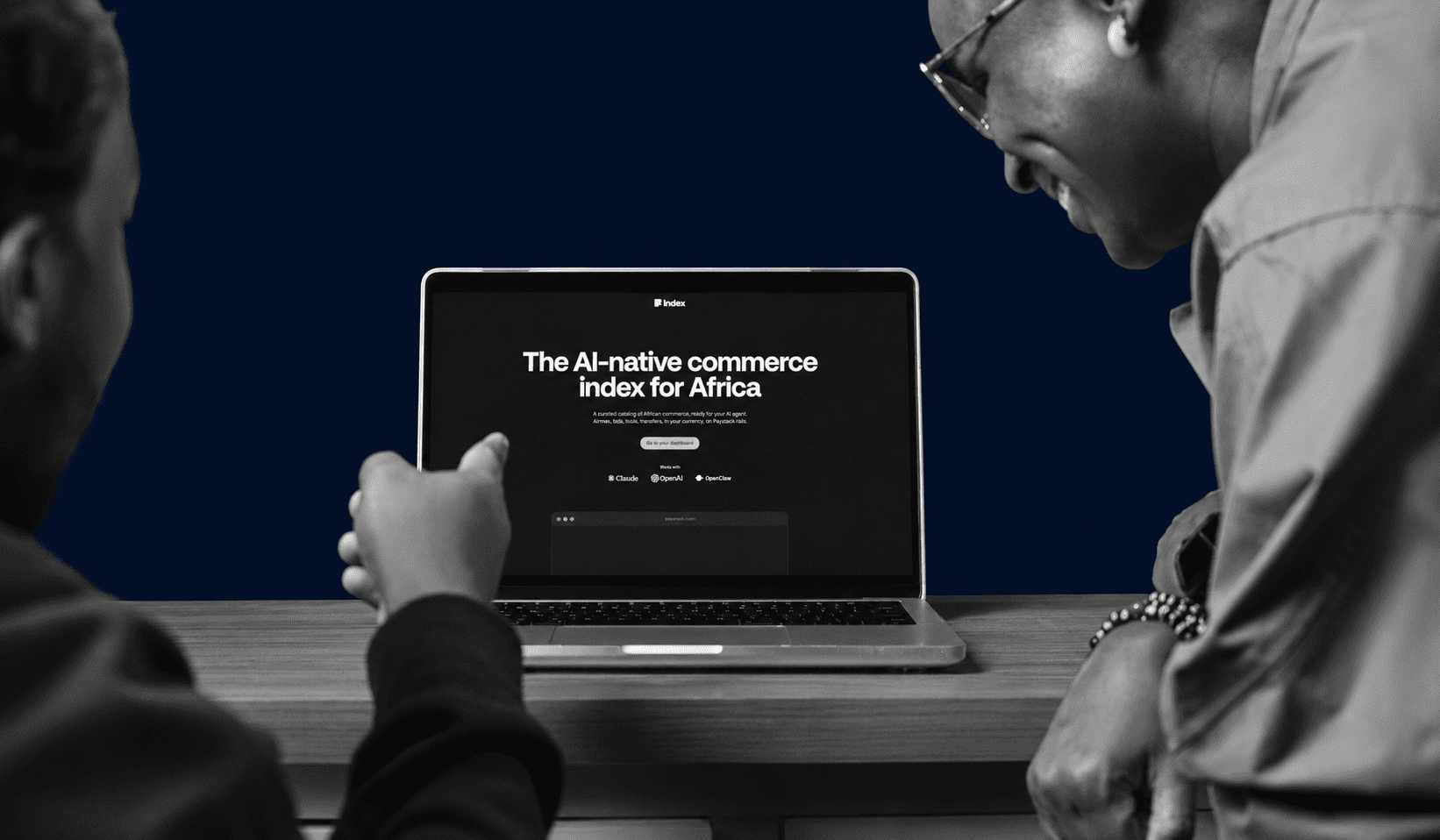
This is the headache and high-wire act that Paystack is wading into with its latest experiment. Five months after restructuring into a holding company with AI as a strategic priority, the Stripe-owned fintech has unveiled Paystack Index, a tool that lets AI agents like ChatGPT and Claude complete real transactions on behalf of users in Nigeria.

But the trust deficit is well-documented. A Visa study released this month found that while 88% of Nigerian consumers use AI to assist with shopping, only 34% would trust an AI agent to complete a purchase.

In South Africa, that figure plunges to 23%; in Kenya, it’s 29%. Across Egypt, 91% rely on AI for research and price comparisons, but trust in checkout collapses to 38%. Consumers appear to be comfortable with discovery but deeply uncomfortable with delegation, especially when it involves their actual money.

Yet Paystack is betting on getting users to collapse those misgivings entirely.

How Index works—and the questions it raises

Index allows users to buy airtime, send money via Zap, or order food from Chowdeck simply by typing plain-language prompts. Instead of navigating a banking app or merchant site, a user can say “buy ₦500 MTN airtime for 080…” and the transaction processes in the background. The AI parses the intent, verifies permissions, routes the request to the merchant, and settles via Paystack’s infrastructure.

The company says Index does not store card numbers or CVVs, instead relying on its existing payment rails. Users remain “in control of every authorised payment.”

But the product raises uncomfortable questions that Paystack hasn’t publicly answered: What happens when an AI agent misinterprets a request? Who is liable when a transaction goes sideways: the user, the merchant, the AI provider, or Paystack? How does a merchant verify that an AI agent, not a human, has approved a payment, especially given current fraud detection systems designed around human behaviour and device fingerprints?

These questions aren’t far-fetched. The Visa study also revealed that 36% of Egyptian consumers reported experiencing a financial scam in the past year, with nearly half occurring on social media. Fraud is already a pervasive concern. Introducing autonomous agents into that environment invites a new class of attack vectors, including prompt injection, misdirection, or simply AI hallucinations, translating “buy a small gift” into an expensive purchase.

A strategic bet born from a restructure

Index is the first tangible output from TSG Labs, the venture studio Paystack established when it formed The Stack Group (TSG) in January. That restructuring separated its regulated, cash-generating businesses—Paystack payments, the Zap consumer app, and Paystack Microfinance Bank—from the higher-risk experimental work of TSG Labs.

This structure is designed to contain risk. If Index attracts regulatory scrutiny or blows up in some unforeseen way, the financial and operational impact on the core payment business is theoretically ring-fenced. It’s a smart corporate hedge, but it doesn’t solve the fundamental trust problem facing the product itself.

For now, Paystack is framing Index as a learning exercise, not a commercial product. CEO Shola Akinlade says he expects the learning process to take at least a year. The company is rolling it out through a controlled early-access program, initially only in Nigeria, with a curated set of merchants to study early-adopter behaviour.

“If you take a step back and compare the number of people using their browser for commerce and now introducing agents for discovery, you’ll see agents are coming up, and browsers are going down,” Akinlade said.

Paystack isn’t alone in racing toward agentic commerce. Visa has already begun enrolling banks in its Agentic Ready programme, preparing financial institutions for autonomous transactions. Across the continent, companies are betting that AI agents will become a key interface for digital life, and payments need to follow.

But Visa’s data suggests the infrastructure is arriving ahead of consumer trust. Consumers have shown they will use AI to discover products. Whether they will ever trust it to spend their money remains the open question. Index is Paystack’s bet that the line will move.

How A Bootstrapped Nigerian Startup Survived A Death Spiral To Outdo Global Giants

By Henry Nzekwe  |  June 24, 2026

Chuma Chukwujama graduated from Obafemi Awolowo University in 1996 with an electrical engineering degree and a clear conviction that he did not want to be an engineer. Instead, he walked into a Nigeria where computers were exotic curiosities, banks still ran on paper, and the word “startup” meant nothing to anyone.

Nigeria, at the time, was transitioning from military to civilian rule. That coincided with a period when computers were just becoming a real thing and small banks were trying to figure out how to connect their systems and computerise their operations. Chukwujama stepped into that gap early; one might say he’s been there since the actual Day 1.

Twenty-five years later, his company Xceed365HR counts First Bank, Zenith Bank, Fidelity Bank, Union Bank, and Seplat Energy among its clients. It has grown into a thriving business without raising a kobo of venture capital.

And this month, it launched what it calls Africa’s first “agentic” AI HR platform; software that can autonomously retrieve contracts, run compliance checks against local tax law, process payroll, and dispatch onboarding communications without a human touching a button. Not bad for someone who started out connecting computers for small banks.

The pivot

For the first decade of his career, Chukwujama built whatever clients needed. Payroll systems, school management platforms, SIM card registration solutions for telecoms, the works. Between 2005 and 2015, his team developed bespoke systems across telecommunications, education, and corporate services.

“We were good at it, but we were spreading ourselves thin,” he tells WT. “The pivot to Xceed365HR as a focused, cloud-based product company was the decision that changed everything. It forced us to go deep.”

In 2015, when most Nigerian companies were still wary of the cloud, he decided to stop being a custom software shop and commit to a single product, encouraged by the observation that foreign HR platforms weren’t built for Nigerian payroll compliance, Nigerian tax remittance structures, or Nigerian pension administration. “The localisation they required was either non-existent or so costly that it wiped out the value,” he says.

A near-death experience

The path to that pivot was not smooth. Around 2010, the company was transitioning from on-premises software to the cloud. They evaluated a rapid application development tool with a large global community behind it and decided to build on it. Within six months, they had a product and went live with a major client.

Then things started going wrong. The system became slow, the features they needed weren’t being added, and integrations weren’t working. Eventually, they discovered the vendor had quietly discontinued the product, by which point they had spent three to four years building on it, with multiple clients live on the platform.

“I genuinely considered quitting,” Chukwujama says. “Continuing meant managing clients on a failing platform while simultaneously rebuilding everything and migrating them across. That process took five years. We lost customers during that period.”

What got him through was a decision that no matter what it cost, they would not abandon the clients they had. And, he adds, “the favour of God. I do not say that casually.”

The AI bet

The technology shift that surprised Chukwujama most was neither mobile nor cloud. It was AI. “The capability leap was so steep, and the implications for how software is built and how people work were so immediate, that it forced changes inside our company at a pace that was genuinely difficult to manage.”

L-R Chuma Chukwujama, CEO and Co-founder of Xceed365HR and Duke Obasi, CTO and Co-founder.

In June 2026, Xceed365HR launched Version 3 of its platform, a system the company describes as fully “agentic”. The term has become a buzzword across the industry, but Xceed365HR is using it to describe something specific: software that operates across five integrated layers, covering how employees interact with the platform, how AI agents execute decisions, and how those agents are grounded in each client’s data and each country’s regulatory environment.

An HR executive can now instruct the system through Microsoft Teams in plain language. The platform handles the rest. The company claims V3 reduces the total cost of ownership by 70% compared to global Tier-1 vendors and cuts HR operational expenses by 63%.

Whether that claim survives scrutiny is a separate question. Xceed365HR has not published independent benchmarking data. What is harder to dispute is the client list, which includes several industry giants. Big names such as First Bank, Fidelity Bank, Union Bank, Zenith Bank, Nembe, and Seplat Energy are all live on the platform.

The un-funded founder

What makes Chukwujama’s trajectory unusual is what’s missing: venture capital. In an era when African tech founders are measured by how much they raise, Xceed365HR has grown to millions in annual revenue on zero outside funding.

“What the slower path gave us was domain depth that you simply cannot acquire any other way,” he says. “Ten years of building custom software for Nigerian enterprises across different sectors meant that by the time we built Xceed365HR, we already understood how these organisations actually worked, not how we imagined they worked.”

What does he see in today’s founders? “A confidence that speed to market compensates for that kind of depth. Sometimes it does. But in enterprise software, especially in Africa, where the regulatory environments and operational realities are genuinely different from anywhere else in the world, shortcuts in domain knowledge tend to surface eventually,” he says.

The bigger picture

The Middle East and Africa software-as-a-service market generated USD 18.9 B in revenue in 2024 and is on track to reach USD 41.8 B by 2030, according to industry figures cited by the company. By 2050, one in four working-age people globally will be African. Yet much of the software managing that workforce remains designed for Europe and North America.

“Global providers have largely treated Africa as an afterthought,” Chukwujama says. “Global enterprise software giants have treated Africa as an afterthought,” he said in a separate interview.

Xceed365HR is rolling out Version 3 across Nigeria, Ghana, Kenya, and the United Arab Emirates. South Africa is next. The company is also launching new services alongside the platform upgrade; one called Early Bird allows employees to access up to half of their earned salary before payday. Another, called Pulse, routes salaries, pension contributions, and tax payments directly to relevant institutions, built on Nigeria’s existing fintech infrastructure.

If he were starting from scratch today with no reputation, no customers, and no capital, Chukwujama says he would go “deep into AI skills from day one.” But he would do one thing exactly the same: “stay focused on the enterprise and on Africa.”

“Africa is where the opportunity is. It is where the gap between what enterprises need and what is available to them is largest. I would not trade that position for an easier market.”

PayPal’s USD 100 M Africa Funding Pledge Fizzles As It Halts VC Arm

By Staff Reporter  |  June 23, 2026

Less than a year after PayPal’s splashy USD 100 M commitment to African digital commerce, the company’s venture capital arm has been shut down, raising questions about how serious the payments giant actually is about the continent it spent two decades ignoring.

PayPal Ventures, founded in 2016 and one of fintech’s longest-running corporate VC outfits, has paused all new investment activity and is winding down operations. The team shrank from more than 10 partners in late 2025 to just two, and the unit now lists no employees on PayPal’s website. Investment bank Jefferies has been hired to explore selling the remaining portfolio positions on the secondary market.

The decision comes as part of a sweeping restructuring under new CEO Enrique Lores, who replaced Alex Chriss in March 2026 after the board deemed Chriss wasn’t moving quickly enough. Lores has announced plans to cut roughly 20% of PayPal’s global workforce, more than 4,500 jobs, over two to three years to save at least USD 1.5 B.

The new leadership has indicated that PayPal is retreating to its core, and it appears venture investing, especially in far-flung markets, is a luxury it can no longer afford.

Africa: a pattern of half-measures

The timing couldn’t be more awkward. Just months ago, PayPal was publicly talking up its African ambitions. In January 2026, the company announced a high-profile partnership with Nigerian fintech leader Paga, enabling Nigerians to link PayPal accounts to Paga wallets and receive payments from over 200 countries.

PayPal’s Otto Williams, SVP and regional head for Middle East and Africa, framed it as a long-term bet, with the company pledging USD 100 M to fuel digital commerce across the region through investments, acquisitions, and partnerships. The fund had already backed regional players like Tabby (Saudi Arabia), Paymob (Egypt), and Stitch (South Africa).

But that USD 100 M commitment was always going to be deployed in part through PayPal Ventures. With the VC arm now shuttered, it’s unclear what happens to that pledge.

The pivot also comes after years of neglect that left deep scars. PayPal restricted inbound payments to Nigeria around 2004 over fraud and chargeback risks, locking African users out of receiving funds while allowing only outbound sends.

That “temporary” restriction lasted 22 years. Earlier attempts to re-enter, including a 2014 partnership with First Bank of Nigeria and a 2021 tie-up with Flutterwave, offered limited, business-only fixes that did little to rebuild trust. A recent uproar from Kenyan users over account terminations also captures the fraught relationship.

A market that moved on without them

While PayPal dithered, Africa’s fintech ecosystem grew into a powerhouse. Kenya’s M-Pesa processes transactions worth hundreds of billions of dollars annually. Today, Africa accounts for about 70% of global mobile money transaction value.

Nigeria’s digital economy reached NGN 1.07 Q (USD 754 B) in domestic payments volume in 2024, with over 430 fintech firms operating in the space. Local champions like Paystack (acquired by Stripe), Flutterwave, and Paga have scaled impressively in PayPal’s absence. Paga alone processed NGN 17 T across 169 million transactions in 2025.

PayPal’s belated “PayPal World” strategy, which aims to bridge existing local wallets to its global network rather than compete for consumer accounts, looks less like a visionary move and more like a grudging admission that the company lost the wallet war.

PayPal’s retreat also reflects how corporate VC often comes with strings attached, and those strings can be cut the moment a new CEO decides to trim costs. PayPal’s shares have dropped nearly 40% in the past year and over 83% in the past five years. Understandably, it’s hard to prioritise new conquests when a company is fighting for survival in its core markets.

The deeper problem is credibility. PayPal spent two decades telling Africans their market was too risky. Now, having finally made noises about showing up, it’s already pulling back. For a company that built its brand on enabling global commerce, that’s a shortcoming that local competitors might fancy exploiting.

Transsion Swoops In On Africa’s Renewables Boom Amid Smartphone Slump

By Henry Nzekwe  |  June 22, 2026

Africa’s top smartphone maker is quietly building a presence in the continent’s renewable energy sector, moving beyond phones into solar power and electric vehicles as its core handset business slows.

Transsion Holdings, the Chinese company behind the Tecno, Infinix and Itel brands, controls about 50% of Africa’s smartphone market. But that dominance is under pressure. In the first half of 2025, the company’s Africa revenue fell 4.45% to CNY 9.65 B (~USD 1.3 B), while handset revenue dropped 18.41% year-on-year.

The company is now pivoting to “new energy” mobility and renewable energy products. Through its Itel and Oraimo brands, Transsion has launched a variety of home solar energy systems designed for African households with unreliable electricity. Its solar products, which are quickly gaining ground in the Nigerian market, provide an economical power solution for regions where many households still rely on generators and burning wood, coal or kerosene for lighting.

In electric vehicles, Transsion introduced its TankVolt brand of electric two-wheelers and tuk-tuks in Uganda in 2023 and has since expanded to Nigeria, Kenya, Tanzania and Ethiopia. It later launched Revoo, another electric motorcycle brand, which entered the Nigerian market in 2025. The company now ranks among Africa’s top three EV brands by units sold.

Transsion is applying the same playbook that made it Africa’s smartphone leader, leveraging affordable products tailored to local needs, backed by extensive distribution networks and after-sales support. It is also offering financing options through partnerships with financial institutions.

On Monday, Transsion deepened its renewable energy bet through NewTrails Capital, a Chinese growth-stage fund, in which it owns a stake. NewTrails completed a USD 55 M investment in Spiro, considered Africa’s largest electric vehicle and battery-swapping company. The deal closed Spiro’s latest equity round at USD 270 M, one of the largest single fundraising closes in African clean technology.

NewTrails Capital operates in Shanghai, Shenzhen and Nigeria. It views Spiro as an “infrastructure-like business” and sees the company’s battery-swapping network as part of a broader energy transition across African markets.

Spiro has deployed more than 100,000 electric motorcycles and established over 2,500 battery-swapping stations across seven African markets, including Kenya, Rwanda, Uganda, Nigeria and Cameroon. The company has raised about USD 557 M in total disclosed funding.

Transsion’s push into renewables comes as competition in smartphones intensifies. Chinese rivals including Xiaomi and Honor have eroded its lead, particularly in low-end smartphones. The company is seeking a main-board listing in Hong Kong to fund its expansion into electric vehicles, home appliances and renewable energy.

Africa’s electric two-wheeler market is poised for growth. Annual sales of motorbikes are projected to rise from 1.9 million units in 2023 to 2.3 million by 2030. The continent’s EV market is estimated to reach USD 28 B by 2030.

Transsion is betting that the distribution networks and local market knowledge that built its phone empire can now power its next act in renewable energy and electric mobility.

Nigeria’s Fintech Giants Reeling As Apex Bank Blocks Their Ambitions

By Staff Reporter  |  June 19, 2026

Nigeria’s top fintech companies are reeling as a new move by the central bank to restrict any payment firm from dominating both consumer and merchant markets puts their playbook at loggerheads with the rules and a hard ceiling on their ambitions.

In a circular issued earlier this week, the Central Bank of Nigeria said any licensed financial institution that controls more than 25% of the consumer-issuing market will be restricted to a maximum of 15% market share in merchant-acquiring activities. The restrictions apply to groups of related entities, preventing firms from bypassing the rules through subsidiaries. The rules take effect on December 31, 2026.

Consumer issuing covers services that enable consumers to make payments, including bank accounts, payment cards and digital wallets. Merchant acquiring is the infrastructure that enables businesses to accept payments, including payment gateways, Point-of-Sale terminals and merchant settlement systems.

The move has significant implications for companies like Moniepoint, OPay, PalmPay, Paystack and Flutterwave, many of which have spent years building strong merchant-payment businesses and are increasingly expanding into customer-facing banking services.

Moniepoint controls roughly 38.5% of Nigeria’s POS market, according to industry data, while OPay holds about 27%. Both companies have built massive customer bases by focusing heavily on underserved consumers, small traders and informal businesses.

The new rules come as fintechs make aggressive moves into banking. In January, Paystack acquired Ladder Microfinance Bank, which followed the launch of its consumer payments app, Zap. In April, Flutterwave secured a microfinance banking licence. Both moves were designed to give the companies greater control over funds and deposits, converting payment users into banking customers.

The CBN said the restrictions are designed to prevent excessive concentration in Nigeria’s rapidly expanding digital payments ecosystem, which surpassed NGN 1 Q (~USD 733 B) in 2025. The regulator also cited concerns about systemic risk and the emergence of operators with substantial market presence across key payment activities.

The rule effectively forces dominant fintechs to choose between consumer and merchant markets. A company that controls more than 25% of consumer payments cannot hold more than 15% of merchant acquiring, and vice versa.

For Flutterwave, valued at over USD 3 B, and OPay, valued at USD 2.75 B, the restrictions could force a strategic rethink. Traditional banks could also be affected if they seek to build a substantial market share in merchant acquiring while maintaining their dominant positions in consumer banking.

The CBN has given operators until December 31, 2026, to restructure their operations. Monthly market share reports will be submitted to the regulator for monitoring and enforcement.

As it stands, the era of building across both sides of the payments market may be coming to an end for Nigeria’s fintech giants.

Mobile Coverage Reaches 91% Of Africans Yet 1 Billion Remain Offline, GSMA Finds

By Staff Reporter  |  June 18, 2026

Mobile technologies contributed USD 240 B to Africa’s economy in 2025, equivalent to 7.8% of the continent’s GDP, according to a report released this week by the GSMA, the industry body representing mobile operators globally.

The sector supported roughly 13 million jobs and generated USD 45 B in public revenues through taxes, spectrum fees and license payments. The mobile industry’s economic contribution is expected to reach USD 290 B by 2030 as digital adoption deepens.

But the report also highlights a striking disconnect. While mobile broadband networks now reach most of the continent, nearly 1 billion Africans who live within coverage areas do not use mobile internet. Only about 9% of Africans live outside mobile broadband coverage. The challenge, the GSMA said, has shifted from expanding networks to ensuring people can afford and use them.

The usage gap

Affordability is the primary barrier. Smartphone prices remain out of reach for many low-income households, and data costs discourage regular use despite improvements in coverage. Limited digital skills, online safety concerns and social barriers also constrain adoption.

The report comes as African telecom operators reposition themselves beyond traditional voice and data services. According to GSMA Intelligence research, 79% of operators in Africa now identify becoming a digital transformation partner as a primary objective, deploying artificial intelligence, expanding digital services and opening network capabilities to developers through standardised APIs.

“Africa’s mobile industry is entering a new phase of development,” said Vivek Badrinath, Director General of the GSMA. “Having connected millions of people and businesses over the last decade, the focus is increasingly shifting towards unlocking greater value through AI, digital services and new forms of innovation.”

Operators are expected to spend more than USD 76 B on network infrastructure by 2030. Mobile-enabled services are increasingly supporting financial inclusion, digital commerce, healthcare delivery and education across the continent. Africa remains the world’s largest mobile money market, with millions relying on mobile financial services where traditional banking is limited.

Closing the usage gap, the GSMA said, could unlock significant economic opportunities by bringing hundreds of millions more people into the digital economy.