This Egyptian Entrepreneur Is Creating Wealth From Garbage With The Help Of Local Farmers

By Henry Nzekwe  |  December 31, 2018

Surmounting the countless hurdles and getting the better of the numerous obstacles that litter the road to entrepreneurial success in Egypt’s conservative rural south is no easy feat even for those that have the socio-economic advantage on their side.

But a woman venturing into what is primarily considered a male-dominated field with nerves of steel, and rocking the establishment by disrupting deep-seated practices to trigger environmental change and far-reaching social impact, is nothing short of exceptional and even somewhat unheard of.

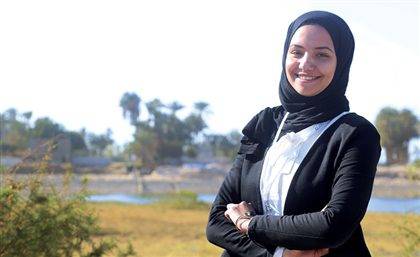
And that’s the narrative for Alshaimaa Omar, a 28-year-old chemical engineer who hails from the rural city of Sohag and who, against the odds, is pulling down all the stops to effect change in her community.


Alshaimaa took on quite a task when she set out to defy gender stereotypes in her community by opting to tread a path many women her age would instead take a pass on, or perhaps let themselves be coaxed into taking a pass on.


Her initial idea was to create renewable energy from agricultural waste gathered from farmlands in her locale to cater to the energy needs of her immediate community. Today, she is the proud Founder of Biomax;  a startup that now has operations in 12 cities and is carving a niche for itself in the area of transforming agricultural waste into biogas. The company has since scaled up its operations to include larger farms in urban areas and the production of organic fertilizers.

Also Read: This Ethiopian Supergirl Is Working Wonders In Robotics And AI

Her hometown, Sohag, is located some 500 kilometers south of Cairo, the Egyptian capital. In the serenity of this rural community where the Nile is at its quietest, and the calmness is in stark contrast with the chaos that has become the hallmark of the overpopulated capital city, agriculture constitutes the livelihood of the locals as it is the predominant source of income for people living in the community. And it was from within this seemingly cutoff community that Alshaimaa got her inspiration and set about bringing her idea to life.

The young Chemical Engineering graduate of Alminia University came upon something of a breakthrough when she perfected a process that is efficient at converting waste from farmlands and cattle into renewable energy. And she was not going to settle for a feature on a local TV Show or a speech at a Science Fair for kids.

She decided to put her idea to work, and that was to mark the beginning of an eventful journey that has dealt her both cherries and rutabagas in almost equal measure. But it did come right in the end.

When the female entrepreneur delivered a talk at Techne Drifts; an entrepreneurial roadshow that is known to tour parts of Upper Egypt and the Nile Delta to empowering, motivating, and inspiring entrepreneurs in some of the remotest cities in Egypt, she let the audience in on how it all began.

Alshaimaa kicked off her enterprise by dealing with local farmers. She had to make countless trips to villages, some of them very remote, to discuss her idea with the farmers who possessed the resource – which was ironical, ‘waste’, in this case.

Ignorant of the wealth that could be generated from the agricultural and cattle waste that was being churned out on a regular, these farmers were pretty cool with discarding the substances however they deemed fit.

More: After Two Failed Attempts, This Entrepreneur Has Finally Found Her Breakthrough In Botswana

The Biomax Founder’s proposal came across as ridiculous and improbable initially, and these farmers can be forgiven for their ignorance given that they didn’t have much by way of education or exposure. So Alshaimaa had her work cut out for her in making a group of old-time farmers understand that the wastes they had been discarding since time immemorial could be of far more value.

She enticed them with prospects of being able to make more income, generate gas that can be used for domestic purposes, and replace the chemical fertilizers they had become accustomed to with organic ones which could do a better job.

Now, you would be tempted to think anyone would jump at the idea of creating value off something that has never been of any use to them, but getting those farmers on board was by no means a cake walk.


The farmers were not exactly enchanted by the idea initially, and it was not because it was a bad one. They were lukewarm and lackadaisical at first – somewhat unwilling to cooperate – albeit, for a different reason; one hinged on gender.


Egypt has some somewhat conservative rural societies, and Upper Egypt is one of them. In such areas, it is uncommon and even slightly unheard of, for farmers to do business with women, and yet very young ones at that. This unmentioned factor was what mainly spurred their insipid reception of Shaimaa’s proposal which was by no means a bad one.

But determined to follow through on her idea, Alshaimaa pressed on. She had resolved to bring her vision to fruition, and if it meant that she had to be implacable and relentless, she was determined to roll up her sleeves and get to work. And that’s precisely what she did – worked them until they budged. Her efforts paid off in the end as she was able to break from the stereotype and get a lot of people to believe in her vision and work with her.

But that wasn’t the only spanner that almost ruined her works as she did face some family pressure too. As a young woman in her mid-twenties in a typical rural Egyptian setting, venturing into business was never really going to go down well with her folks.

Her family was not pleased with the path she had chosen, and they were pretty vocal against it, especially as she had to make trips to distant places. There were many occasions in which she had to leave in the wee hours of the morning and return late at night. This incensed her folks even further.

At times, the pressure from them was too much and quitting seemed like the best option, but her passion for chasing her vision ensured that stopping was never an option for her. Her parents eventually came around when they saw that she could not be deterred and her efforts were yielding fruits.

You might like: Reaching For The Stars: These South African Teens Are Set To Launch Africa’s First Private Satellite

Through dogged persistence, she has seen her brainchild, Biomax, grow and expand across 12 cities in Egypt. The startup also claims to rake in up to EGP 200 K (nearly USD 12 K) in annual revenue on a yearly basis. And all these by collecting organic waste and processing it into biogas which can be used for a variety of purposes, and organic fertilizer which is known to increase productivity for farmers in addition to being eco-friendly.

Alshaimaa Omar was 24-years-old and fresh out of college when she took advantage of a project launched by the Egyptian Ministry of Environment to kick-start her journey. By leveraging the training afforded by the program, she got started on establishing her company, but it was going to be a while before the idea morphed into an actual business. But in spite of the challenges, she prevailed.

Although she has now gotten some financial support from Egypt’s Ministry of Environment, in partnership with the United Nations Development Program (UNDP), she was hampered by the difficulties associated with her country’s centralized economy. This meant that she found it very difficult to get any starting aid since not very many organizations look in the direction of entrepreneurs in remote cities like Sohag.

At Techne Drifts, she also revealed that it was difficult to get the company up and running initially as help did not come from any association. Thus, creating awareness about the project itself proved a Herculean Task. She, however, hinted at the major turning point is when she had a stint in the Delta region. It was during this time in the coastal cities that doors opened, and her project got significant traction. This success spurred her on and led her to expand.


Alshaimaa’s unbeatable drive, stamina, and tenacity are quite evident but digging a little bit deeper would reveal an individual who is also passionate about preserving nature and conserving the environment in a country where those details are not given enough attention.


At the core of the inspiration which triggered the idea behind Biomax is the need to stop waste from degrading the environment. And that motivation has seen her create a company that transforms garbage into something that is of benefit to both people and the environment.

By turning waste into energy, Alshaimaa and the rest of the team at Biomax are preserving the environment, contributing their quota towards curbing climate change, and tackling global warming which has become a worrying environmental concern. And by also creating wealth in the process, it’s a win-win.


Image CourtesyYousef Adel Emad | M04 Networks

Africa’s Top-Funded Defencetech Upstart Turns To University To Solve Its Talent Problem

By Henry Nzekwe  |  July 31, 2026

Terra Industries, the Nigerian defence technology startup that has raised USD 34 M this year from investors including Palantir-linked 8VC and Lux Capital, is partnering with Miva Open University to build robotics and drone laboratories across the university’s learning centres, starting with a pilot in Abuja.

Under the agreement, Miva students will learn to design, assemble, test and fly drones as part of their academic programmes. Terra will run hands-on workshops, train faculty, and offer internships and jobs to top performers.

The company says the partnership was borne out of the simple calculation that Nigeria’s drone industry cannot scale without the engineers to build it.

Terra operates a 15,000-square-foot manufacturing facility in Abuja, the largest drone factory in Africa, and is constructing a 34,000-square-foot plant in Ghana. The company’s autonomous systems already protect infrastructure assets valued at roughly USD 11 B across eight African countries. But hardware alone is not enough.

“We are building tools designed for the realities on the ground,” Terra CEO Nathan Nwachuku said in February, after the company’s second funding round. “Security technology should not always be imported when local innovation can respond faster and more effectively.”

That local innovation depends on a pipeline of trained talent. Nigeria’s defence sector has historically relied on imported systems with limited technology transfer. The Nigerian Army has publicly acknowledged constraints caused by “inadequate skilled manpower” in drone warfare and armament development.

Miva, Nigeria’s first private open university, graduated 1,280 students at its maiden convocation in June. The institution has since launched a bachelor’s degree in Artificial Intelligence and announced plans to expand into robotics and drone laboratories.

“By mastering autonomous systems, aerial robotics, and hardware engineering, our students are preparing to solve real-world Nigerian challenges,” Miva Chancellor Sim Shayaga said at the convocation.

The Terra-Miva partnership mirrors a strategy unfolding elsewhere in Nigeria’s emerging defence sector. In May, Terra’s CEO committed NGN 40 M (~USD 29 K) to support the South-East Maths Olympiad, with summer internships at Terra for winners.

In February, Terra signed a joint venture agreement with the Defence Industries Corporation of Nigeria (DICON) to establish local production lines for drones, robotics and cybersecurity systems. That agreement explicitly includes “training programmes for staff from both organisations”.

This suggests the willingness of Terra to not only build drones but also the ecosystem that will sustain them.

There’s a sense of urgency kicking in on that front. Nigeria’s House of Representatives this month called for a “National Drone Industrialisation Policy” to transform the country’s drone manufacturing sector “from its current entrepreneurial stage to a structured, state-supported strategic industry”. Lawmakers noted that Nigeria possesses “a pool of engineering talent, a growing technology entrepreneurship ecosystem”, but lacks the structured policy and capital to match.

The Miva partnership offers a direct line to that talent pool for Terra while providing students with hands-on experience in a sector that is attracting global capital.

“We are shifting the narrative from consuming technology to actively engineering it,” Shayaga said.

Nigeria’s On-Demand Delivery Graveyard Claims Latest Victim Of A Model That Can’t Survive

By Henry Nzekwe  |  July 30, 2026

On July 29, GoLemon stopped accepting orders. The Lagos-based grocery delivery startup, founded by former Paystack employees, will shut down its customer support on August 2, and dozens of employees will lose their jobs. The company had moved over NGN 2 B (`USD 1.4 M) worth of groceries across Lagos in 28 months and had 40,000 registered customers. None of that was enough.

“Despite our efforts to raise additional funding, we couldn’t find a sustainable path forward within the time available to us,” GoLemon said in its shutdown statement. The company claims individual orders were profitable; the average basket size was around NGN 43.7 K. But it never hit the volume needed to cover warehouses, engineering, logistics and supply chain overhead. When the next funding round didn’t arrive, the runway ended.

GoLemon is not an isolated case. It’s the latest tombstone in a graveyard that keeps growing.

Jumia Food shut down in Nigeria and six other African countries in December 2023. Jumia said market conditions made the business “unsustainable”. Bolt Food exited Nigeria the same month. “We have made the difficult decision to discontinue our food delivery operations in Nigeria due to business reasons,” Bolt said.

FoodCourt, a Y Combinator-backed cloud kitchen startup, paused operations in March 2026 after staff strikes over unpaid wages and mounting debt. Eden Life, which offered food delivery among other home services, paused its consumer business in February 2026 to refocus on corporate clients. That’s five major players gone or paused in under three years.

Nigeria’s online food delivery market hit USD 1.14 B in 2025 and is projected to reach USD 2.73 B by 2034. The demand is real. But demand doesn’t always translate to enough paying customers to sustain a business. One analysis pointed out that at its NGN 43.7 K average basket size and over NGN 2 B in orders, for instance, GoLemon processed around 57,000 orders over two years, or about 80 daily on average, which is considerably way off where it needs to be to have a shot at profitability.

GoLemon and FoodCourt shared the same “control everything” operating philosophy. FoodCourt owned central kitchens, cooked meals under multiple virtual restaurant brands and managed fulfilment. GoLemon sourced directly from farmers, operated warehouses, built its own tech platform and handled deliveries. This “full-stack” approach promised better quality and lower prices. What it actually delivered was enormous fixed costs.

“The full-stack cost trap” is how some analysts describe it. Several of the largest African startup failures shared this operating architecture. It proved lethal in the inflationary, currency-volatile conditions of 2023–2026.

In Nigeria, inflation has been running at multi-decade highs, diesel prices remain elevated, and consumer spending is under pressure. A business model that requires warehouses, kitchens, inventory and large operational teams becomes extremely difficult to sustain when every input cost continues to rise.

The survivors are doing the opposite

The contrast with Nigeria’s surviving delivery companies is visible. Chowdeck and Glovo largely operate as technology marketplaces that connect customers with existing restaurants, supermarkets and riders. They don’t own the kitchens or the inventory. Their asset-light structures allow them to scale without carrying the heavy burden of physical infrastructure.

Chowdeck, backed by Y Combinator, hit one million monthly orders in October 2025. It raised a USD 9 M Series A in August 2025. By late 2025, it had crossed into profitability.

GoLemon likely saw this coming. In December 2025, it partnered with Chowdeck, letting customers order GoLemon groceries through the Chowdeck app while GoLemon handled sourcing and fulfilment. The arrangement expanded its reach and reduced delivery complexity.

But it wasn’t enough. The fixed costs were already too high, and the funding didn’t arrive in time, as investors likely baulked at the grim unit economics and niche play without enough of a defensible moat.

This isn’t just a Nigeria problem

The struggles in Nigeria mirror what’s happening globally. Deliveroo slipped back to a GBP 19.2 M (USD 25.6 M) loss in the first half of 2025. Just Eat Takeaway missed earnings expectations in the first half of 2025, pressured by falling order volumes. The company cut about 450 jobs as it integrated automation. And on-demand platforms like Uber, Deliveroo and Foodora have operated for over a decade and still haven’t achieved consistent profitability.

The food delivery business is brutally difficult everywhere. Thin margins, high logistics costs and price-sensitive customers make profitability elusive. The difference is that in Nigeria, the operating environment is even harder, featuring poor road networks, erratic power supply, currency volatility and a venture capital market that has become far more selective.

During the 2021–2022 venture capital boom, investors funded rapid expansion in expectation of future profits. That era is over and funders are increasingly choosing sustainable unit economics over user numbers. Consumer startups that require heavy physical infrastructure have found the transition particularly painful.

The back-to-back failures of GoLemon and FoodCourt are likely to reinforce a shift already underway as investors favour backing asset-light platforms over businesses trying to own the entire value chain.

A Startup Processed 1B Transactions To Give 8M Africans A Credit Score Banks Wouldn’t

By Henry Nzekwe  |  July 29, 2026

In Harare, a man buys bricks with cash and pays the builder the same way. Over months, he pours concrete for the foundation, raises the walls to window level, and carefully budgets to get the timber for the roof. Then, abruptly, he stops.

For five or six years, the house sits there—open to the sky, half-finished—while he saves up again. When he finally puts the roof on, it only covers half the structure. He moves in without tiles or paint, spending another decade completing what should have taken six months.

Dalumuzi Mhlanga grew up watching this pattern. It had nothing to do with poverty but the absence of a financial instrument that could stretch a repayment over years. They had the income, the land, and the discipline. What they did not have was a bank willing to look past their account balance.

Mhlanga is now the founder and CEO of Notto, which calls itself Africa’s first licensed alternative credit bureau. The company has analysed over a billion transaction records and generated more than eight million credit scores across the continent. But the origin story of Notto is less about big data and more about a deeply personal paradox he observed long before he wrote a line of code.

“It started with members of my own family who had been paying rent in full and on time for years,” he tells WT. “They were consistently meeting this very significant financial obligation, but they still could not access home loans.”

That contradiction became the intellectual and emotional anchor for his work. If credit is fundamentally about determining whether a person is willing and able to meet obligations consistently, then why does paying rent—often the largest monthly expense a person has—count for nothing?

The contrast crystallised during his freshman year at Harvard. Almost weekly, his mailbox contained another unsolicited credit card offer from Capital One. He had virtually no income at the time, yet the American financial system was already prepared to begin a relationship with him.

“On one side, you had people in Africa who had demonstrated for years that they could meet significant obligations, but the system could not see them. On the other side, you had a system that was willing to look beyond somebody’s account balance today.”

When the Zimbabwean founder and his team initially built Notto, they thought they were solving a product problem. They designed a specialised credit score for home loans. After two years, they realised they had started at the wrong end of the chain. The issue was not a missing product, they discovered, but absent infrastructure. The plumbing required to identify rent payments, utility bills, and mobile money behaviour simply did not exist in a standardised form.

The internal enemy

What makes this problem particularly stubborn, Mhlanga argues, is not a lack of lender interest. Banks know the opportunity is massive. The real friction sits inside the banks themselves.

“Large enterprises have governance structures and processes,” he explains. “The idea may need to go through a product committee, a risk committee, a credit committee, technology, compliance and then the people who actually release the balance sheet.”

By the time an initiative reaches the finish line, the quarterly targets that drive staff bonuses have rolled over several times.

“Infrastructure does not always produce results inside one quarter,” he adds. “Somebody is sitting there thinking: this may take too long to yield results, and may even wonder if they may still be in the organisation by that time.”

So the obstacle is less a misconception about creditworthiness and more an architecture of institutional inertia, Mhlanga reckons. Banks are designed to manage risk and hit short-term metrics. Alternative data, he points out, does not fit neatly into that machine, yet.

The loan shark paradox

After processing over a billion transaction records, Notto’s data revealed something that contradicts the industry’s cautious posture. Some of the most creditworthy Africans are already paying exorbitant rates to informal lenders and still repaying faithfully.

“You see people taking loans at 20 or 30 percent interest month on month, and they pay them back,” Mhlanga says. “The market is still a bit of a wild, wild west, and many lenders have not figured out how to price risk properly. They price for the risk of the entire portfolio, so they charge that same very high rate to some of the most creditworthy people.”

This is the hidden tax on financial invisibility. People who could easily service a low-interest mortgage are instead borrowing from loan sharks at predatory rates simply because the formal system cannot verify them.

Notto’s infrastructure tries to separate that population from the high-risk pool using non-traditional signals, such as digital payment receipts, mobile money inflows, and regular bill settlements.

The pivot that saved the company

There was a moment when Mhlanga genuinely questioned whether the model would survive. The original plan was B2C, that is, to collect alternative data directly from tenants and landlords to generate specialised scores. “The data collection was slow, expensive and difficult to scale,” he admits.

The pivot was painful but decisive. Instead of gathering raw data themselves, they decided to work with enterprises—telcos, payment gateways, and fintechs—that already had it.

They would build the infrastructure to turn that existing data into credit intelligence at scale. The shift transformed the company, but integration became the new challenge. Mhlanga notes that banks do not discard their legacy risk frameworks overnight, and alternative data must live alongside existing credit policies before it can replace them.

Who guards the guardians?

The use of non-traditional data inevitably raises questions about privacy and fairness. Mhlanga’s response is to lean heavily into regulation. Notto operates as a licensed credit bureau, he emphasises, subject to data protection, consent, and residency laws in each market.

“I do not see regulators as constraints to innovation,” he says. “Regulators are protecting consumers, and consumers need to be protected. A company should not simply say, ‘Trust us,’ especially when it is dealing with people’s financial information.”

It is a prudent stance, but it does not resolve the deeper tension in that the same data that unlocks a mortgage could also be used to exclude, price-gouge, or surveil. For now, Mhlanga trusts the oversight frameworks to draw that line.

The long bet

Looking ahead, Mhlanga measures success not by the number of microloans disbursed but by the length of the credit. He wants a young couple in Lagos, Conakry, or Mali to walk into a bank and leave with a twenty-year mortgage. Not only does that require a leap of faith about economic stability, but it also demands a cultural shift.

“Your credit score should matter more than your account balance,” he insists. “An account balance is only a picture of where you are today. Creditworthiness tells us something about your future.”

When asked if he would pass his own test using only digital transaction data, Mhlanga does not hesitate. He applies the same three filters he uses for every customer: consistent income, bills paid in full and on time, and enough residual capacity to save. He believes he passes all three.

The real question is whether Africa’s financial system will ever learn to ask the same questions. For now, millions are still building their homes one brick at a time, not because they cannot pay, but because the system refuses to believe them until they already have.

Morocco’s Plan To Build Africa’s First EV Battery Gigafactory Is Afoot With Major Backing

By Staff Reporter  |  July 27, 2026

Africa is rich in the minerals the world needs to power its electric future. The Democratic Republic of Congo produces more than 70% of the world’s cobalt. Zimbabwe holds massive lithium reserves. South Africa has manganese. Yet for decades, the continent has shipped these raw materials overseas, only to import back the finished batteries at a premium. The value addition happened elsewhere, as did the jobs.

That pattern is now being disrupted. The African Development Bank has approved a EUR 100 M (USD 114 M) loan to support the construction of Africa’s first electric vehicle battery gigafactory in Morocco, marking a significant step in the continent’s long‑standing ambition to move beyond exporting raw minerals and instead capture more value through local processing and manufacturing.

The project, led by Chinese battery manufacturer Gotion High‑Tech, will require an initial investment of about USD 1.3 B to build an integrated lithium iron phosphate battery plant in the Rabat‑Salé‑Kénitra Free Trade Zone. The first phase will produce 10 gigawatt‑hours of battery cells and packs annually for electric vehicles, with plans to expand to 100 GWh, placing it among the world’s major battery manufacturing sites.

Unlike many battery projects that only assemble battery packs, the Moroccan facility will also manufacture cathodes and anodes, the two key battery components, creating an integrated battery value chain within Africa. Much of the output is destined for export to European markets.

“Battery storage is the missing link in Africa’s clean energy transition,” Kevin Kariuki, the bank’s vice president for Power, Energy, Climate and Green Growth, said in a statement. “A facility of this scale, powered primarily by renewable energy, strengthens the foundations for the large-scale integration of solar and wind power, which our grids increasingly depend on.”

The project reflects Africa’s growing push to industrialise rather than just extract. According to the AfDB, the gigafactory is expected to create more than 600 direct jobs during its first phase while achieving a 70% local industrial integration rate, helping develop domestic suppliers and technical skills.

“This gigafactory will be a major catalyst for strengthening Morocco’s industrial competitiveness and for accelerating its emergence as Africa’s manufacturing hub for sustainable mobility industries,” said Achraf Tarsim, the bank’s country manager for Morocco.

Morocco’s existing automotive industry, proximity to Europe and free trade agreements have made it an attractive destination for Chinese EV battery makers. But the project also sits at the centre of a geopolitical contest. Europe is increasingly concerned that Chinese investment in Morocco could become a backdoor for circumventing EU tariffs on subsidised Chinese cars. Meanwhile, Morocco aims to establish a complete manufacturing supply chain capable of providing parts for half a million electric vehicles per year by the end of 2026.

The gigafactory represents a test case. The continent has long talked about industrialisation. This is the first time the pieces are actually being assembled.

Kenyan Court Delivers Blow To Unlicensed Loan Apps Seeking Debt Repayment

By Staff Reporter  |  July 27, 2026

Getting a loan in Kenya is often as easy as downloading an app. There’s no need for paperwork, collateral, or questions asked. The money lands in the borrower’s M-PESA account within minutes. But there’s always a catch, and this often means borrowers have to hand over access to their contacts, messages, and call logs. A missed payment means one’s entire phonebook would get a text message shaming them.

Kenya has tried to fix this. In 2022, it started requiring digital lenders to get a license from the Central Bank. The idea was to separate the legitimate operators from the ones that were basically running digital shylock operations. Two hundred and fifty-two lenders got licensed. Hundreds more did not.

But the unlicensed lenders kept lending anyway. And when borrowers stopped paying, they went to court. Last week, a Nairobi Small Claims Court told them they cannot do that anymore.

In two separate cases, Tri-State Capital Limited and Mombo iCapital Limited tried to recover unpaid loans from borrowers. The amounts were not huge: KES 500 K (USD 3.85 K) and KES 162.3 K (USD 1.252 K), respectively. Before even looking at whether the borrowers actually owed the money, Resident Magistrate Gladys Kiama asked a more fundamental question: were these companies legally allowed to be lending in the first place?

Neither could prove it held a CBK licence. Both cases were struck out.

The ruling does not mean borrowers can simply ignore debts they genuinely owe, the court held. What it means is that those running a loan app without a licence cannot walk into a courtroom and expect the judicial system to enforce their contracts.

For the hundreds of loan apps still operating without licences, this changes the math considerably. Getting a licence was already a regulatory requirement. Now it is also the difference between having legal recourse when borrowers default and having none at all. For borrowers, it is a measure of protection against lenders who never followed the rules in the first place.

The ruling also follows a separate Small Claims Court decision earlier this month that barred digital lenders from recovering excessive interest and unexplained charges from borrowers, reinforcing the application of the in duplum rule under the Kenyan Banking Act. In one case, the court ruled against a vehicle financing company after a KES 400 K loan ballooned to KES 976.75 K.

Kenya’s licensing push was designed to fix problems that had long plagued the digital lending market, such as high interest rates, aggressive debt collectors, and the misuse of borrowers’ personal data. The framework is meant to ensure that only operators meeting minimum standards can legally run loan businesses in Kenya.

African Female Founders Gain Ground In Startups But Lose Even More Ground In Funding

By Henry Nzekwe  |  July 27, 2026

The number of African tech startups with female founders has edged up over the past two years, but a new report shows that women-led ventures are receiving a shrinking share of venture capital, raising concerns that the ecosystem is moving backward on gender equality just as funding begins to recover.

The third edition of the “Diversity Dividend” report, released on Monday by Disrupt Africa in partnership with Madica, Thinkroom and Jumpstarter Crowdfunding, found that 19.2% of the more than 3,000 startups sampled now have at least one female co-founder, up from 17.3% in 2024. The share of startups led by a female CEO rose to 12.1% from 11.1%.

But progress in representation has not translated into funding. In 2025, only 16.9% of funded startups had a woman on their founding team, down from 26.3% in 2023. Just 9.6% were led by a female CEO, compared with 15.3% two years earlier. The trend has continued into 2026: of the 60 startups that raised funding in the first five months of the year, only five had a female CEO.

“Diversity is not going to increase if diverse startups cannot access the funding they need to grow,” said Gabriella Mulligan, co-founder of Disrupt Africa.

The findings point to a widening gap between the growing number of women entering the startup world and the capital available to scale their businesses. In 2025, female-founded startups accounted for just 0.9% of the USD 3.2 B raised by African tech companies, the lowest share in four years. In the first quarter of 2026, startups with a woman CEO or at least one woman co-founder raised just USD 49 M out of USD 597 M, or 8.2% of total funding.

The report surveyed more than 3,000 startups and included interviews with founders and investors across the continent. It identified persistent biases in fundraising, including questions about female founders’ personal lives that are rarely asked of men, and a tendency among some investors to suggest that women-led teams need a male co-founder to be taken seriously.

“We’ve heard it before, and we’ll continue to hear it. Getting past representation and specifically gender equality requires much more than ‘choosing diversity’,” said Akinyi W. Ooko Ombaka, head of portfolio success at Madica. “It necessitates creating a real environment for equitable opportunities to thrive.”

Some investors are pushing back against the trend. Madica, an Africa-focused pre-seed programme affiliated with Flourish Ventures, has backed 13 companies across 11 sectors and eight countries, with 53.85% led by female CEOs and 69.23% having diverse founding teams.

But such pockets of progress remain the exception. The report concludes that while small steps have been taken towards greater gender diversity, the sector remains far from parity. With African tech funding rebounding after a prolonged downturn, the risk is that women founders will be left behind in the recovery.

Image Credit: Flickr

Kenya’s New Pay & Mental Health Rules For AI Data Workers Rip Outsourcing Playbook

By Staff Reporter  |  July 24, 2026

Kenya is preparing to mandate minimum pay and mental healthcare for workers training artificial intelligence systems, a move that could upend the economics of a global outsourcing industry that has long relied on low-cost labour in the country.

The proposed policy, outlined in a draft document from the ICT Ministry, would require AI companies and outsourcing firms to comply with locally set duty-of-care standards, including safeguards against harmful content, access to mental health support and transparent contracting practices. The government will publish occupational protection guidelines covering minimum standards for written contracts, psychosocial support, grievance mechanisms and working conditions.

The policy follows years of complaints from Kenyan workers employed by outsourcing firms serving global technology companies such as OpenAI and Meta. Content moderators and data annotators review and remove harmful material from online platforms and label images, text and audio to train AI models like ChatGPT. Workers say they are exposed to graphic violence, self-harm, child abuse and rape, while receiving little or inadequate psychological support.

Some content moderators were paid between USD 1.46 and USD 3.74 an hour. In the United States, moderators earn an average of USD 21.00 to USD 27.00 per hour. Investigations have revealed that many workers earn barely above the statutory Kenyan hourly minimum wage of about USD 1.00, with some earning as little as USD 1.50 per hour. Kenya’s minimum wage in major urban areas is approximately KES 1 K per month, roughly USD 125.00.

The proposed policy says a fair-pay-reference framework will set transparent pay benchmarks for data annotation, content moderation and AI quality evaluation roles, calibrated against international rates for equivalent work. Companies employing Kenyan AI workers would be required to disclose their pay structures against those benchmarks through a compliance reporting mechanism.

In the last five years, Kenya has emerged as a global hub for AI data annotation and content moderation because of its large English-speaking workforce. Technology companies increasingly outsource the work to specialist contractors in countries such as Kenya to reduce labour costs while creating legal distance from the employment relationship. By outsourcing these services, tech giants significantly slash expenses by paying significantly lower wages compared to hiring domestic workforces in the United States or Europe.

The regulatory intervention comes as Kenya’s AI Bill, 2026, advances through parliament. The bill introduces a risk-based framework and a new AI commissioner with powers to classify systems and grant approvals.

Activists have argued that the bill stops short of translating concerns into enforceable labour protections. Over 35 tech workers have filed a landmark legal challenge demanding that exposure to toxic digital content be classified as a recognised occupational hazard warranting specialised insurance and psychiatric care.

Kenya’s move signals that the era of unregulated outsourcing may be ending for the global AI industry, which has built its training infrastructure on cheap labour in the Global South.

Image Credit: RFI/Amélie Tulet

AI Shows Early Promise In African Health Supply Chains But Evidence Remains Thin

By Staff Reporter  |  July 24, 2026

Artificial intelligence is beginning to tackle some of the most persistent problems in African health supply chains, from inaccurate demand forecasting to manual procurement. However, several stubborn challenges and early signs of potential that remain largely unproven paint a complicated reality, as a new report shows.

A new report maps 20 artificial intelligence solutions already deployed in African health supply chains, but its findings also note that most evidence is self-reported, impacts remain unverified, and many solutions are still confined to pilot projects that have yet to prove they can scale.

The report by healthcare consulting firm Salient Advisory, titled “AI Applications in African Health Supply Chains,” identifies seven critical supply chain problems where AI appears most amenable to delivering impact today. It highlights early wins that could grab any health minister’s attention: approximately USD 38 M in reduced procurement spending in Ethiopia, procurement planning time in Kenya cut from days to under an hour, and a 20% drop in pharmacy stock levels in Morocco.

Yet the report’s own methodology section acknowledges that findings are based on a “purposeful review” that is “neither systematic nor exhaustive”. Impacts are “self-reported by solution providers” and “have not been independently verified”. The analysis is “subject to publication bias,” meaning deployments with positive outcomes are more likely to be reported than those with neutral or negative results.

“Early evidence suggests AI solutions are delivering measurable results in specific contexts, offering health systems a promising path to do more with less,” said Deji Ogunye, Director of Supply Chain at Salient Advisory. “But self-reported results from a limited number of deployments are not yet sufficient on their own to drive adoption at scale”.

The research, which draws on input from supply chain leaders across global health institutions, including the Gates Foundation, the Global Fund and the Clinton Health Access Initiative, also highlights the significant barriers to adoption.

Legacy integration, data quality constraints and limited technical capacity remain formidable obstacles. Another report, for example, finds that 55.7 cents of every IT dollar go toward maintaining legacy systems across African banks, a constraint that mirrors challenges in health supply chains.

Across African health systems, poor-quality, incomplete and non-representative data undermine the reliability of AI systems. Many public health systems operate with limited access to stable electricity, reliable internet and compatible software platforms, making it difficult to deploy and maintain automated tools.

The findings suggest that AI could help governments do more with less, and this is a critical consideration as official development assistance to African health systems contracts sharply, but only if they build the infrastructure to support it. Governments and global health institutions, the report argues, need to stop treating AI adoption in supply chains as a pilot programme and start treating it as infrastructure.

Yet the gap between early pilot results and system-wide adoption remains wide. The report does not quantify the cost of scaling these solutions, nor does it assess whether the reported savings offset the investment required to deploy them at scale.

The evidence currently suggests AI can deliver measurable improvements in specific contexts. Whether those improvements can be replicated, scaled and sustained across African health systems remains an open question.

How Data & Technology Can Unlock The Next Wave Of Agricultural Finance In Africa

By Guest Post  |  July 23, 2026

By Desmond Koney, CEO, Complete Farmer

Across Africa, agriculture remains both the continent’s most important economic sector and one of its most underfinanced. It employs over half of the continent’s total workforce and represents approximately 17% of Africa’s GDP, yet it continues to struggle to attract the scale and type of capital required to modernise and expand. Indeed, according to the World Bank, only 1% of bank lending goes to the agricultural sector in Africa.

The result is a persistent financing gap that limits productivity, constrains farmer incomes, and reduces resilience in the face of climate and market shocks. At the heart of this challenge is not a lack of global capital. Financial institutions and private investors alike often hesitate to deploy funds into African agriculture because of one fundamental constraint: insufficient, fragmented, or unreliable data.

Without reliable data on key metrics such as farm performance, production cycles, input usage, yields, or repayment behaviour, lending to smallholder or mid-sized farms becomes an exercise in guessing rather than evidence-based investment.

In that context, it is not surprising that many banks default to collateral-heavy lending models that exclude the majority of farmers, or that private investors remain cautious about direct exposure to agricultural production. The financing gap in this sector is staggering: in 2024, the International Finance Corporation (IFC) estimated that SMEs across Africa faced a USD 117 B financing shortfall.

But this challenge is precisely where technology can fundamentally reshape the equation. At Complete Farmer, we have spent years building infrastructure to address this structural information gap. Through our CF Grower platform, we are working to transform agriculture from a largely informal, opaque system into a data-rich, transparent, and investable asset class.

Building Trust Through Data

The core problem in agricultural finance is not just access to capital but access to credible information. Many farming operations, particularly small and medium-scale ones, lack formal records that banks require for underwriting. This creates a cycle where the absence of data leads to lack of financing, and lack of financing prevents the generation of better data.

This is a common problem across Africa’s informal economy: the World Bank has noted that “since MSMEs lack access to traditional credit facilities through banks and other traditional lenders, there is a shortage of credit data on MSME borrowers, also referred to as ‘thin file’ borrowers.”

However, digital agriculture platforms can break this cycle. By capturing structured, real-time data across the agricultural value chain — from input distribution and planting decisions to field monitoring, agronomic support, and harvest outcomes — technology platforms like CF Grower create a verifiable performance history for each farm. This transforms agriculture into a sector where risk can be measured, priced, and managed more effectively.

For lenders, this shift is profound. With the ability to evaluate farm-level performance data, they can improve credit underwriting, reduce default uncertainty, and ultimately lower the cost of capital for farmers.

Unlocking Private Capital

Much of the discussion around agricultural finance in Africa focuses on institutional actors, such as development finance institutions, multilateral banks, and government-backed programmes. While these remain essential, they cannot alone meet the scale of demand.

There is a vast pool of private capital that remains underutilised in agriculture, including from groups such as impact investors, family offices, diaspora investors, and even retail investors. The challenge is that agriculture, as traditionally structured, does not present itself as an easily investable or transparent asset class.

Technology changes this. By introducing traceability and standardised data structures, platforms like CF Grower allow agricultural production to be “packaged” in a way that investors can understand and evaluate. When investors can see what is being grown, where it is being grown, how it is being managed, and what outcomes are being achieved, they are in a much stronger position to make informed investment decisions.

This is also the thinking behind our work with the International Finance Corporation through the Africa Agriculture Accelerator Program. By combining digital infrastructure, farmer data, and market access, we are helping create the conditions for agricultural businesses to become more investment-ready, giving financial institutions and private investors greater confidence to deploy capital into the sector.

In this sense, data can act as a vital bridge between private capital and African farmers. Indeed, one of the most important shifts technology enables is conceptual: farmers are no longer just producers of crops, but producers of data. Every interaction with a digital agricultural system generates information that can be used to refine risk models, improve forecasting, and enhance financing decisions.

The Multiplier Effect

The implications of closing the agricultural financing gap extend far beyond individual farmers. Increased access to capital leads to higher productivity, more stable supply chains, and improved food security. It also strengthens rural economies, creates employment, and reduces vulnerability to external shocks such as climate variability and global price fluctuations.

The World Bank has argued that “Agricultural development is an especially pro-poor source of economic growth — about two to four times more effective in raising incomes among the poorest than growth in other sectors.”

However, these outcomes depend on one critical enabler: the ability of capital to flow efficiently into the sector. Without reliable data infrastructure, that flow remains constrained.

Unlocking Capital

Ultimately, unlocking more capital for African agriculture requires more than better lending decisions but, more profoundly, a financing model built around how farming actually works. At Complete Farmer, we integrate financing throughout the entire production cycle by working with financing, insurance, and input partners to fund the farmers we support.

Complete Farmer also coordinates the procurement and distribution of inputs, provides continuous agronomic support during production, aggregates harvests through structured off-take, and facilitates repayment based on crop sales. This integrated approach helps manage credit, operational, production, and data risks, giving both farmers and capital providers greater confidence. The result? As agricultural practices become more transparent, measurable, and structured, it becomes not only easier to finance but also increasingly attractive as a scalable investment opportunity for Africa’s future. 

Digital platforms like CF Grower demonstrate that it is possible to build an agricultural ecosystem where data is continuous, transparent, and actionable. In doing so, they lay the foundation for a new kind of agricultural finance: one that is inclusive, scalable, and attractive not just to institutions, but to private investors seeking meaningful, real-world impact.

Two Founders, Stranded Abroad By Failed Cards, Are Building Africa’s Missing ‘Financial Passport’

By Henry Nzekwe  |  July 22, 2026

In 2019, Oluwatomi Ayorinde was stranded in Mannheim, Germany. His Nigerian bank card, which had worked perfectly at home, simply stopped working abroad. He wrote down the experience—a habit he rarely indulged—because something about it nagged at him. Years later, while building his Y Combinator-backed fintech CrowdForce, it happened again.

Around the same time, Chizaram Ucheaga found himself in France, unable to access his own money, relying on someone else’s card to get by. He had spent years helping banks and agents move cash across Nigeria. If someone who understood payment rails as intimately as he did could still be rendered helpless by a border crossing, he reasoned, this was neither a glitch nor some error on his part.

Africa’s fintech revolution has been defined by the singular obsession of getting money into the continent. Remittances to Africa now exceed USD 100 B annually, with fees that can top 8% and settlements that take days. The largest transaction volumes, investor interest, and development funding have all been tied to inbound payments.

Remittance corridors have been engineered, optimised, and celebrated. Flutterwave, Sendwave, Chipper Cash and a host of others built fortunes solving the inbound problem. But the outbound direction—helping Africans spend, preserve, and move their wealth once they step outside the continent—remained a neglected, broken afterthought.

That neglect is what Ayorinde and Ucheaga are now trying to fix with Timon, a travel payments platform that has quietly processed over USD 47 M in transaction volume since its launch in September 2024, almost entirely through organic, word-of-mouth growth. The startup, recently backed by the notoriously selective crypto accelerator Alliance, now counts 100,000 users across 16 African countries and is deepening its presence in Kenya.

All this came to be because both men happened to cross paths while running an entrepreneurship group together in church, where Ucheaga advised startups as a director at the Founder Institute. After a Sunday church service, Ayorinde called Ucheaga into a car and pitched the idea, asking him to research it and give an honest verdict.

Ucheaga, whom Ayorinde trusted because he was “methodical and unemotional,” ran the numbers and came back with a simple answer: “We should do it.” What made the decision easy was that Ucheaga had hit the same wall years earlier. “We arrived at the same conclusion separately, through our own experiences, before we ever compared notes,” he said.

The accidental infrastructure

Notably, stablecoins—cryptocurrencies pegged to assets like the US dollar—were never on Timon’s original roadmap. The initial vision was a straightforward travel card for Africans, built for loading local currency and spending abroad. But users kept asking for something else. They wanted to fund their wallets with stablecoins.

Ayorinde and Ucheaga built the feature. Today, roughly 70% of all wallet funding on Timon flows through stablecoins.

“We stopped seeing stablecoins as just another funding option and started seeing them as the infrastructure layer for global travel payments,” Ucheaga said.

The shift reveals something counterintuitive about the African consumer. The narrative around cryptocurrency on the continent has largely focused on speculation or remittance substitution. But Timon’s user behaviour suggests a more pragmatic use case in preservation and portability. With currencies across the continent depreciating at unpredictable rates, holding value in a stable digital dollar is becoming less of a niche preference and more of a survival mechanism for a certain class of mobile professionals.

“The person moving money today isn’t always sending it home,” Ayorinde said. “They might be earning in dollars or stablecoins and need to spend that money wherever they physically are, which could be in a different country every month.”

The users who surprised them

When they started building, the founders assumed they were serving a relatively narrow slice of frequent flyers. They were wrong.

“We initially thought we were building for a niche,” Ucheaga said. “But it turned out to be much more.”

Parents using Timon cards to fund their children’s education abroad, avoiding the Kafkaesque bureaucracy of cross-border transfers. Remote workers earning in foreign currencies but living in Accra, Nairobi, or Lagos. Entrepreneurs whose work takes them from Johannesburg to London to Dubai in a single quarter. Some customers live in one country, earn in another, and spend somewhere else entirely—sometimes all three at once.

The company’s expansion strategy has followed this organic demand rather than a conventional market-entry playbook. Kenya emerged as one of Timon’s fastest-growing markets not because the founders targeted it, but because Kenyan users discovered the product through referrals and started pulling others in. The same pattern repeated across Nigeria, Ghana, and South Africa.

“We don’t expand because the market looks attractive on paper,” Ayorinde said. “We expand because customers are already there.”

The scars of previous ventures

Neither founder came to this problem fresh. Both carry the weight of earlier failures and reinventions that shaped how they built Timon.

Ayorinde’s first startup, Mobile Forms, was an offline data collection product. It worked technically. Nobody wanted it. That failure forced a pivot as he realised customers didn’t just need software; they needed people on the ground to collect data, which led to CrowdForce, a network of field agents. CrowdForce eventually birthed PayForce, a financial services business that processed millions in monthly volume and was acquired by FairMoney in 2023.

“The biggest lesson is not to fall in love with a solution,” Ayorinde said. “Keep listening until you understand the real problem.”

At Timon, he applied that lesson with deliberate restraint. The company spent six months building and listening before scaling at all. “What took six years to learn at my previous venture, we applied in under two years at Timon.”

Ucheaga learned his lesson through a different kind of grind. In the mid-2000s, he helped build a two-way SMS platform for banks and pension administrators. When regulations restricted unsolicited messaging, the business had to pivot. They adapted digital pen technology for the Nigerian market and launched Mavis Talking Books, an offline learning platform that served over 20,000 learners.

“Every pivot begins with paying attention,” Ucheaga said. “If you’re willing to adapt to what the market is telling you, today’s setback can become tomorrow’s business.”

The financial passport

Timon now offers virtual and physical payment cards, cross-border transfers, local payouts, and global eSIMs, all accessible through a single app. Physical cards can be picked up at airports or delivered within 24 to 48 hours.

But the founders are restless with the “travel card” label. They describe what they’re building as a “financial passport”, a single platform that handles everything a traveller needs, from flights and accommodation to insurance and local spending, whether they’re an African leaving the continent or a foreigner entering it.

“Ten years from now, success means people only need two things when they travel: their national passport and their financial passport,” Ucheaga said.

For that vision to become reality, African finance needs to become dramatically more interoperable. The future, as the founders see it, isn’t about replacing banks or card networks but making it seamless to move between stablecoins, local currencies, cards, and local payment rails like M-Pesa.

Ayorinde is more direct about what he thinks is coming. “Stablecoins are not just another fintech trend,” he said. “They are changing the fundamental infrastructure of finance. I genuinely believe every financial institution that wants to remain relevant over the next twenty years needs a stablecoin strategy.”

The sceptic’s test

If a sceptical African bank executive challenged the premise, arguing that remittances remain the dominant opportunity, Ucheaga would put down the numbers first. Timon has processed USD 47 M, currently running at roughly USD 4.5 M a month, with users in 16 countries.

But the evidence he finds most persuasive is less the volume and more the qualitative signal.

“The feedback we hear most often from customers is: ‘it just works,'” he said. “That’s the whole case in three words. Legacy cards fail exactly at the moment a customer crosses a border, and currencies across the continent keep depreciating, pushing more people to hold and move value outside their local currency. That’s a different problem from remittances, and it’s the one we think the next decade of African fintech gets built around.”

Whether Timon becomes the financial passport of that future, or merely an early signal of a broader shift, remains an open question. But the problem it’s addressing is evident in the fact that African payment infrastructure has been a one-way valve for too long. The money flows in, but getting it out, or moving it around once one goes elsewhere, is still messy.

Two founders stranded in Germany and France, card in hand yet not able to spend, learned that lesson the hard way. They’re betting others won’t have to.